New
New

    Common defects of the human eye

    I can describe common defects of the eye and how we treat them.

    New
    New

      Common defects of the human eye

      I can describe common defects of the eye and how we treat them.

      These resources will be removed by end of Summer Term 2025.

      Switch to our new teaching resources now - designed by teachers and leading subject experts, and tested in classrooms.

      These resources were created for remote use during the pandemic and are not designed for classroom teaching.

      Lesson details

      Key learning points

      1. Common defects of the eye (e.g. cataracts, short- and long-sightedness) and how they impair vision.
      2. How common defects of the eye can be treated.
      3. Interpretation of ray diagrams to explain how common eye defects affect vision, and the effects of corrective lenses.
      4. How colour blindness occurs and its impact on vision.

      Keywords

      • Lens - An object that can focus light rays. In the eye, it brings light rays to focus on the retina.

      • Retina - The back of the eye which senses light brightness and colour.

      • Focus - The process of bringing light rays together to converge at a single point creating a clear image.

      • Refraction - Occurs when light travels from one transparent medium to another, causing a change in direction.

      Common misconception

      Mistakes with the defects and treatments in vision caused by long- and short-sightedness (e.g. getting the symptoms or the type of lenses mixed up) or how lenses actually correct vision are common.

      The conditions are dealt with separately with clear and concise information conveyed and supported with diagrams and reinforced with questions that focus on these mistakes and misconceptions.

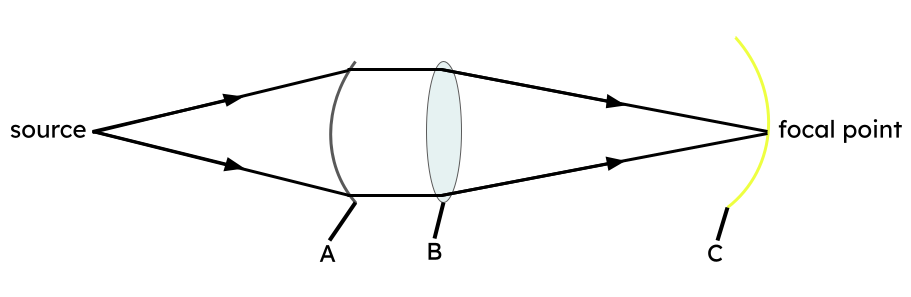
      The impact of concave and convex lenses on focal point can be demonstrated using a light box and lenses, as in physics, and really helps to demonstrate the corrective nature of lenses.
      Teacher tip

      Equipment

      None required.

      Licence

      This content is © Oak National Academy Limited (2025), licensed on Open Government Licence version 3.0 except where otherwise stated. See Oak's terms & conditions (Collection 2).

      Lesson video

      Loading...

      Prior knowledge starter quiz

      Download quiz pdf

      6 Questions

      Q1.
      What name is given to the point on the retina on which light focuses?

      cornea
      iris
      Correct answer: fovea
      optic nerve

      Q2.
      What changes the shape of the lens?

      Correct answer: ciliary muscles
      iris
      cornea
      pupil

      Q3.
      Starting with the light entering the eye, put the following steps in order to describe how we see.

      1 - Light enters the eye.
      2 - Light is refracted by the cornea.
      3 - Light is focused by the lens.
      4 - Light is sensed by the retina.

      Q4.
      Which part of the eye changes size to control how much light enters the eye?

      Correct Answer: Iris, The iris

      Q5.
      Label the parts of this diagram.

      An image in a quiz
      Correct Answer:A,cornea

      cornea

      Correct Answer:B,lens

      lens

      Correct Answer:C,retina

      retina

      Q6.
      Match the description of the lens to the object it is focusing on.

      Correct Answer:lens is long and thin,when the ciliary muscles relax to focus on objects that are far away

      when the ciliary muscles relax to focus on objects that are far away

      Correct Answer:lens is short and fat,when the ciliary muscles contract to focus on objects that are near

      when the ciliary muscles contract to focus on objects that are near

      Assessment exit quiz

      Download quiz pdf

      6 Questions

      Q1.
      Which of the following statements describes short-sightedness?

      Able to see things clearly far away, but objects close up appear blurred.
      Correct answer: Able to see things clearly close up, but objects further away appear blurred.
      Objects close up and also objects further away both appear blurred.

      Q2.
      Which of these statements are true about long-sightedness?

      A concave lens can be used to correct vision.
      Correct answer: A convex lens can be used to correct vision.
      Correct answer: Without glasses, the focal point is past the retina.
      Correct answer: Long-sightedness can occur when the lens stiffens.
      Long-sightedness can occur when the eyeball is elongated.

      Q3.
      What part of the eye is replaced during a cataract operation?

      Correct Answer: The lens, lens

      Q4.
      Which common eye defect results when the focal point of light is behind the eye?

      short-sightedness
      Correct answer: long-sightedness
      colour blindness
      cataracts

      Q5.
      A patient has an elongated eyeball. Select the condition they are most likely to have and the type of lens that could be used to correct the defect.

      long-sightedness
      Correct answer: short-sightedness
      Correct answer: concave lens
      convex lens

      Q6.
      Two siblings are tested for the red-green colour blindness gene. The sister's phenotype is Rr and the brother's phenotype is r. Which of the following statements are correct about the siblings?

      The sister is red-green colour blind.
      Correct answer: The sister is a carrier of red-green colour blindness.
      Correct answer: The sister has normal colour vision.
      The brother has normal colour vision.
      Correct answer: The brother is red-green colour blind.

      Lesson appears in

      UnitBiology / Coordination and control: the human nervous system