


New
New
Lesson 5 of 5
Round a 4-digit number to the nearest thousand, hundred and ten
I can use place value to round a 4-digit number to the nearest thousand, the nearest hundred and the nearest ten.

Lesson 5 of 5
New
New
Round a 4-digit number to the nearest thousand, hundred and ten
I can use place value to round a 4-digit number to the nearest thousand, the nearest hundred and the nearest ten.
Lesson details
Key learning points
- Identify the next and previous multiples of 10, 100 or 1,000 to the number on a number line.
- If the value of the digit you are looking at is 5 or more you round to the next multiple.
- If the value of the digit you are looking at is less than 5 you round to the previous multiple.
Keywords
Rounding - Making a number simpler but keeping its value close to what it was.
Common misconception
Sometimes pupils forget to change all of the necessary digits when rounding. For example, when rounding 4,698 to the nearest hundred, they might say 4,798
Make sure you spend time really focusing on the parts of the slide deck that show that when rounding to the nearest thousand, the answer must be a multiple of 1,000; the same principle applies when rounding to the nearest 100 or 10
Lessons 3 and 4 have number lines included as additional materials for pupils to practice the skills. This lesson encourages the pupils to sketch the number lines themselves before ultimately relying on rules and place value knowledge - but some pupils may still need the earlier number lines.

Teacher tip

Licence
This content is © Oak National Academy Limited (2025), licensed on Open Government Licence version 3.0 except where otherwise stated. See Oak's terms & conditions (Collection 2).
Lesson video
Loading...
Prior knowledge starter quiz
Download quiz pdf
6 Questions
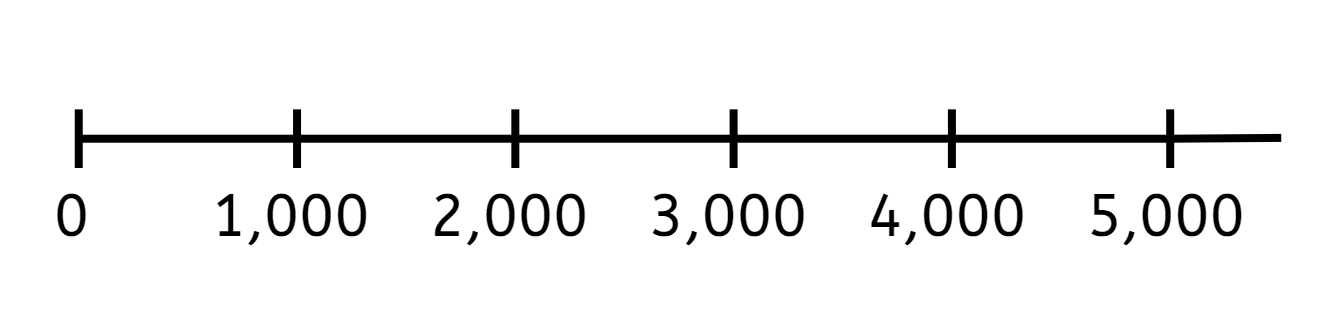
Q1.Round 4,255 to the nearest multiple of 1,000
Round 4,255 to the nearest multiple of 1,000
Q2.Round 6,329 to the nearest multiple of 1,000
Round 6,329 to the nearest multiple of 1,000
5,000
6,300
6,400
7,000
Q3.Round 4,825 to the nearest multiple of 10
Round 4,825 to the nearest multiple of 10
4,000
4,800
4,820
5,000
Q4.Select all of the statements which are true.
Select all of the statements which are true.
4,500 rounded to the nearest multiple of 1,000 is 4,000
Q5.Which of these numbers is 3,700 when rounded to the nearest multiple of 100?
Which of these numbers is 3,700 when rounded to the nearest multiple of 100?
3,750
4,000
Q6.Which of these numbers is 3,700 when rounded to the nearest multiple of 10?
Which of these numbers is 3,700 when rounded to the nearest multiple of 10?
3,694
3,705
Assessment exit quiz
Download quiz pdf
6 Questions
Q1.Which of these numbers could be the result of rounding to the nearest multiple of 1,000?
Which of these numbers could be the result of rounding to the nearest multiple of 1,000?
2,500
4,010
5,001
Q2.Match the values to the statements so they are correct.
Match the values to the statements so they are correct.

6,350
6,300
6,000
Q3.Which of these numbers is 5,000 when rounded to the nearest multiple of 10, 100 and 1,000?
Which of these numbers is 5,000 when rounded to the nearest multiple of 10, 100 and 1,000?
4,986
5,005
Q4.Which of these statements are true?
Which of these statements are true?
5,555 rounded to the nearest multiple of 10 is 5,550
Q5.What is 2,800 g to the nearest kilogram? kg.
What is 2,800 g to the nearest kilogram? kg.
Q6.What is 3,500 ml to the nearest litre? l.
What is 3,500 ml to the nearest litre? l.