New
New

    The effect of light intensity on rate of photosynthesis in algae: practical

    I can carry out an investigation into the effect of light intensity on the rate of photosynthesis in algae.

    New
    New

      The effect of light intensity on rate of photosynthesis in algae: practical

      I can carry out an investigation into the effect of light intensity on the rate of photosynthesis in algae.

      These resources were made for remote use during the pandemic, not classroom teaching.

      Switch to our new teaching resources now - designed by teachers and leading subject experts, and tested in classrooms.

      Lesson details

      Key learning points

      1. Following an appropriate method to vary light intensity and measure the colour change of indicator.
      2. Accurate measurement of variables (distance, time, colour change); control of variables that might affect the results.
      3. Comparison of indicator colour to a chart to determine pH.
      4. Record results in an appropriate table.

      Keywords

      • Light intensity - the amount of light reaching a given surface area in a period of time

      • Rate - a measure of how much change occurs per unit of time

      • Variable - a factor that can be changed during an experiment

      • Control variable - a factor that is kept the same during an experiment

      • Accurate - a measurement result is considered accurate if it is judged to be close to the true value

      Common misconception

      Some pupils do not consider how to control variables carefully enough. This means results are likely to be less accurate and so do not provide conclusions that can be used to support a hypothesis.

      Each type of variable is considered during the lesson and repeated to help pupils to understand the differences between each type of variable.

      Get pupils to follow the same practical procedure so that results can be shared between groups. This will enable a mean change in pH to be calculated and will help to improve the reliability of results that are obtained.
      Teacher tip

      Equipment

      Light source, beaker, bijou bottles, hydrogencarbonate indicator, measuring cylinder, algae immobilised in alginate beads, graduated pipette, spatula, pH indicator chart, foil, meter rule, stopclock.

      Content guidance

      • Risk assessment required - equipment

      Supervision

      Adult supervision required

      Licence

      This content is © Oak National Academy Limited (2025), licensed on Open Government Licence version 3.0 except where otherwise stated. See Oak's terms & conditions (Collection 2).

      Lesson video

      Loading...

      Prior knowledge starter quiz

      Download quiz pdf

      6 Questions

      Q1.
      Wat are the reactants in photosynthesis?

      Correct answer: carbon dioxide and water
      glucose and oxygen
      water and oxygen
      carbon dioxide and glucose

      Q2.
      As algae photosynthesise, what will happen to the concentration of carbon dioxide in the water?

      Correct answer: it decreases
      it increases
      it remains constant
      it fluctuates randomly

      Q3.
      What is an independent variable?

      Correct answer: a factor that is changed during an experiment
      a factor that is kept the same during an experiment
      a factor that is measured during an experiment

      Q4.
      What is a control variable?

      a factor that is changed during an experiment
      Correct answer: a factor that is kept the same during an experiment
      a factor that is measured during an experiment

      Q5.
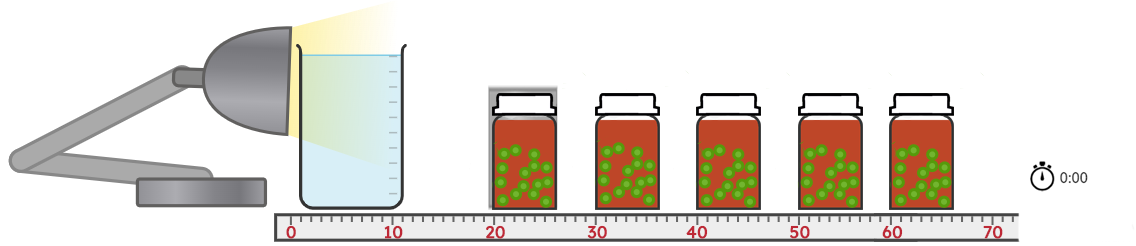
      When investigating the effects of light intensity on the rate of photosynthesis, which of the following are control variables?
      An image in a quiz
      Correct answer: temperature
      Correct answer: number of algal beads
      light intensity
      change in pH

      Q6.
      Why is it important to control the temperature in this experiment?

      because temperature affects the amount of water
      because temperature affects the colour of the pondweed
      Correct answer: because temperature can affect the rate of photosynthesis
      because temperature can affect the ight intensity

      Assessment exit quiz

      Download quiz pdf

      6 Questions

      Q1.
      What is an accurate measurement?

      Correct answer: a measurement close to the true value
      a measurement taken quickly
      a measurement taken with a ruler
      a measurement using more equipment

      Q2.
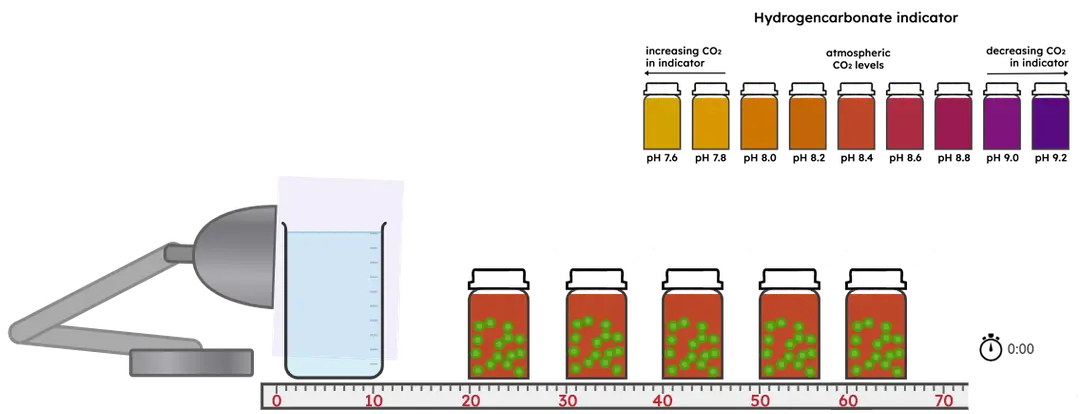
      How can you use the equipment shown to measure the rate of photosynthesis?
      An image in a quiz
      Correct answer: Count the number of bubbles of oxygen produced in a specific period of time.
      Measure the volume of carbon dioxide produced in a specific period of time.
      Measure the change in the pH, shown by the indicator of the indicator.

      Q3.
      Why does photosynthesis lead to a colour change in the indicator solution?

      An image in a quiz
      Photosynthesis gives out carbon dioxide which makes solutions more acidic.
      Correct answer: Photosynthesis uses carbon dioxide which increases the pH of the solution.
      Photosynthesis releases glucose, altering the solution's colour.
      Light absorbed by the algal beads reacts with the indicator solution.

      Q4.
      How can you reduce the intensity of the light that the pondweed receives from the lamp?

      An image in a quiz
      Put a beaker of water between the pondweed and the lamp.
      Increase the brightness of the lamp.
      Correct answer: Move the pondweed away from the lamp.

      Q5.
      If the indicator changes from cherry red to purple, what does this tell you about the rate of photosynthesis?

      there is no photosynthesis occurring
      photosynthesis is happening at a low rate
      Correct answer: photosynthesis is happening at a high rate
      photosynthesis has stopped completely

      Q6.
      What is a logical prediction for this investigation?

      An image in a quiz
      As distance increases, the rate of photosynthesis will increase.
      Correct answer: As distance increases, the rate of photosynthesis will decrease.
      As distance increases, the rate of photosynthesis will stay the same.

      Lesson appears in

      UnitBiology / Photosynthesis: factors affecting the rate

      UnitCombined science / Photosynthesis: factors affecting the rate