Myths about teaching can hold you back
- Year 9
Congruence in shapes
I can recognise that for congruent shapes both side lengths and angle sizes are preserved.
- Year 9
Congruence in shapes
I can recognise that for congruent shapes both side lengths and angle sizes are preserved.
Lesson details
Key learning points
- Two shapes are not congruent if there is a pair of lengths with a scalar not equal to one.
- Congruent does not mean the orientation must be the same.
- The angle sizes do not change.
Keywords
Congruent - If one shape can fit exactly on top of another using rotation, reflection or translation, then the shapes are congruent.
Co-interior angles - Co-interior angles are on the same side of the transversal line and in between the two other lines.
Common misconception
Pupils may think that they do not have enough information about a shape to determine whether it is congruent to another shape, when in fact they do.
Pupils could attempt the draw the shape based on the information that they have. They can then consider whether there are multiple way that the shape can be drawn while still satisfying all the given information.
To help you plan your year 9 maths lesson on: Congruence in shapes, download all teaching resources for free and adapt to suit your pupils' needs...
To help you plan your year 9 maths lesson on: Congruence in shapes, download all teaching resources for free and adapt to suit your pupils' needs.
The starter quiz will activate and check your pupils' prior knowledge, with versions available both with and without answers in PDF format.
We use learning cycles to break down learning into key concepts or ideas linked to the learning outcome. Each learning cycle features explanations with checks for understanding and practice tasks with feedback. All of this is found in our slide decks, ready for you to download and edit. The practice tasks are also available as printable worksheets and some lessons have additional materials with extra material you might need for teaching the lesson.
The assessment exit quiz will test your pupils' understanding of the key learning points.
Our video is a tool for planning, showing how other teachers might teach the lesson, offering helpful tips, modelled explanations and inspiration for your own delivery in the classroom. Plus, you can set it as homework or revision for pupils and keep their learning on track by sharing an online pupil version of this lesson.
Explore more key stage 3 maths lessons from the Geometrical properties: similarity and Pythagoras' theorem unit, dive into the full secondary maths curriculum, or learn more about lesson planning.
Licence
Prior knowledge starter quiz
6 Questions
Q1.Which transformations always produce an image that is congruent to the object?
Q2.When two shapes are congruent, which property of the shapes always remain invariant?
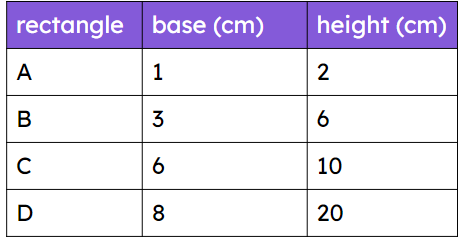
Q3.The table shows the base and height of four rectangles. Which rectangle is congruent to a rectangle that is 6 cm by 3 cm?

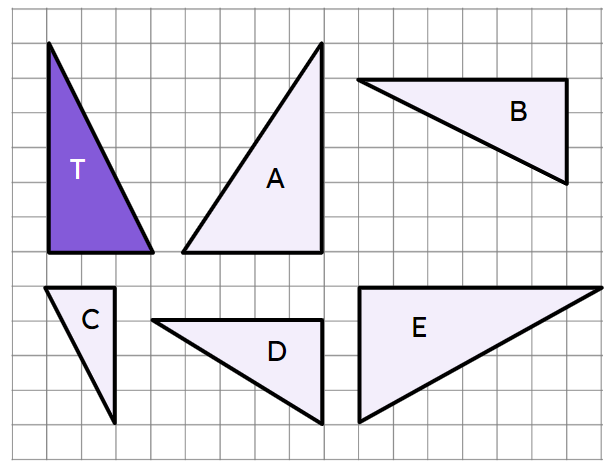
Q4.Which triangle is congruent to triangle T?

Q5.Angles in a quadrilateral sum to °.
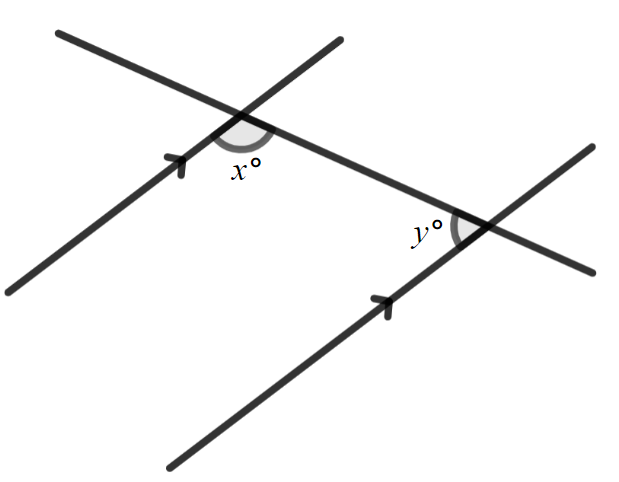
Q6.The diagram shows a pair of angles on parallel lines. When $$x=145$$, $$y=$$ .

Assessment exit quiz
6 Questions
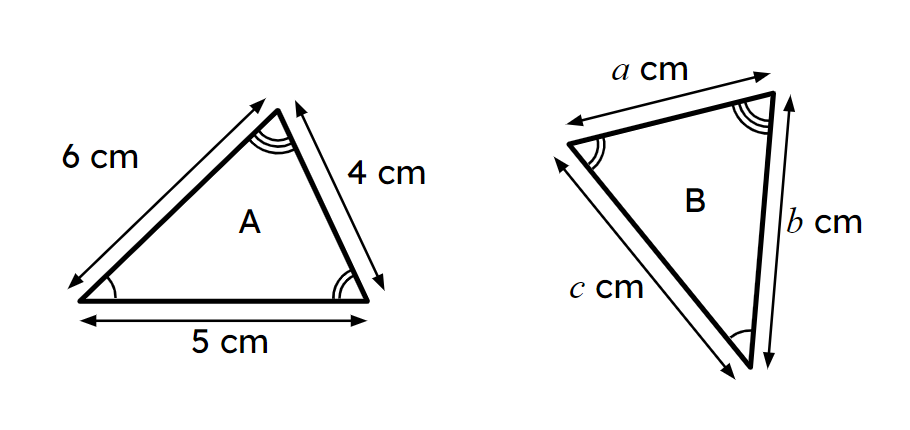
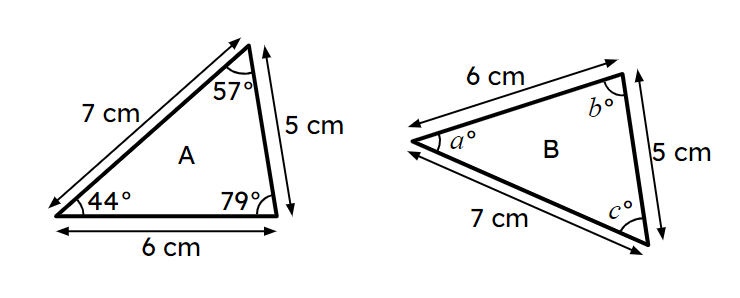
Q1.Triangles A and B are congruent. Match each unknown length from triangle B with its size.

$$a\text{ cm}$$ -
4 cm
$$b\text{ cm}$$ -
6 cm
$$c\text{ cm}$$ -
5 cm
Q2.Triangles A and B are congruent. Match each unknown angle from triangle B with its size.

$$a°$$ -
44°
$$b°$$ -
79°
$$c°$$ -
57°
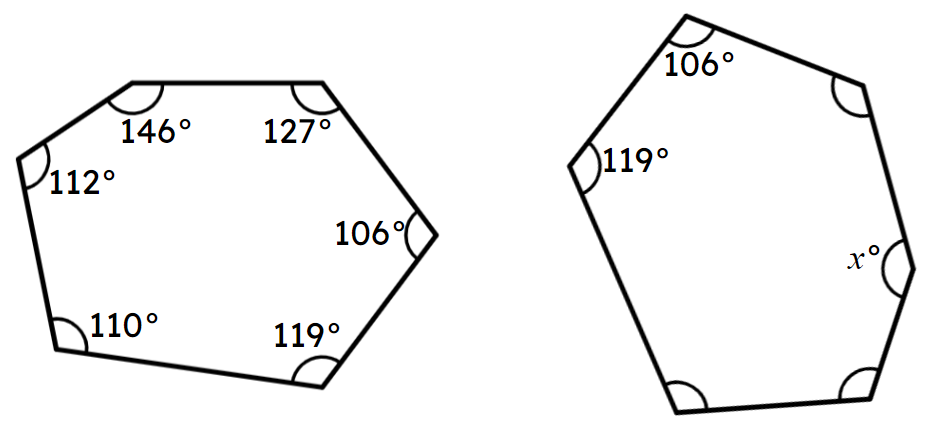
Q3.The image shows two congruent hexagons. What is the size of the angle $$x°$$?

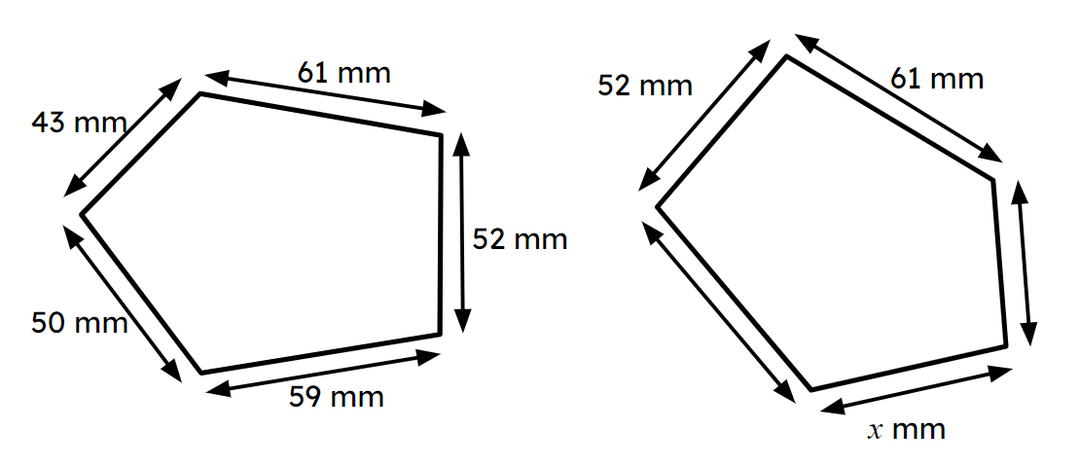
Q4.The image shows two congruent pentagons. What is the value of $$x$$?

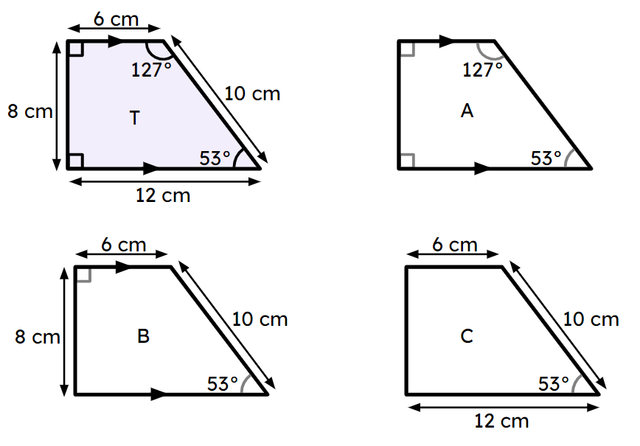
Q5.Shape T is a trapezium. Which quadrilateral contains enough information to determine whether it is congruent to shape T?

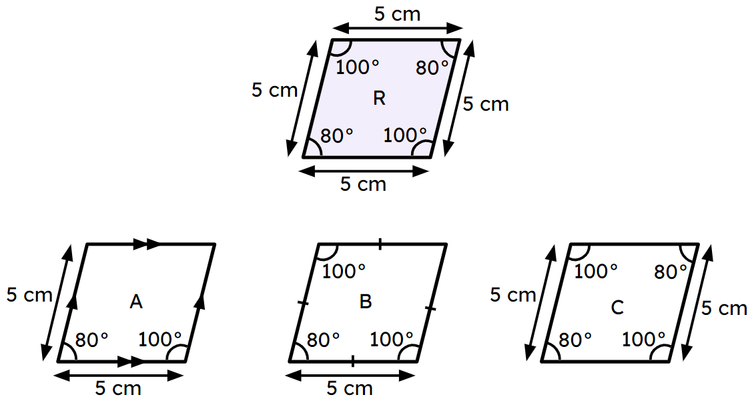
Q6.Shape R is a rhombus. Which quadrilateral is not congruent to shape R?