Choose exam board for KS4 Computer Science (GCSE)
Choose exam board for KS4 English
Choose exam board for KS4 French
Choose exam board for KS4 Geography
Choose exam board for KS4 German
Choose exam board for KS4 History
Choose tier for KS4 Maths
Choose exam board for KS4 Music
Choose exam board for KS4 Physical education (GCSE)
Choose exam board for KS4 Religious education (GCSE)
Choose exam board for KS4 Spanish

      Rearranging to solve linear equations
      Lesson details

      Learning outcome

      I can recognise that equations with unknowns on both sides of the equation can be manipulated so that the unknowns are on one side and then solve this equation.

      Key learning points

      1. Any linear equation written in the form Ax + B = C can be solved.
      2. Like terms can be collected onto one side of an equation in order to write it in the form Ax + B = C.
      3. An equation that had unknowns on both sides can then be solved.

      Keywords

      • Equation - An equation is used to show two expressions that are equal to each other.

      Common misconception

      To subtract from both the variable and numerical terms when subtracting from both sides.

      To subtract $$2$$ from $$5x+3$$ leaves $$5x+1$$, not $$3x+1$$. Use visual representations like balance scales and bar models to show this.

      Teacher tip

      If you have algebra tiles in your classroom use them to set up simple equations which you can then use to get pupils to "Take two ones from both groups" or "Take two $$x$$ from both groups". Get them to physically see that they are different.

      Licence

      This content is © Oak National Academy Limited (2025), licensed on Open Government Licence version 3.0
      except where otherwise stated. See Oak's terms & conditions
      (Collection 2).

      Lesson video

      Loading...

      Prior knowledge starter quiz

      6 Questions

      Q1.
      In order to maintain in an equation, any manipulation must be applied to both sides of the equation.

      Correct answer: equality
      positivity
      solutions
      variables

      Q2.
      What must be added to both sides of the equation to turn $$x=7$$ into $$x+3=10$$?

      Correct answer: $$3$$
      $$3x$$
      $$7$$
      $$10$$

      Q3.
      What must be added to both sides of the equation to turn $$x+3=10$$ into $$5x+3=4x+10$$?

      $$4$$
      $$5$$
      $$x$$
      Correct answer: $$4x$$
      $$5x$$

      Q4.
      $$(−4)$$ is added to both sides of the equation $$9x+4=6$$. What is the resulting equation?

      $$x=−4$$
      $$9x=6$$
      Correct answer: $$9x=2$$
      $$5x=2$$

      Q5.
      $$y=$$ is the solution to the equation $$29=6y−7$$

      Correct Answer: 6, six, y=6

      Q6.
      Solve $$2y−4=−8$$

      $$y=6$$
      $$y=−6$$
      $$y=2$$
      Correct answer: $$y=−2$$
      $$y=−4$$

      6 Questions

      Q1.
      An equation is used to show two that are equal to each other.

      equalities
      solutions
      variables
      Correct answer: expressions

      Q2.
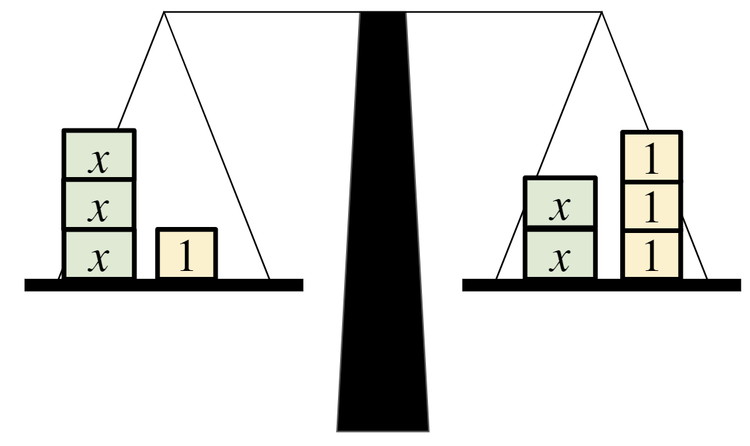
      What equation is represented by this balance model?

      An image in a quiz
      $$3x=1$$
      $$2x=3$$
      $$5x=4$$
      $$x+1=x+3$$
      Correct answer: $$3x+1=2x+3$$

      Q3.
      Which additive step will manipulate the equation $$7x−3=2x+18$$ so that it has unknowns on only one side?

      Correct answer: $$+(−7x)$$
      $$+(3)$$
      Correct answer: $$+(−2x)$$
      $$+(−18)$$
      $$+(−x)$$

      Q4.
      Add $$3x$$ to both sides of the equation $$x+2=7−3x$$

      $$x+5=10−3x$$
      $$3x+2=7$$
      $$4x+2=7−6x$$
      Correct answer: $$4x+2=7$$
      $$4x+5=10$$

      Q5.
      $$x=$$ is the solution to the equation $$5x+21=9x+5$$

      Correct Answer: 4, four, x=4, x = 4

      Q6.
      Solve $$6x−1=7−3x$$

      Correct answer: $$x={8\over{9}}$$
      $$x={8\over{3}}$$
      $$x=−{8\over{9}}$$
      $$x={9\over{8}}$$
      $$x={6\over{9}}$$

      To help you plan your 8 maths lesson on: Rearranging to solve linear equations, download all teaching resources for free and adapt to suit your pupils' needs...