Myths about teaching can hold you back
- Year 10•
- Foundation
Calculating the mean from a grouped frequency table
I can calculate the mean from a grouped frequency table.
- Year 10•
- Foundation
Calculating the mean from a grouped frequency table
I can calculate the mean from a grouped frequency table.
Lesson details
Key learning points
- The mean is a measure of central tendency.
- The mean can only be estimated with a grouped frequency table.
- Calculating this from a grouped frequency table may be easier when the data is very large.
Keywords
Frequency - The frequency is the number of times an event occurs; or the number of individuals (people, animals etc.) with some specific property.
Interval - An interval is all the values between two points. e.g. 4 < x ≤ 10
Common misconception
That estimation is guessing.
Estimation is a process with each step being logical. In this case the estimation is necessary because some of the detail is lost in a grouped frequency table.
To help you plan your year 10 maths lesson on: Calculating the mean from a grouped frequency table, download all teaching resources for free and adapt to suit your pupils' needs...
To help you plan your year 10 maths lesson on: Calculating the mean from a grouped frequency table, download all teaching resources for free and adapt to suit your pupils' needs.
The starter quiz will activate and check your pupils' prior knowledge, with versions available both with and without answers in PDF format.
We use learning cycles to break down learning into key concepts or ideas linked to the learning outcome. Each learning cycle features explanations with checks for understanding and practice tasks with feedback. All of this is found in our slide decks, ready for you to download and edit. The practice tasks are also available as printable worksheets and some lessons have additional materials with extra material you might need for teaching the lesson.
The assessment exit quiz will test your pupils' understanding of the key learning points.
Our video is a tool for planning, showing how other teachers might teach the lesson, offering helpful tips, modelled explanations and inspiration for your own delivery in the classroom. Plus, you can set it as homework or revision for pupils and keep their learning on track by sharing an online pupil version of this lesson.
Explore more key stage 4 maths lessons from the Comparisons of numerical summaries of data unit, dive into the full secondary maths curriculum, or learn more about lesson planning.
Licence
Prior knowledge starter quiz
6 Questions
Q1.The sum of the 10 data points in a data set is 180. The mean of this data set is .
Q2.Match each summary statistic to its value for a data set of: 1, 3, 6, 10, 13, 15, 15.
mean -
9
median -
10
mode -
15
range -
14
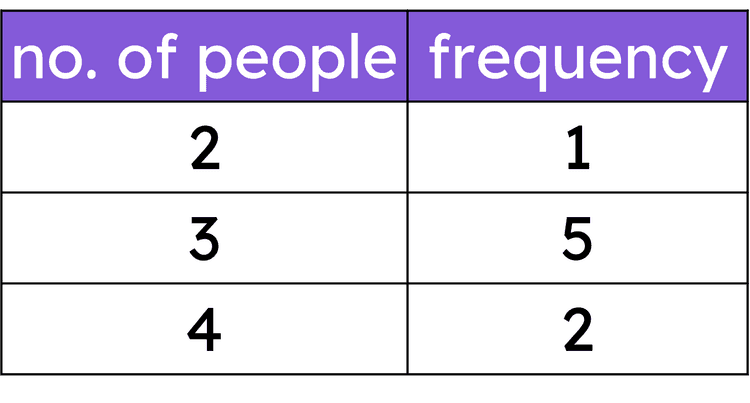
Q3.In total, many people are there in this data set?

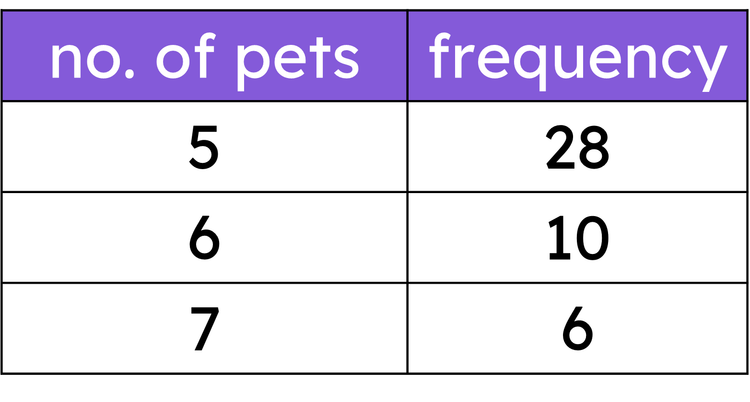
Q4.The table shows the number of pets owned by some volunteers at an animal rescue centre. Calculate the mean number of pets.

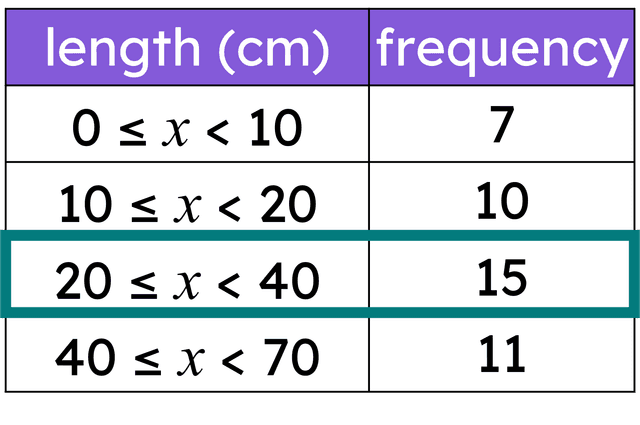
Q5.This grouped frequency table shows the length of grass in different people’s gardens. What does the highlighted row of this grouped frequency table mean?

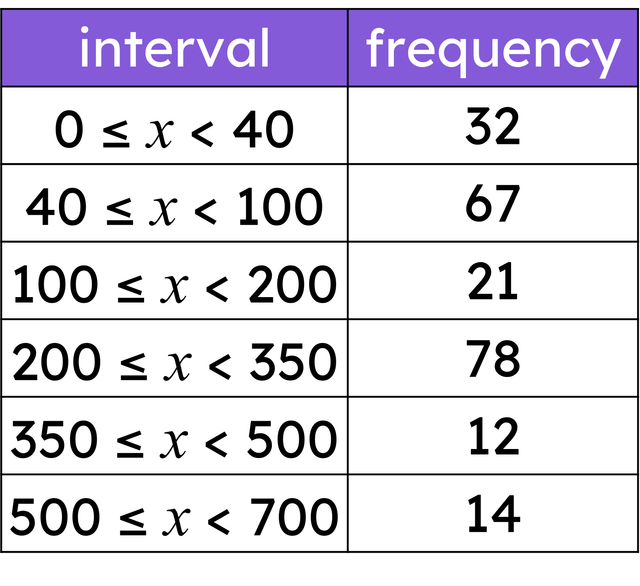
Q6.The average expected range of this data set is .

Assessment exit quiz
6 Questions
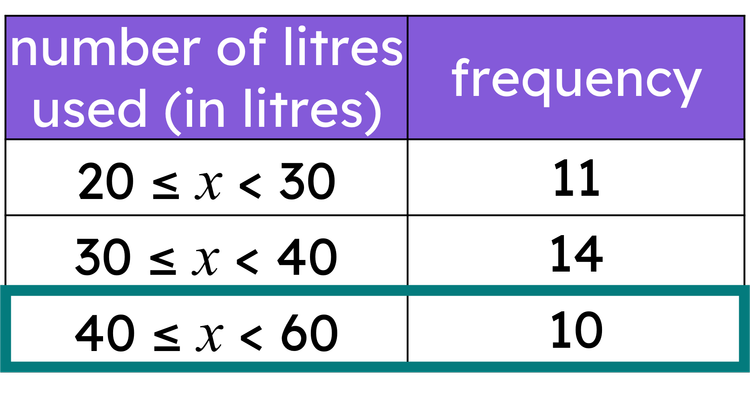
Q1.What is the midpoint of this interval?

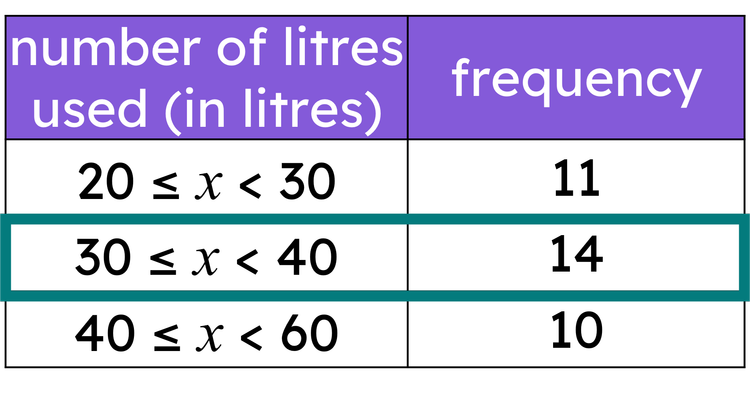
Q2.An estimate for the total number of litres used by the 10 people who each used between 40 and 60 litres is litres.

Q3.Which of these statements are correct?

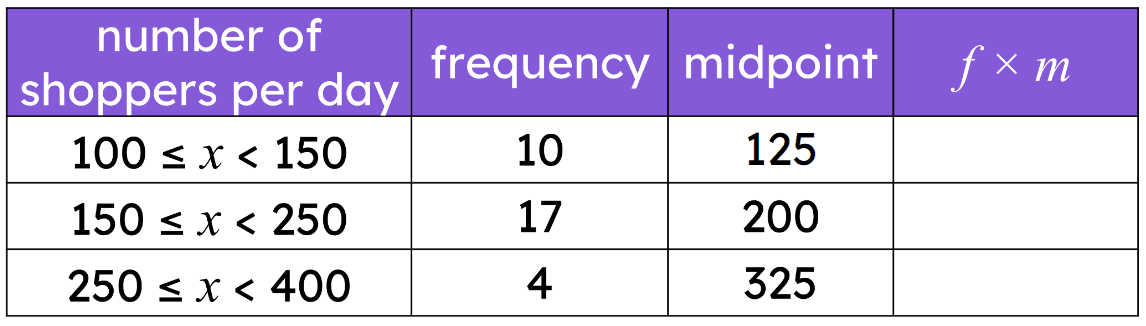
Q4.A supermarket manager records the total number of shoppers each day for a month. The table shows her results.
The estimate for the total number of shoppers in this data set is shoppers.

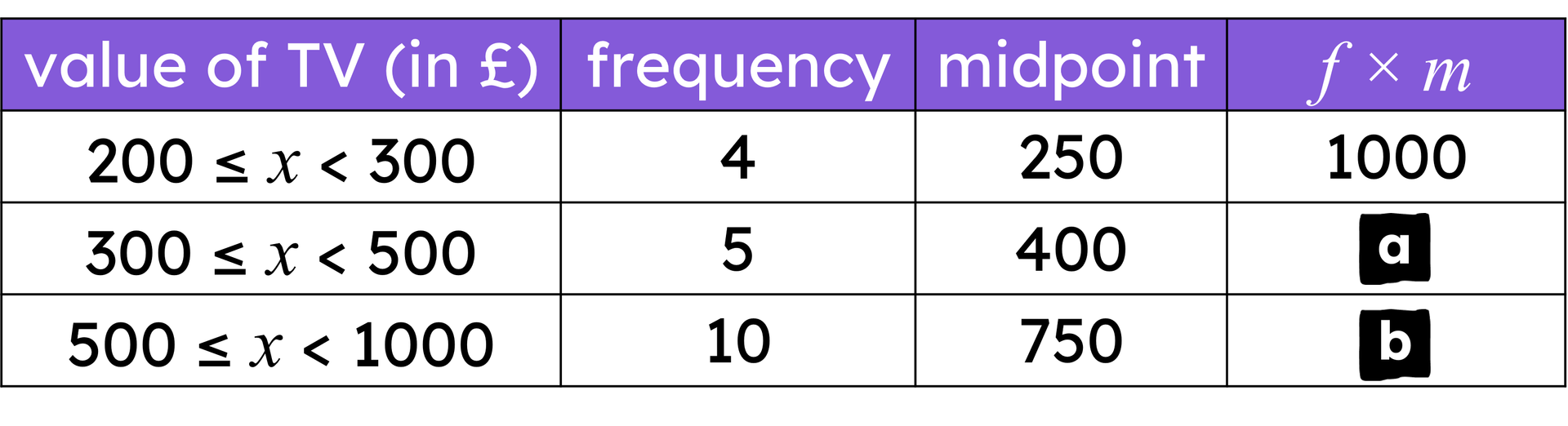
Q5.Both $$a$$ and $$b$$ are the totals of their columns. Which of these statements are correct?

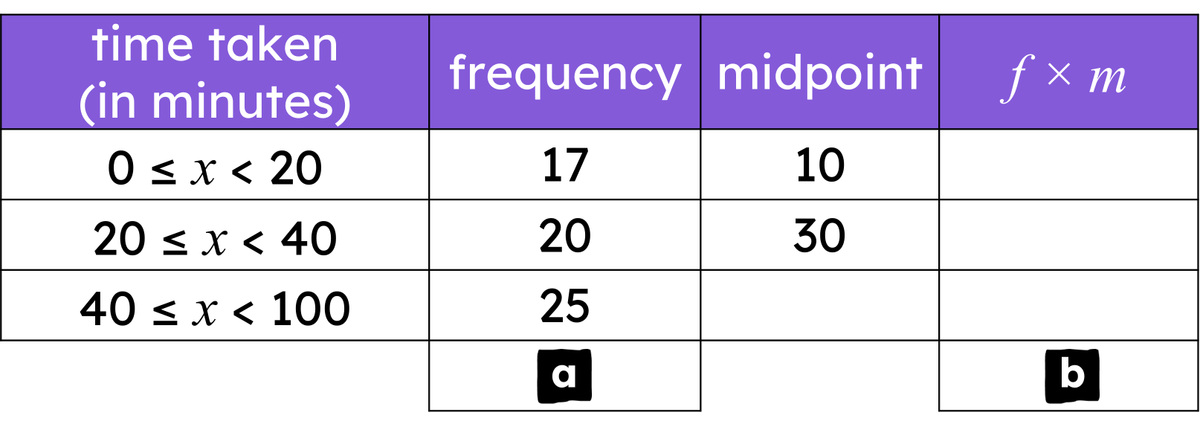
Q6.The table shows some pupils' marks in an exam. The estimated mean score to the nearest integer is marks.