Myths about teaching can hold you back
- Year 10•
- Foundation
Checking understanding of measures of central tendency
I can identify the limitations of each measure of central tendency and identify which should be used.
- Year 10•
- Foundation
Checking understanding of measures of central tendency
I can identify the limitations of each measure of central tendency and identify which should be used.
Lesson details
Key learning points
- The mode is a useful measure of central tendency for certain data sets.
- The median is a useful measure of central tendency for certain data sets.
- The mean is a useful measure of central tendency for certain data sets.
Keywords
Measure of central tendency - A measure of central tendency is a summary measure that attempts to describe a whole set of data with a single value that represents the middle or centre of its distribution.
Statistical summary - A statistical summary sums up the features of a data set.
Common misconception
Mean, median and mode are only useful if they are close together.
If the mean is significantly higher or lower than the other averages, this suggests an extreme value in the data set.
To help you plan your year 10 maths lesson on: Checking understanding of measures of central tendency, download all teaching resources for free and adapt to suit your pupils' needs...
To help you plan your year 10 maths lesson on: Checking understanding of measures of central tendency, download all teaching resources for free and adapt to suit your pupils' needs.
The starter quiz will activate and check your pupils' prior knowledge, with versions available both with and without answers in PDF format.
We use learning cycles to break down learning into key concepts or ideas linked to the learning outcome. Each learning cycle features explanations with checks for understanding and practice tasks with feedback. All of this is found in our slide decks, ready for you to download and edit. The practice tasks are also available as printable worksheets and some lessons have additional materials with extra material you might need for teaching the lesson.
The assessment exit quiz will test your pupils' understanding of the key learning points.
Our video is a tool for planning, showing how other teachers might teach the lesson, offering helpful tips, modelled explanations and inspiration for your own delivery in the classroom. Plus, you can set it as homework or revision for pupils and keep their learning on track by sharing an online pupil version of this lesson.
Explore more key stage 4 maths lessons from the Comparisons of numerical summaries of data unit, dive into the full secondary maths curriculum, or learn more about lesson planning.
Licence
Prior knowledge starter quiz
6 Questions
Q1.Which of these is not a measure of central tendency?
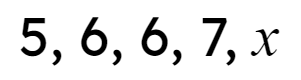
Q2.The mode of this data set is 6. Which of these values can $$x$$ take?

Q3.The mean of this data set is 5, so $$x$$ is .

Q4.The range of this data set is 5. What could the values of $$x$$ be?

Q5.The median of this set of data is 6. Which of these describe all the values $$x$$ be?

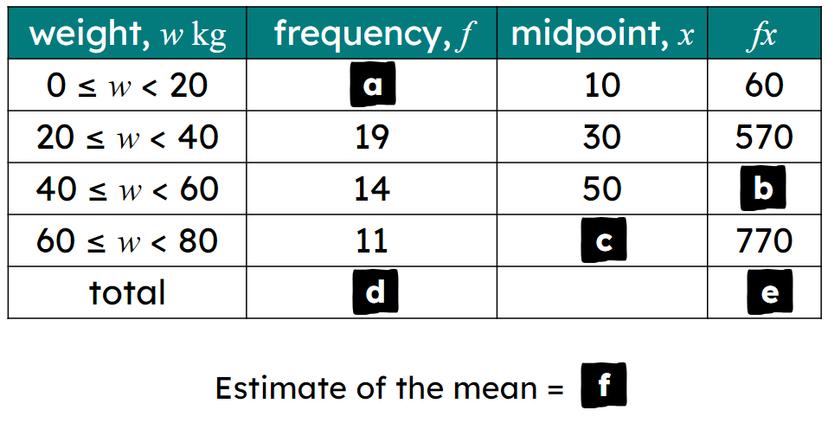
Q6.Match each letter to the number it represents.

$$a$$ -
6
$$b$$ -
700
$$c$$ -
70
$$d$$ -
50
$$e$$ -
2100
$$f$$ -
42
Assessment exit quiz
6 Questions
Q1.In which of these data sets is the mean more likely to be influenced by outliers or unsymmetrical data?
Q2.Which of these measures of central tendency can be used to summarise qualitative data?
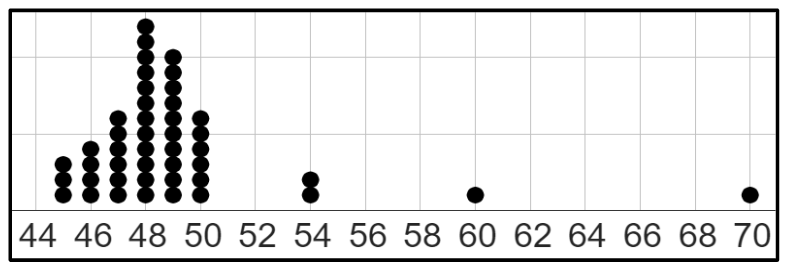
Q3.This dot plot shows a data set where the mode = median = 48. Will the mean be less than 48, equal to 48 or more than 48?

Q4.Select the true statements for the data set: 8, 13, 8, 11, 10, 13, 8, 11, 12, 10.
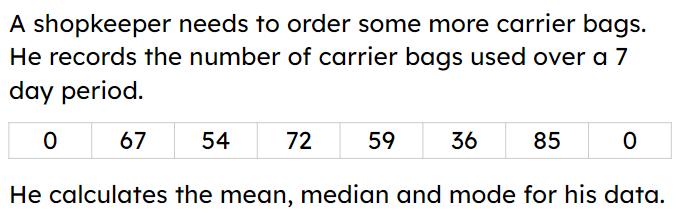
Q5.Which of the measures of central tendency would be the most appropriate measure for the shopkeeper to use to know how many carrier bags to order?