Choose exam board for KS4 Computer Science (GCSE)
Choose exam board for KS4 English
Choose exam board for KS4 French
Choose exam board for KS4 Geography
Choose exam board for KS4 German
Choose exam board for KS4 History
Choose tier for KS4 Maths
Choose exam board for KS4 Music
Choose exam board for KS4 Physical education (GCSE)
Choose exam board for KS4 Religious education (GCSE)
Choose exam board for KS4 Spanish

      Key features of a quadratic graph
      Lesson details

      Learning outcome

      I can identify the key features of a quadratic graph.

      Key learning points

      1. A quadratic graph is a parabola.
      2. The roots of a quadratic graph are where the graph intersects with the x-axis.
      3. The turning point is the maximum or minimum point of the graph.
      4. The coordinates of the turning point can be found by completing the square.

      Keywords

      • Roots - When drawing the graph of an equation, the roots of the equation are where its graph intercepts the x-axis (where y = 0).

      • Turning point - The turning point of a graph is a point on the curve where, as x increases, the y values change from decreasing to increasing or vice versa.

      Common misconception

      Parabolas are 'upwards' or 'downwards'.

      Encourage use of language such as "The turning point of this parabola is a maximum/minimum value" and "As the absolute values of $$x$$ increase, the $$y$$ values decrease/increase".

      Teacher tip

      Model good technical language and get pupils to repeat it to you. This encourages use of the correct mathematical language.

      Licence

      This content is © Oak National Academy Limited (2025), licensed on Open Government Licence version 3.0
      except where otherwise stated. See Oak's terms & conditions
      (Collection 2).

      Lesson video

      Loading...

      Prior knowledge starter quiz

      6 Questions

      Q1.
      What shape is the graph of the equation $$y = 6x^2-3x+9$$?

      A linear graph
      Correct answer: A parabola
      An upward curve
      A vertical line

      Q2.
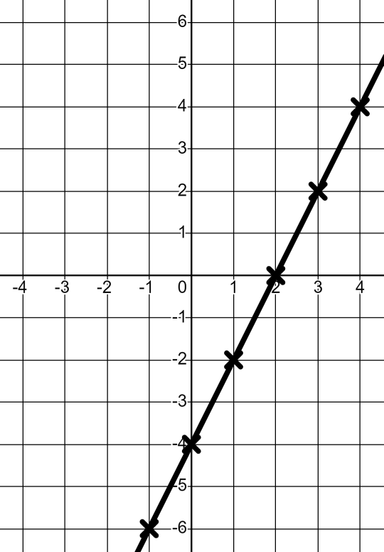
      What is the $$y$$-intercept of this linear graph?

      An image in a quiz
      (2, 0)
      Correct answer: (0, -4)
      $$x$$ = 0
      $$y$$ = -4

      Q3.
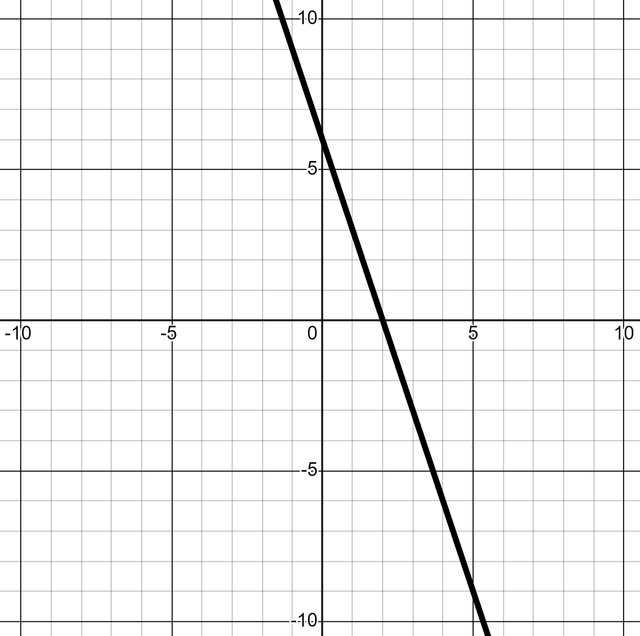
      Which of these are key features of the graph of the equation $$3x+y=6$$?

      An image in a quiz
      Gradient of 3
      Correct answer: $$x$$-intercept at (2, 0)
      Correct answer: Gradient of -3
      Correct answer: Linear graph
      Correct answer: $$y$$-intercept at (0 ,6)

      Q4.
      Factorise $$x^2-8x+7$$.

      $$(x-8)(x+7)$$
      $$(x-7)(x+1)$$
      Correct answer: $$(x-7)(x-1)$$
      $$(x+4)(x+3)$$
      $$(x+7)(x+1)$$

      Q5.
      Factorise $$x^2-8x+16$$.

      $$(x+4)(x-4)$$
      $$(x+4)^2$$
      Correct answer: $$(x-4)^2$$
      $$(x-8)(x+16)$$

      Q6.
      Expand and simplify $$(x+5)^2-10$$

      $$x^2+15$$
      $$x^2+5x+15$$
      $$x^2+25x+15$$
      Correct answer: $$x^2+10x+15$$
      $$x^2+10x+25$$

      6 Questions

      Q1.
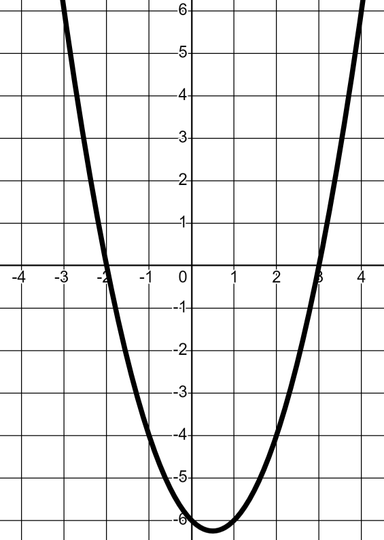
      $$x=-2$$ and $$x=3$$ are __________ of the equation shown in this graph.

      An image in a quiz
      intercepts
      intersects
      Correct answer: roots
      Correct answer: solutions

      Q2.
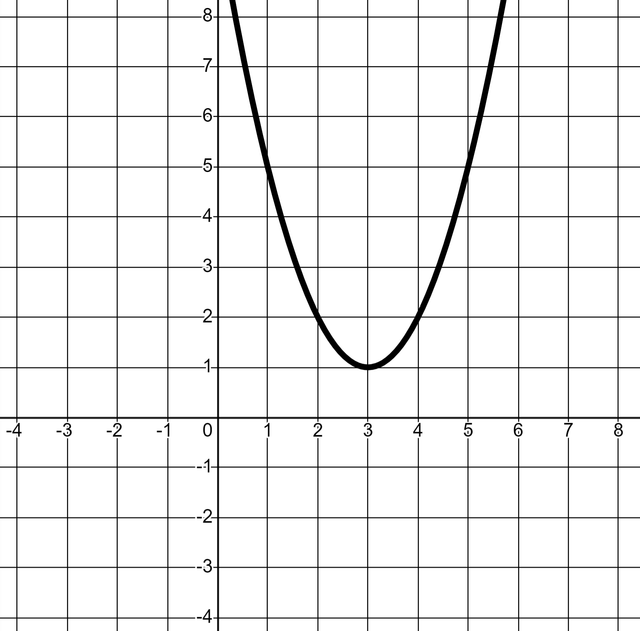
      (3, 1) is the __________ of this quadratic graph.

      An image in a quiz
      bottom
      end
      lowest solution
      Correct answer: minimum point
      Correct answer: turning point

      Q3.
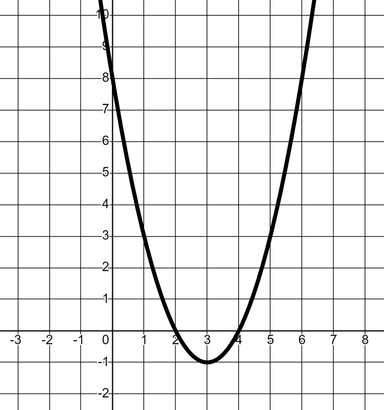
      What are the roots of this equation?

      An image in a quiz
      (2, 0)
      Correct answer: $$x$$ = 2
      $$x$$ = 3
      Correct answer: $$x$$ = 4
      $$x$$ = 8

      Q4.
      What is the turning point of this graph?

      An image in a quiz
      $$x$$ = 2
      $$x$$ = 3
      (0, 8)
      (2, 0)
      Correct answer: (3, -1)

      Q5.
      Factorise $$y=x^2-4x-12$$ to find the roots of the equation.

      $$(x-3)(x-4)$$, therefore roots at $$x=3$$ and $$x=4$$
      $$(x+6)(x-2)$$, therefore roots at $$x=-6$$ and $$x=2$$
      Correct answer: $$(x-6)(x+2)$$, therefore roots at $$x=6$$ and $$x=-2$$
      $$(x+3)(x+4)$$, therefore roots at $$x=-3$$ and $$x=-4$$

      Q6.
      The quadratic equation $$y=x^2+14x+49$$ has __________.

      no roots
      one root
      Correct answer: one repeated root
      two roots

      To help you plan your 10 maths lesson on: Key features of a quadratic graph, download all teaching resources for free and adapt to suit your pupils' needs...