Myths about teaching can hold you back
- Year 10•
- Foundation
Problem solving with plans and elevations
I can use my knowledge of plans and elevations to solve problems.
- Year 10•
- Foundation
Problem solving with plans and elevations
I can use my knowledge of plans and elevations to solve problems.
Lesson details
Key learning points
- The plans and elevations may be drawn to scale.
- You can combine an isometric drawing with its plan and elevations to find missing information.
- Scaling could be indicated by a scale factor or a ratio.
Keywords
Plan - The plan of a solid is the view of it from above.
Front elevation - The front elevation of a solid is the view of it from the front.
Side elevation - The side elevation of a solid is the view of it from the side.
Isometric paper - Isometric means distances between points stay the same. In this lesson you may use isometric paper which has equally spaced dots or points.
Common misconception
Curves cannot be drawn on isometric paper.
It is perfectly possible to draw a curve on isometric paper.
To help you plan your year 10 maths lesson on: Problem solving with plans and elevations, download all teaching resources for free and adapt to suit your pupils' needs...
To help you plan your year 10 maths lesson on: Problem solving with plans and elevations, download all teaching resources for free and adapt to suit your pupils' needs.
The starter quiz will activate and check your pupils' prior knowledge, with versions available both with and without answers in PDF format.
We use learning cycles to break down learning into key concepts or ideas linked to the learning outcome. Each learning cycle features explanations with checks for understanding and practice tasks with feedback. All of this is found in our slide decks, ready for you to download and edit. The practice tasks are also available as printable worksheets and some lessons have additional materials with extra material you might need for teaching the lesson.
The assessment exit quiz will test your pupils' understanding of the key learning points.
Our video is a tool for planning, showing how other teachers might teach the lesson, offering helpful tips, modelled explanations and inspiration for your own delivery in the classroom. Plus, you can set it as homework or revision for pupils and keep their learning on track by sharing an online pupil version of this lesson.
Explore more key stage 4 maths lessons from the Plans and elevations unit, dive into the full secondary maths curriculum, or learn more about lesson planning.
Licence
Prior knowledge starter quiz
6 Questions

Q1.The type of paper shown in the diagram is called paper.

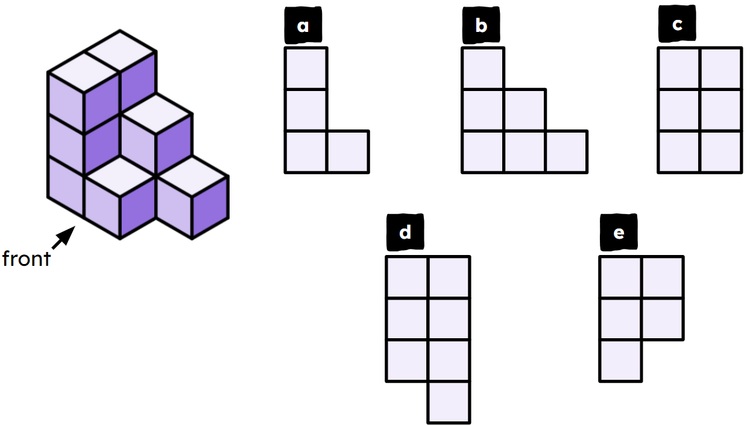
Q2.The diagram shows a solid constructed from cubes. Which figure shows the front elevation of the solid?

Q3.The diagram shows a solid constructed from cubes. Which figure shows the side elevation of the solid?

Q4.The diagram shows a solid constructed from cubes. Which figure shows the plan of the solid?

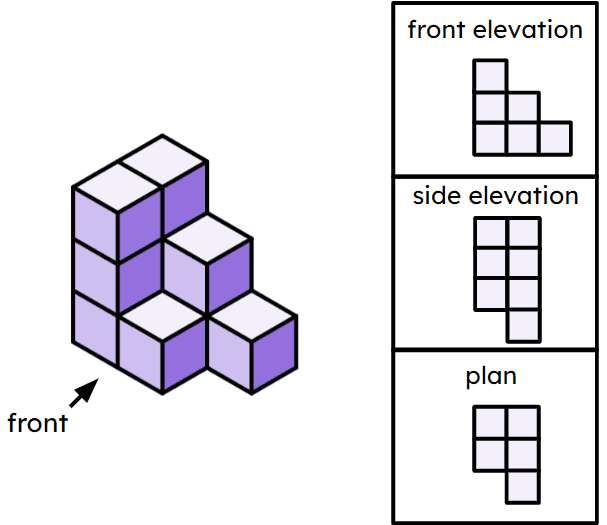
Q5.The diagram shows a solid constructed from cubes. The ___________ has been drawn incorrectly.

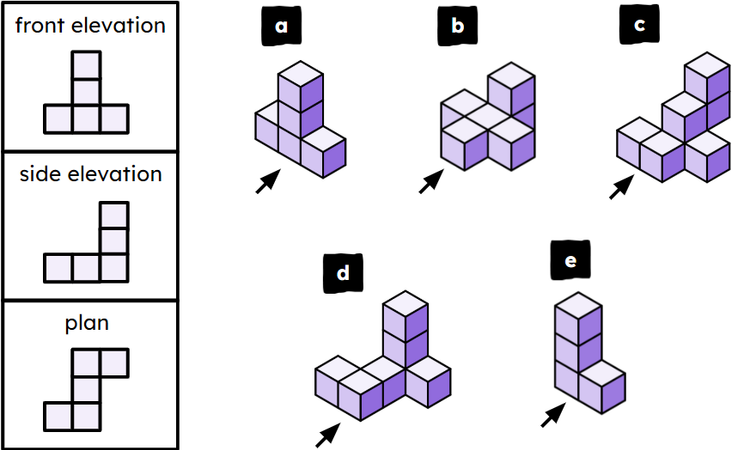
Q6.Which solid matches the front elevation, side elevation and plan as the figures shown in the boxes?

Assessment exit quiz
6 Questions
Q1.The plan of a solid is the view of it from __________.
Q2.Jacob is producing a scale drawing of a building using the scale 1 : 500. The building is 80 m tall. The height of Jacob's scale drawing should be cm.
Q3.Jacob is correctly producing a scale drawing of a building using the scale 1 : 400. The height of Jacob's scale drawing is 8 cm. The actual height of the building is m.
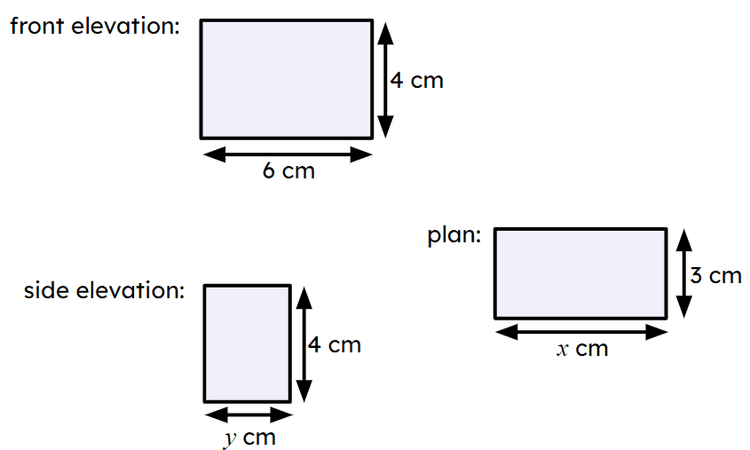
Q4.The diagram shows the plan and elevations for a cuboid. The value of $$x$$ is .

Q5.The diagram shows the plan and elevations for a cuboid. The value of $$y$$ is .

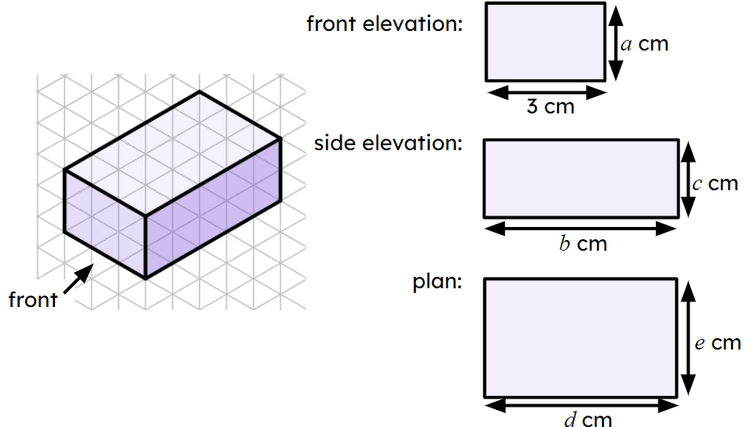
Q6.The diagram shows an isometric drawing of a cuboid, along with its plan and elevations. Which unknowns are equal to 5?