



Categories

Curriculum planning
4 February 2026Support pupils to work scientifically and build their understanding with Oak's research-led curriculum

Elisabeth Pugh
Subject Lead (science)
Oak’s science curriculum and lesson resources uniquely combine research-informed pedagogy with practical classroom application. Designed to offer both structure and adaptability, the curriculum supports teachers to deepen pupils’ scientific understanding while developing their enquiry skills.
Designed by subject experts from the University of York Science Education Group (UYSEG) and Centre for Industry Education Collaboration (CIEC), the curriculum is grounded in research from the Best Evidence Science Teaching (BEST) project. It provides a coherent, carefully sequenced approach from key stage 1 through to key stage 4, helping pupils build knowledge over time through purposeful, hands-on learning that meets the needs of diverse classrooms.
At its heart is a clear commitment to progression. Scientific knowledge is carefully sequenced so that new knowledge builds on what pupils already understand, allowing them to develop an increasingly secure and sophisticated understanding as they move through school. This structured approach supports consistency across phases, while remaining fully adaptable to the needs of individual classrooms and schools.
Explore our science curriculum:
- Science curriculum key stages 1-2
- Science curriculum key stages 3-4 including GCSE AQA
- Science key stages 3-4 including GCSE Edexcel
- Science key stages 3-4 including GCSE OCR
Building scientific understanding through big questions
With our curriculum partners UYSEG and CIEC, we have drawn on the concept of ‘big ideas’ in science education and reframed them as big questions to underpin the new science curriculum. Big questions retain the ambition of capturing core concepts of science, while presenting this knowledge in a form that is more accessible and meaningful for pupils of different ages. Framed as questions, they invite curiosity and provide a clear purpose for learning, helping pupils to see how individual lessons and units contribute to answering a larger question.
Each big question is revisited across the curriculum, with pupils developing an age-appropriate answer at every key stage. As pupils progress, this becomes more detailed and precise, supported by increasingly sophisticated scientific knowledge and vocabulary. The units that contribute to answering each question form a coherent thread from KS1 to KS4, creating a clear pathway for progression. This approach helps teachers plan for cumulative learning whilst pupils connect new knowledge with what they already know, ensuring that the curriculum is both knowledge-rich and coherently structured around ideas that grow with learners over time.
Research-informed and classroom-ready
Oak’s science curriculum has been developed by science teachers, education specialists and researchers from the UYSEG team at the University of York for secondary, and CIEC for primary. It draws on BEST: their major research-informed curriculum development project. BEST aims to transform science education research into practice, building in evidence on common misunderstandings in science, effective diagnostic questioning and formative assessment, and effective sequencing of core concepts. The result is a curriculum that translates high-quality research into practical classroom resources.
Lessons integrate diagnostic questions and response activities to help teachers identify and address common misconceptions early. Practical work is not treated as an add-on, but is carefully paired with the scientific knowledge it is designed to develop. Additional guidance supports teachers to make each practical purposeful, ensuring pupils are actively engaged and working scientifically while developing conceptual understanding.
Supporting teachers to teach science with confidence
The resources are designed with teachers and pupils in mind. Subject-specific knowledge is clearly explained and easy to follow, helping teachers understand not only what to teach but why it matters. Misconceptions are addressed within lessons, and support is provided through teacher tips, reducing planning burden and supporting more accurate scientific understanding for pupils.
Laying strong foundations in primary science
For primary teachers, Oak’s science curriculum provides scientifically accurate, carefully structured lessons that support strong foundations, giving you the confidence to teach science, no matter your level of expertise. Each unit builds logically on what pupils have already learned, helping teachers develop confidence while ensuring pupils’ understanding is secure.
Hands-on practical activities are woven throughout the curriculum to spark curiosity and foster engagement through real-world investigations. Diagnostic questions are seamlessly integrated into lessons, supporting teachers to expose and address misconceptions early.
The curriculum also includes additional lessons on climate change and sustainability (such as the year 6 unit Climate change and sustainability), enriching science learning and supporting wider curriculum aims, while covering all statutory and non-statutory guidance.
Strengthening scientific rigour across secondary
At secondary level, the curriculum offers a scientifically rigorous approach that supports clarity, accuracy and progression across key stages, providing a reliable foundation for long-term curriculum planning.
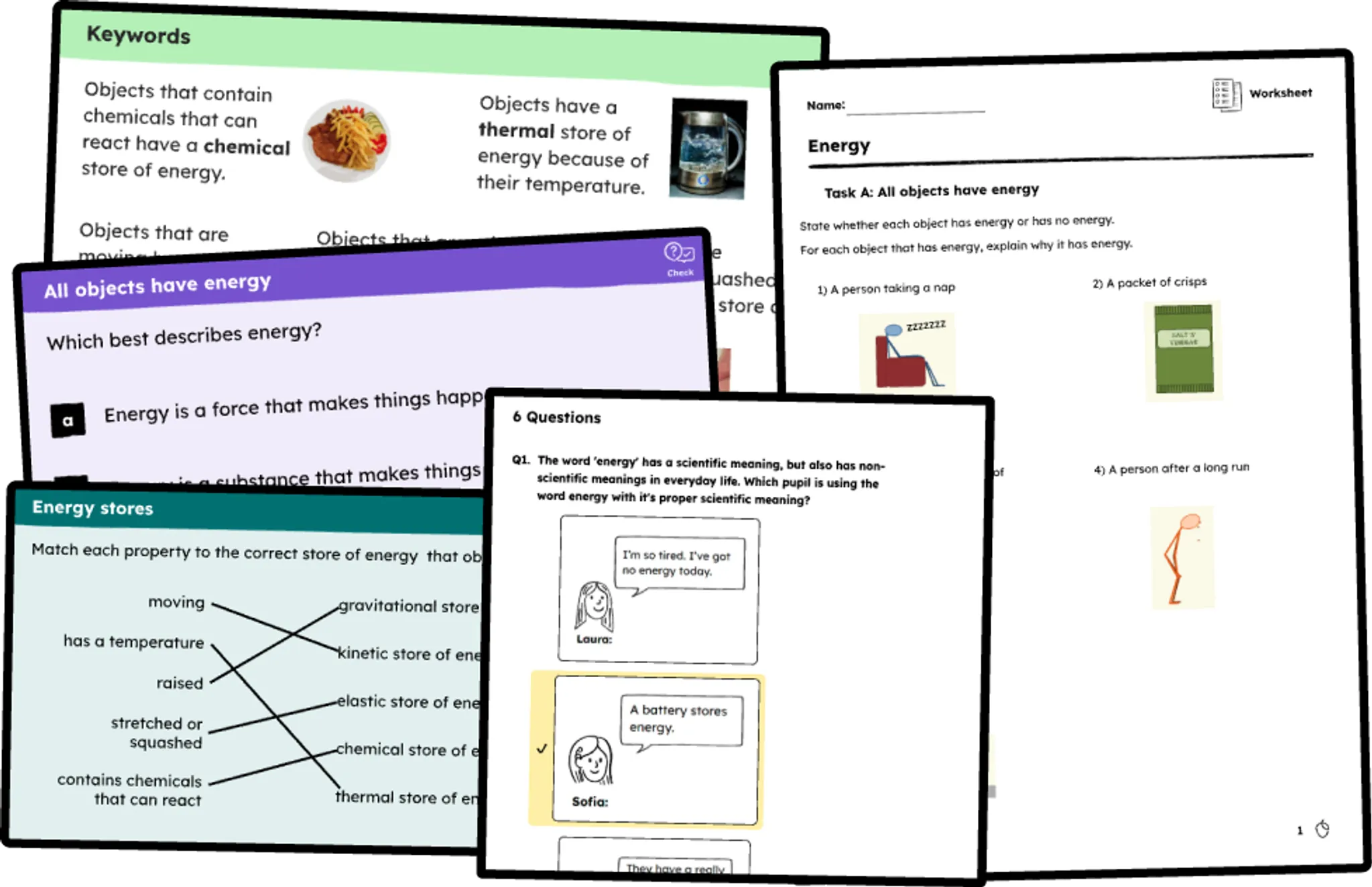
Resources from the year 7 lesson Energy in the unit Forces.
Practical activities cover all required apparatus, techniques and mathematical skills, with clear teacher guidance to ensure practical work is purposeful and meaningful, for example, this year 10 OCR lesson 'Distillation: separating a mixture of inks’. Diagnostic questions are embedded throughout lessons, helping teachers identify gaps in understanding and tackle misconceptions before they become barriers to progress. This structured, research-informed approach supports consistency across classes and year groups, even where teachers are teaching outside their specialism.
At GCSE, the curriculum covers AQA, Edexcel and OCR exam boards at foundation and higher tiers for biology, chemistry, and physics, as well as combined science.
Aligned with Curriculum and Assessment Review priorities
You will have seen the government's response to the Curriculum and Assessment Review recommendations to revise the national curriculum and update GCSEs, and will be thinking ahead. Oak’s curriculum for science aligns strongly to lots of the areas detailed in the recently published Curriculum and Assessment review. For example, climate change and sustainability are addressed through a clear curriculum thread, How can we live sustainably to protect Earth for a better future?, which runs across phases and is rooted in core scientific ideas.
Examples of this include the year 4 unit 'Living things and the environment' which includes lessons 'Changing environments: reforestation and recycling' and 'How scientists communicate with the public’. Another example is the year 11 AQA lesson 'Negative human interactions with ecosystems and impacts on biodiversity'. Pupils build understanding of the science underpinning climate change, Earth systems, resources, and human impact, and apply this knowledge to consider evidence-informed responses. Alongside this, practical work is purposefully planned to develop both substantive knowledge and disciplinary understanding, rather than sitting as an add-on.
Going forward, Oak will be working with expert partners to update our resources and provide guidance for what’s changing so you can stay ahead of the changes and plan with confidence. Fill in this form if you're interested in being kept updated by us.
Personalise your lessons with Aila
If you want to personalise your lessons, our AI lesson assistant Aila can help. In an intuitive, step-by-step process, you can co-create lessons that start with your learning outcome and adapt for your pupils as you go. Personalise for reading age, add context for your classroom, and download fully editable lesson plans, slide decks, quizzes and worksheets - all in just minutes.
Continuity, adaptability and high-quality science education
Oak’s science curriculum brings together research-based pedagogy, practical classroom application and a clear vision for progression in science education. By combining big ideas, carefully sequenced knowledge and purposeful practical work, it supports teachers to deliver high-quality science lessons that build understanding over time.
Designed to be free, adaptable and rooted in the realities of classrooms, the curriculum offers continuity across key stages while remaining flexible enough to meet diverse pupil needs. It provides a shared, evidence-informed foundation for teaching science well – supporting both teachers and pupils to deepen their understanding of the world through science.
Use this form if you interested to find out more about using our science curriculum, or have questions, and we'll be in touch.