


New
New
Checking understanding of summary statistics from a list
I can calculate the mean, median, mode and range from a list of data.


Lesson 1 of 12
New
New
- Year 10
Checking understanding of summary statistics from a list
I can calculate the mean, median, mode and range from a list of data.
Lesson details
Key learning points
- The mean, median and mode are measures of central tendency.
- The range is a measure of the spread of the data.
- Calculating these from a list is easy when the data set is small.
Keywords
A statistical summary - sums up the features of a data set. It may contain the average (mean, median and/or mode) which measures the central tendency. It may also contain the range which measures the spread.
Common misconception
Pupils may forget to order the data to support finding the median, mode and range.
Use small data (ordered and unordered) to find the range and the median based on position. Race to find range and median of a longer list with one "team" ordering first and the other team not. Ordering can help with speed, accuracy and give insight.
Remind pupils that each 'average' is trying to find a single value that describes a typical value in the data set. You may only wish to complete part of this lesson depending on the expected outcomes of your pupils.

Teacher tip

Licence
This content is © Oak National Academy Limited (2025), licensed on Open Government Licence version 3.0 except where otherwise stated. See Oak's terms & conditions (Collection 2).
Lesson video
Loading...
Prior knowledge starter quiz
6 Questions
Q1.Starting with the smallest, put these numbers in ascending order.
Starting with the smallest, put these numbers in ascending order.
Q2.Starting with the smallest, put these decimals in ascending order.
Starting with the smallest, put these decimals in ascending order.
Q3.The sum is the total when numbers are together.
The sum is the total when numbers are together.
Q4.The sum of 23, 36 and 41 is .
The sum of 23, 36 and 41 is .
Q5.The number that is exactly halfway between 23 and 30 is .
The number that is exactly halfway between 23 and 30 is .
Q6.8 is 9 away from 17 and also 9 away from .
8 is 9 away from 17 and also 9 away from .
Assessment exit quiz
6 Questions
Q1.Which of these data sets has the greatest range?
Which of these data sets has the greatest range?
12, 14, 17, 18, 19, 20
2.4, 5.4, 6.2, 7.3
143, 154, 142, 150, 149
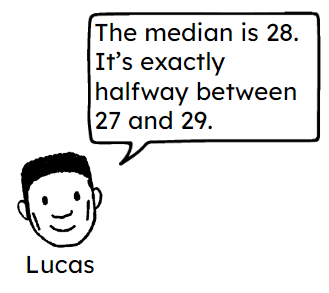
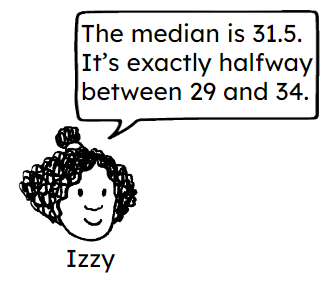
Q2.Who is correct about the median of this data set: 34, 27, 29, 41?
Who is correct about the median of this data set: 34, 27, 29, 41?

Q3.The mean for the data set 2.3, 5.6, 7.4, 3.6, 8.1 is .
The mean for the data set 2.3, 5.6, 7.4, 3.6, 8.1 is .
Q4.Which of these data sets have a mean of 6?
Which of these data sets have a mean of 6?
2, 4, 4, 6, 7
1.4, 3.4, 7.2, 8.9, 8.9
3, 32, 32, 36, 36
Q5.Match each number of values and mean to the correct total.
Match each number of values and mean to the correct total.

Q6.Five suitcases on a trolley have a mean mass of 22 kg. Another suitcase of mass 28 kg is also placed on the trolley. The mean mass of the six suitcases on the trolley is kg per suitcase.
Five suitcases on a trolley have a mean mass of 22 kg. Another suitcase of mass 28 kg is also placed on the trolley. The mean mass of the six suitcases on the trolley is kg per suitcase.
