


New
New
Lesson 3 of 7
Estimate and compare the duration of events and tasks
I can estimate and compare the duration of events and tasks

Lesson 3 of 7
New
New
Estimate and compare the duration of events and tasks
I can estimate and compare the duration of events and tasks
Lesson details
Key learning points
- Estimating and comparing can be used when considering how long different activities might take.
- Adding and subtracting skills might be used when working out intervals or durations.
Keywords
Interval - What is between two values or points. For example, the time between 9:00 and 9:15
Common misconception
Pupils need to be confident with the addition and subtraction of two digit numbers to other two digit numbers to be able to work out intervals or calculate using the intervals.
The idea of using tracing paper to create 15 minute, 30 minute and 45 minute time intervals is suggested and modelled. This can support the arithmetic in the lesson along with counting in 5s around the clock face.
You might want to use simple timers for 1 and 5 minutes or find a timer or alarm clock to give a feeling of durations across the day. There is a lesson on seconds later in the unit. Stopwatches are not used due to the complication of time recorded in decimal notation and the mix of base 60 and 10

Teacher tip

Licence
This content is © Oak National Academy Limited (2025), licensed on Open Government Licence version 3.0 except where otherwise stated. See Oak's terms & conditions (Collection 2).
Lesson video
Loading...
Prior knowledge starter quiz
6 Questions
Q1.Order these time intervals from shortest to longest.
Order these time intervals from shortest to longest.
Q2.How many minutes are there in one hour? There are minutes in one hour.
How many minutes are there in one hour? There are minutes in one hour.
Q3.10 + 35 =
10 + 35 =
Q4.How many minutes are there in three quarters of an hour? There are minutes in three quarters of an hour.
How many minutes are there in three quarters of an hour? There are minutes in three quarters of an hour.
Q5.25 + 15 =
25 + 15 =
Q6.50 − 15 =
50 − 15 =
Assessment exit quiz
6 Questions
Q1.Match the time intervals.
Match the time intervals.

quarter of an hour
half an hour
three quarters of an hour
Q2.Match the activity with a sensible estimate about how long it might take.
Match the activity with a sensible estimate about how long it might take.
3 minutes
30 minutes
1 hour
Q3.What time interval is being shown here?
What time interval is being shown here?
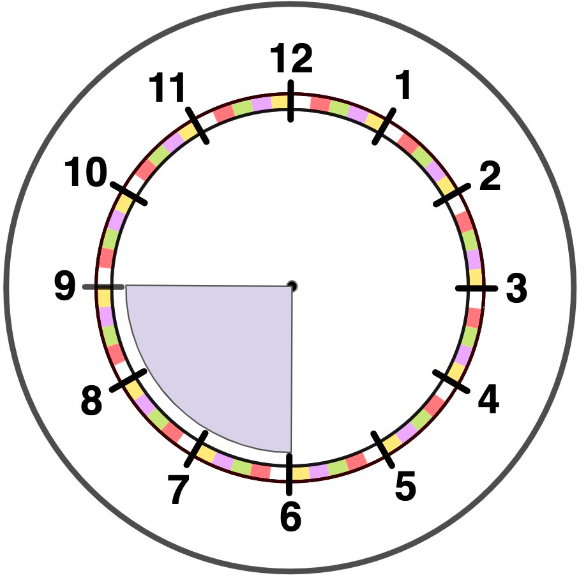
3 minutes
9 minutes
30 minutes
Q4.Pedro started swimming at half past 9 and it took him 20 minutes. What time did he finish?
Pedro started swimming at half past 9 and it took him 20 minutes. What time did he finish?
10 minutes past 9
10 o'clock
Q5.Pedro finished swimming at quarter to 11 and it took him 20 minutes. What time did he start?
Pedro finished swimming at quarter to 11 and it took him 20 minutes. What time did he start?
5 past 11
25 minutes to 10
Q6.What time interval is being shown here? Select all of the options that apply.
What time interval is being shown here? Select all of the options that apply.
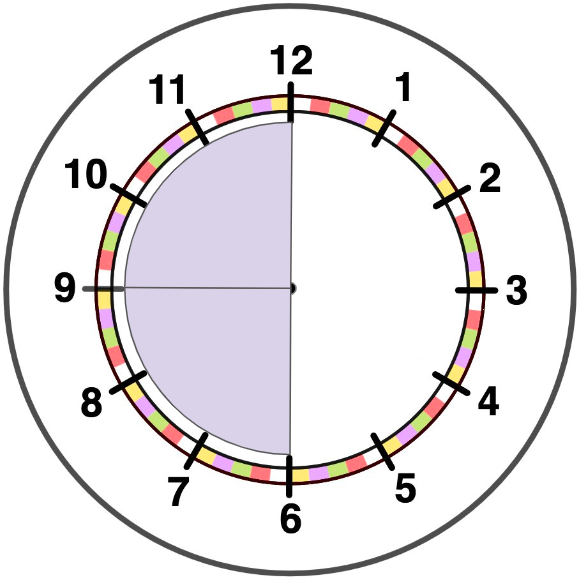
6 minutes
Quarter of an hour