




New
New
Lesson 6 of 10
Interpret sets of negative and positive numbers in a range of contexts
I can interpret sets of negative and positive numbers in a range of contexts.

Lesson 6 of 10
New
New
Interpret sets of negative and positive numbers in a range of contexts
I can interpret sets of negative and positive numbers in a range of contexts.
Lesson details
Key learning points
- For negative temperatures, the further the number is from zero, the colder it is
Keywords
Temperature - How hot or cold something is.
Elevation - Used to describe an object’s height above a given height, such as sea level.
Common misconception
Negative temperatures relate to positive e.g. −5℃ is warmer than −3℃ because 5℃ is warmer than 3℃.
Emphasise directional relationship e.g. numbers decrease as they move to the right. Practical examples can help e.g. freezer temperature.
Take practical opportunities where possible to show pupils positive and negative numbers e.g. using fridge and freezer temperatures or local multi-storey structures.

Teacher tip

Licence
This content is © Oak National Academy Limited (2025), licensed on Open Government Licence version 3.0 except where otherwise stated. See Oak's terms & conditions (Collection 2).
Lesson video
Loading...
Prior knowledge starter quiz
Download quiz pdf
6 Questions
Q1.Tick all of the options where the numbers are arranged in ascending order.
Tick all of the options where the numbers are arranged in ascending order.
5, 4, 3, 2, 1
106, 52, 9, 3
Q2.Tick all of the negative values.
Tick all of the negative values.
0
1
0.5
Q3.Match the parts of the thermometer with their descriptions.
Match the parts of the thermometer with their descriptions.
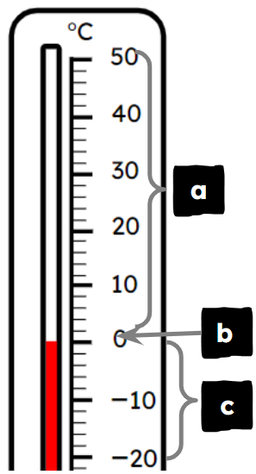

positive
neither positive nor negative
negative
Q4.Which positive temperature is the same distance from zero as −20℃? ℃
Which positive temperature is the same distance from zero as −20℃? ℃
Q5.What number is exactly halfway between −7 and −6?
What number is exactly halfway between −7 and −6?
There is no number in between −7 and −6.
−7.5
−6.25
−7.25
Q6.Match the pairs of numbers with their correct differences.
Match the pairs of numbers with their correct differences.
16
15
18
17
Assessment exit quiz
Download quiz pdf
6 Questions
Q1.Tick all the statements that are true.
Tick all the statements that are true.
−3℃ is colder than −4℃
The temperature was −6℃. One hour later it was −5℃. It got colder.
Q2.Order these temperatures, starting with the coldest.
Order these temperatures, starting with the coldest.
Q3.Use the information in the table to tick all the statements that are true.
Use the information in the table to tick all the statements that are true.
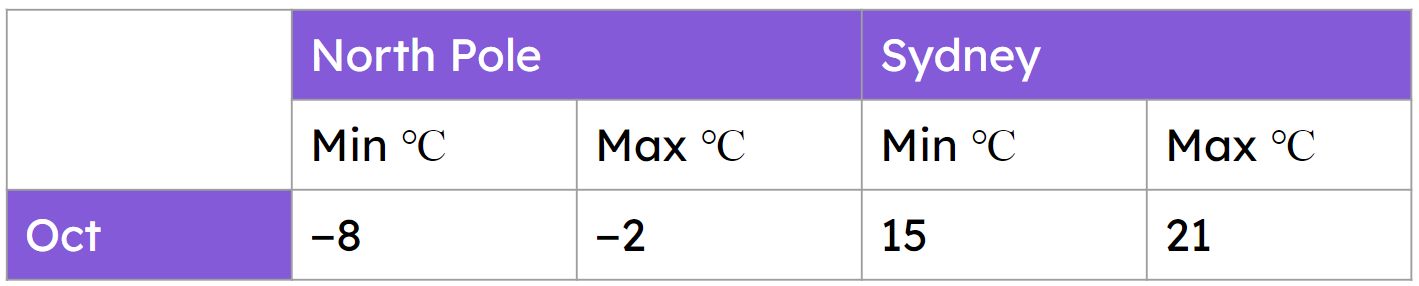
There is a 7℃ difference between the min and max temperatures in the North Pole.
Q4.Use the information in the table to tick all the statements that are true.
Use the information in the table to tick all the statements that are true.
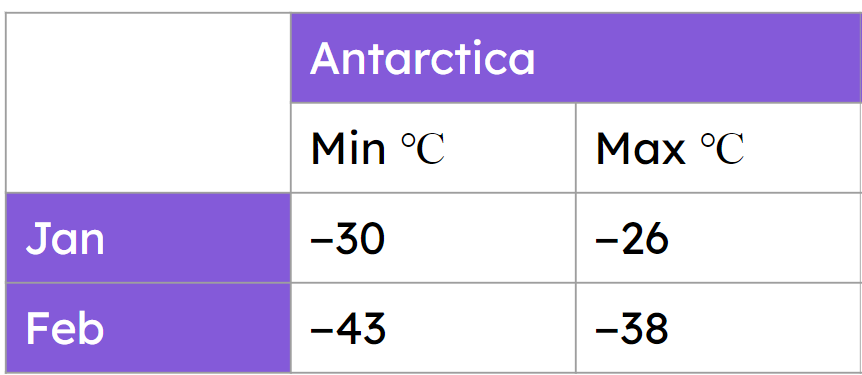
It is warmer in February in Antarctica than it is in January.
The difference between the minimum and maximum temperatures in January is 5℃.
Q5.Put the following numbers into ascending order.
Put the following numbers into ascending order.
Q6.Tick all of the numbers that would appear between −31.5 and −28 on a number line.
Tick all of the numbers that would appear between −31.5 and −28 on a number line.
−32
−27