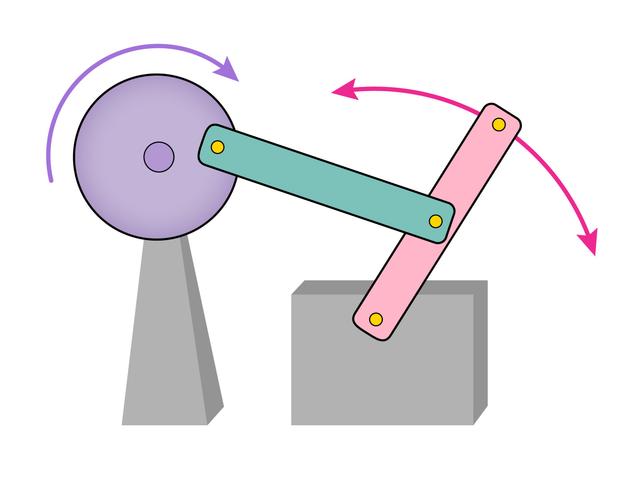
Levers and linkages
I can describe the function of levers and linkages using specific examples.

Levers and linkages
I can describe the function of levers and linkages using specific examples.
Lesson details
Key learning points
- Levers move an input force around a fulcrum by mechanical advantage to an output force.
- Linkages move a force and can change direction of the force.
Keywords
Fulcrum - a fixed pivot point
Effort - input force
Load - output force
Mechanical advantage (MA) - to make moving or lifting something easier
Linkages - a set of levers joined together to transfer and control motion
Common misconception
The only way to gain MA is by increasing the input force.
MA can be increased by increasing the distance from the fulcrum and the effort. For example, increasing the arm length on the handle of a flat head screwdriver when opening a can of paint.


Equipment

Content guidance
- Risk assessment required - equipment

Supervision
Adult supervision required

Licence
Lesson video
Loading...
Prior knowledge starter quiz
6 Questions
Q1.A children's swing is an example of:
Q2.Match the product to the type of output motion:

linear
reciprocating
rotary
oscillating
Q3.What does equilibrium mean?
Q4.To open a tin of paint or varnish more easily, what could you do?
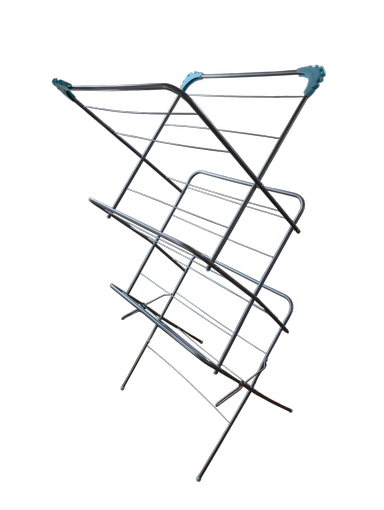
Q5.A work horse is a product that uses linkages. Why do you think it may use linkages?
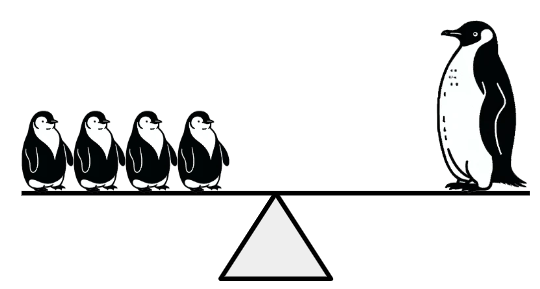
Q6.Look at the picture. What would happen if one of the small penguins moved off the seesaw.
Assessment exit quiz
6 Questions
Q1.Levers have three changeable elements. Match the element to its definition:
a fixed pivot point to move around
the input force
the output force
Q2.Match the products to the order of lever:
second class lever
third class lever
first class lever
third class lever
first class lever
second class lever
Q3.Linkages are a set of levers joined together to:
Q4.In a reverse motion linkage, the input and output...
Q5.How can mechanical advantage (MA) be increased in a first class lever?
Q6.If the input motion in a treadle linkage is rotary, what is the output motion?