New
New
Lesson 5 of 10
Measuring length and height using cm and mm
I can measure length and height using mm or whole cm and mm.

Lesson 5 of 10
New
New
Measuring length and height using cm and mm
I can measure length and height using mm or whole cm and mm.
Lesson details
Key learning points
- The length or height of objects can be measured in mm or in whole cm and mm.
- It is more efficient to start at zero when measuring.
- If the object is not lined up with zero, then the difference needs to be found.
Keywords
Millimetre - A millimetre is a standardised unit of measurement. We can abbreviate millimetre to mm.
Centimetre - A centimetre is a standardised unit of measurement. We can abbreviate centimetre to cm.
Difference - The difference is the result of subtracting one number from another.
Common misconception
The length or height of an object is the numerical value at the end of the ruler (if not at zero).
If an object is not measured from zero, its length is the difference between the numerical value at the start and end of the object.
Where possible, do the suggested activities practically so pupils gain experience of handling measuring equipment and build reference points in relation to length and height.

Teacher tip

Licence
This content is © Oak National Academy Limited (2025), licensed on Open Government Licence version 3.0 except where otherwise stated. See Oak's terms & conditions (Collection 2).
Lesson video
Loading...
Prior knowledge starter quiz
Download quiz pdf
6 Questions
Q1.Match the object to the unit that would be used to measure it.
Match the object to the unit that would be used to measure it.

metres
millimetres
centimetres
Q2.Starting with the shortest, put these units of measure in order.
Starting with the shortest, put these units of measure in order.
Q3.Is the pebble longer or shorter than 1 cm?
Is the pebble longer or shorter than 1 cm?
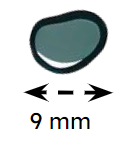
Longer
Q4.What is the length of this leaf?
What is the length of this leaf?
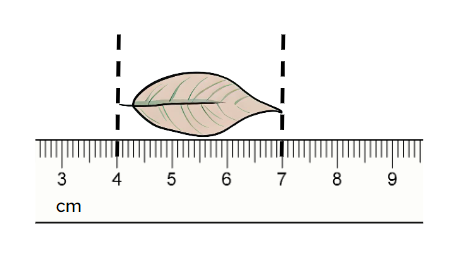
4 cm
7 cm
Q5.Starting with the shortest, put these measurements in order of height.
Starting with the shortest, put these measurements in order of height.
Q6.A piece of string is 100 mm long. 5 cm is cut off. What is the length of the piece of string now?
A piece of string is 100 mm long. 5 cm is cut off. What is the length of the piece of string now?
Assessment exit quiz
Download quiz pdf
6 Questions
Q1.Which of the following would be good to measure in millimetres (mm)?
Which of the following would be good to measure in millimetres (mm)?
Height of a door
Length of a bus
Q2.Match the unit of measure to its abbreviation.
Match the unit of measure to its abbreviation.
m
cm
mm
Q3.What number of mm is the arrow pointing to?
What number of mm is the arrow pointing to?
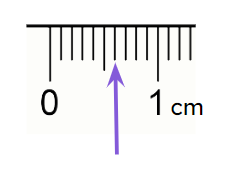
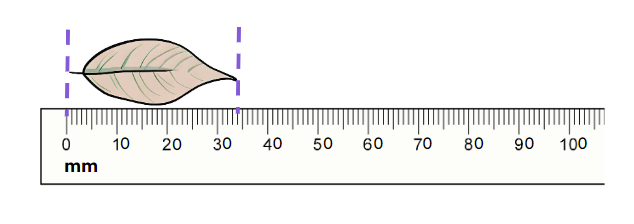
Q4.What is the length of this leaf in mm?
What is the length of this leaf in mm?
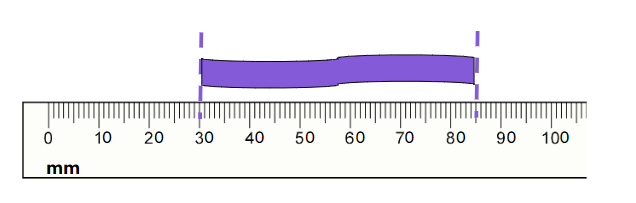
Q5.What is the length of this ribbon in mm?
What is the length of this ribbon in mm?
30 mm
85 mm
Q6.Give the height of this cake in whole cm and mm.
Give the height of this cake in whole cm and mm.