


New
New
Lesson 4 of 10
Use knowledge of place value to calculate with decimal numbers up to and bridging one tenth
I can use knowledge of place value to calculate with decimal numbers up to and bridging one tenth.

Lesson 4 of 10
New
New
Use knowledge of place value to calculate with decimal numbers up to and bridging one tenth
I can use knowledge of place value to calculate with decimal numbers up to and bridging one tenth.
Lesson details
Key learning points
- 10 one hundredths is equal to one tenth or 0.1
- If 7 + 3 is equal to 10 then 7 hundredths + 3 hundredths is equal to 10 hundredths which is equal to one tenth 0.1
- Number facts and place value can be applied when adding hundredths which bridge one tenth.
Keywords
Number fact - A simple calculation using two numbers.
Bridge / bridging - A mental strategy which uses addition or subtraction to cross a number boundary.
Common misconception
Pupils use a known fact but add or subtract with different place values (e.g. 0.6 + 0.04 = 0.1).
Unitise through the use of language to help identify this for pupils. For example: 6 hundredths plus 4 hundredths is equal to 10 hundredths.
Give children the opportunity to explore and compare a range of numbers for which they can apply using known facts to. In particular, allow pupils to discern between numbers that look similar (e.g 0.4 and 0.04).

Teacher tip

Licence
This content is © Oak National Academy Limited (2025), licensed on Open Government Licence version 3.0 except where otherwise stated. See Oak's terms & conditions (Collection 2).
Lesson video
Loading...
Prior knowledge starter quiz
Download quiz pdf
6 Questions
Q1.Tick the number facts that make 10.
Tick the number facts that make 10.
4 + 7

6 + 5
Q2.Ten hundredths are equal to _________.
Ten hundredths are equal to _________.
one
ten tenths
Q3.Tick all of the equations that can represent this part-part-whole model.
Tick all of the equations that can represent this part-part-whole model.
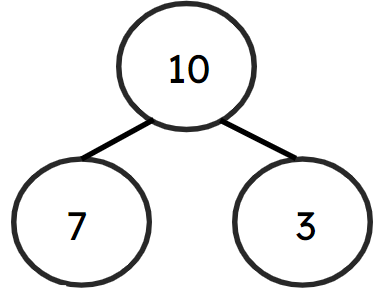
10 = 7 – 3
Q4.I know 6 + 3 = 9 so 60 + 30 =
I know 6 + 3 = 9 so 60 + 30 =
Q5.I know 6 + 3 = 9 so 0.6 + 0.3 =
I know 6 + 3 = 9 so 0.6 + 0.3 =
Q6.Tick the correct equations.
Tick the correct equations.
14 – 0.6 = 0.8
6 + 0.8 = 1.4
0.6 + 0.8 = 14
Assessment exit quiz
Download quiz pdf
6 Questions
Q1.I know 4 + 5 = 9 so 0.04 + 0.05 =
I know 4 + 5 = 9 so 0.04 + 0.05 =
Q2.I know 7 − 4 = 3 so 0.07 − 0.04 =
I know 7 − 4 = 3 so 0.07 − 0.04 =
Q3.Which of these pairs of numbers sum to make 0.1?
Which of these pairs of numbers sum to make 0.1?
0.5 + 0.5
0.09 + 0.1
Q4.Use a known number fact to help you solve: 0.1 − 0.04 =
Use a known number fact to help you solve: 0.1 − 0.04 =
Q5.Fill in the missing number for the equation represented by the number line.
Fill in the missing number for the equation represented by the number line.
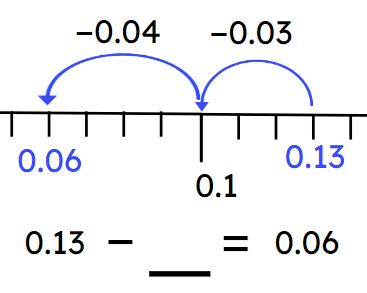
Q6.Fill in the missing number: − 0.08 = 0.09
Fill in the missing number: − 0.08 = 0.09