Myths about teaching can hold you back
- Year 11•
- OCR•
- Foundation
Controlling water balance: the kidneys, and nephron structure
I can describe the role of the kidneys in filtering the blood to control the water balance of the human body, and the structure of a nephron.
- Year 11•
- OCR•
- Foundation
Controlling water balance: the kidneys, and nephron structure
I can describe the role of the kidneys in filtering the blood to control the water balance of the human body, and the structure of a nephron.
Lesson details
Key learning points
- The kidneys are organs of the human excretory system; blood passes through the kidneys and is filtered.
- Water and urea diffuse out of the blood plasma into kidney tubules to be excreted as urine, including nephron structure.
- The kidneys reabsorb as much water as needed from the urine into the blood plasma to maintain water balance in the body.
- Having too much water in the body leads to dilute urine, and vice versa.
Keywords
Urea - a waste product created in the process of breaking down excess proteins and amino acids
Blood plasma - the liquid part of the blood which contains dissolved nutrients and waste products
Kidney - the organ in the excretory system which filters waste products from blood plasma and controls water balance
Excretory system - the organ system responsible for removing waste from blood plasma
Urine - a combination of waste urea, water and other substances which is stored in the bladder until urinated
Common misconception
Misconceptions about the roles of the kidneys, bladder and how the blood is 'cleaned' exist. Students often conflate/confuse these roles, muddle key terms or offer weak descriptions or explanations.
The roles of the kidney and bladder are clearly described, and diagrams and flowcharts are used to support the detailed explanations. Tasks that reinforce understanding and check for clarity and correct use of key words are included too.
To help you plan your year 11 biology lesson on: Controlling water balance: the kidneys, and nephron structure, download all teaching resources for free and adapt to suit your pupils' needs...
To help you plan your year 11 biology lesson on: Controlling water balance: the kidneys, and nephron structure, download all teaching resources for free and adapt to suit your pupils' needs.
The starter quiz will activate and check your pupils' prior knowledge, with versions available both with and without answers in PDF format.
We use learning cycles to break down learning into key concepts or ideas linked to the learning outcome. Each learning cycle features explanations with checks for understanding and practice tasks with feedback. All of this is found in our slide decks, ready for you to download and edit. The practice tasks are also available as printable worksheets and some lessons have additional materials with extra material you might need for teaching the lesson.
The assessment exit quiz will test your pupils' understanding of the key learning points.
Our video is a tool for planning, showing how other teachers might teach the lesson, offering helpful tips, modelled explanations and inspiration for your own delivery in the classroom. Plus, you can set it as homework or revision for pupils and keep their learning on track by sharing an online pupil version of this lesson.
Explore more key stage 4 biology lessons from the Coordination and control: maintaining a constant internal environment unit, dive into the full secondary biology curriculum, or learn more about lesson planning.
Equipment
Licence
Prior knowledge starter quiz
6 Questions
Q1.What substance is stored in the bladder?
Q2.Match the constituent of blood to its description.
red blood cells -
transports oxygen to cells
white blood cells -
play a huge role in immunity
platelets -
are involved in blood clotting
plasma -
contains dissolved substances such as glucose and ions
Q3.Label these parts of the excretory system.

a -
ureter
b -
bladder
c -
urethra
d -
kidney
Q4.What are proteins made of?
Q5.Which of these are ions?
Q6.The process that uses glucose as a fuel to transfer energy for life processes is called cellular .
Assessment exit quiz
6 Questions
Q1.Which body system are the kidneys part of?
Q2.Which of the following are too large to leave the blood during the filtering process?
Q3.Which substances are filtered from the blood and removed from the body in urine?
Q4.Which substances are reabsorbed by the kidney tubules?
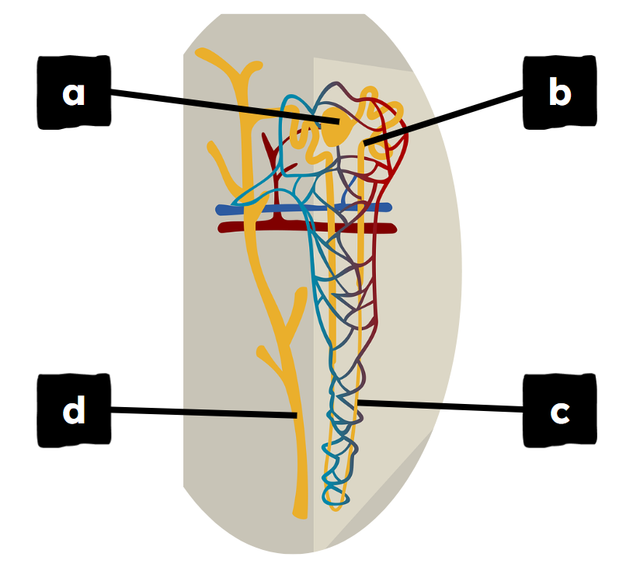
Q5.Match each part of the kidney tubule (nephron) to its correct name.

a -
glomerulus and Bowman’s capsule
b -
proximal convoluted tubule
c -
loop of Henlé
d -
collecting duct