


Atomic number and mass number


Lesson details
Learning outcome
I can relate the atomic number and mass number to the structure of atoms of each element.
Key learning points
- The atomic number of an element states the number of protons in the nucleus of every atom of that element.
- The number of electrons in an atom is equal to the number of protons in the nucleus of the atom.
- The mass number of an element is about equal to the number of protons and neutrons in atoms of that element.
Keywords
Atomic number - The number of protons in the nucleus of an atom, which determines the element's identity.
Mass number - The total number of protons and neutrons in the nucleus of an atom.
Relative atomic mass - The mean mass of an atom relative to 1/12th of the mass of a carbon-12 atom.
Common misconception
Pupils often mix up the atomic number and atomic mass number and get confused over which subatomic particles these represent.
It helps to describe the atomic number as the proton number to help the pupils remember. Also, the provided periodic tables often have a key to help and this should be highlight to pupils.
Teacher tip
It pays to practise the skill of determining the number of subatomic particles for different elements as much as possible. Pupils forget and will keep confusing the atomic and mass numbers.

Licence

Lesson video
Loading...
Prior knowledge starter quiz
6 Questions
Q1.On the periodic table, what does the number 9 represent for the element fluorine?
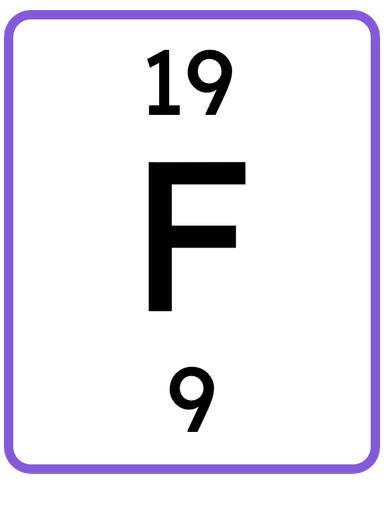
Q2.Match the element to its correct atomic number.

Q3.Which of the following elements are in Group 3?
Q4.The element with the atomic number 26 is known for its use in construction due to its strength and low density. What is this element?
Q5.Give the name, or symbol, of an element in the first period on the periodic table.
Q6.The position of an element in the periodic table is linked to its arrangement of electrons and to its atomic number.
Assessment exit quiz
6 Questions
Q1.What does the atomic number of an element indicate?
Q2.True or false? The atomic number is equal to the number of electrons in a neutral atom.
Q3.What is the relative atomic mass?
Q4.If an atom has an atomic number of 6, how many electrons does it have?
Q5.How does the mass number differ from the atomic number?
Q6.An element has a mass number of 23 and an atomic number of 11. How many neutrons does it have?
To help you plan your 10 combined science lesson on: Atomic number and mass number, download all teaching resources for free and adapt to suit your pupils' needs...
To help you plan your 10 combined science lesson on: Atomic number and mass number, download all teaching resources for free and adapt to suit your pupils' needs.
The starter quiz will activate and check your pupils' prior knowledge, with versions available both with and without answers in PDF format.
We use learning cycles to break down learning into key concepts or ideas linked to the learning outcome. Each learning cycle features explanations with checks for understanding and practice tasks with feedback. All of this is found in our slide decks, ready for you to download and edit. The practice tasks are also available as printable worksheets and some lessons have additional materials with extra material you might need for teaching the lesson.
The assessment exit quiz will test your pupils' understanding of the key learning points.
Our video is a tool for planning, showing how other teachers might teach the lesson, offering helpful tips, modelled explanations and inspiration for your own delivery in the classroom. Plus, you can set it as homework or revision for pupils and keep their learning on track by sharing an online pupil version of this lesson.
Explore more key stage 4 combined science lessons from the Atomic structure and the periodic table unit, dive into the full secondary combined science curriculum, or learn more about lesson planning.