


Measuring instantaneous speed practical (v = s ÷ t)



Lesson details
Learning outcome
I can accurately measure the instantaneous speed of a dynamics trolley.
Key learning points
- A dynamics trolley speeds up (accelerates) along the whole length of a steep ramp.
- Instantaneous speed is the average speed over a very short time period.
- Instantaneous speed can be estimated by measuring movement in a small time period.
- Anomalous readings should be repeated and replaced or removed from sets of repeat readings.
Keywords
Dynamics trolley - A dynamics trolley is a wheeled device used in experiments to study motion, designed to move smoothly over flat surfaces.
Average speed - The average speed of an object is the total distance travelled divided by the total time taken for a journey.
Instantaneous speed - The instantaneous speed of an object is its speed at a specific moment in time.
Anomalous reading - An anomalous reading is a result that is significantly outside the expected pattern in a set of results.
Common misconception
When the trolley is released, it speeds up quickly at the start and then rolls at a constant speed.
Show a video of an accelerating trolley in slow motion identifying the distance travelled in successive equal intervals of time.
Teacher tip
Measuring short time periods is difficult. To give the pupils a better chance of measuring the times accurately, the trolley should be moving fairly slowly, this can be achieved by making sure the ramps are not too steep and using a 'small distance' of 20 cm.

Content guidance
Risk assessment required - equipment

Supervision
Adult supervision required

Licence

Lesson video
Loading...
Prior knowledge starter quiz
6 Questions
Q1.Izzy rode her bike for 3 hours and travelled 45 kilometres.
What was her average speed?
Q2.Lucas rides his bike for 4 hours with an average speed of 15 km/h. He travelled at a speed of 10 km/h for the first two hours.
What speed must he have been travelling at for the last two hours?
Q3.Which of the graphs shows an object moving with increasing speed (accelerating)?
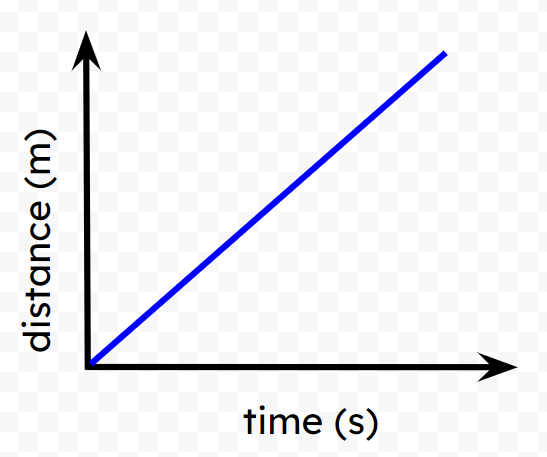
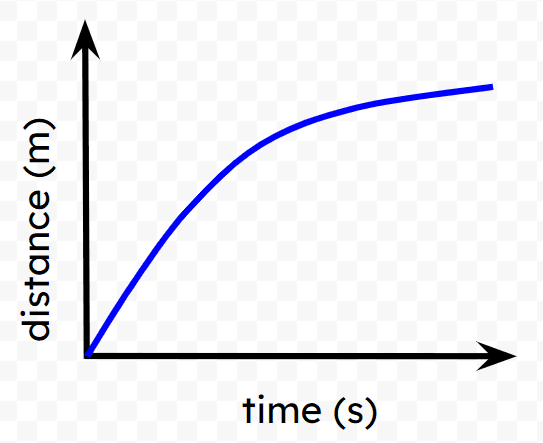
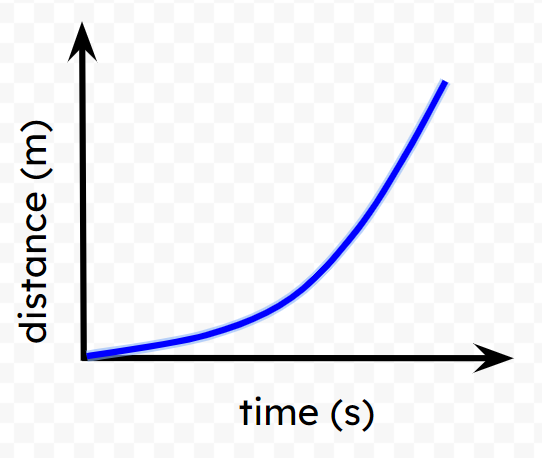
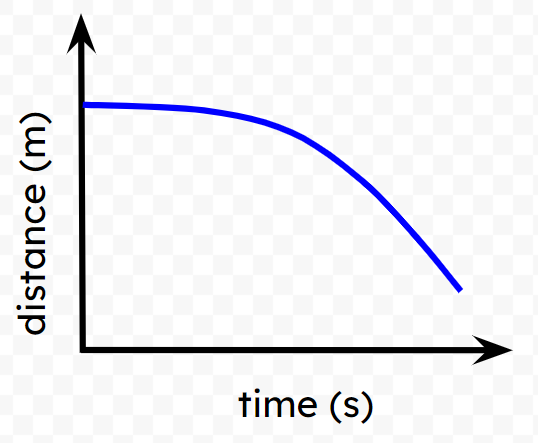
Q4.Andeep ran 20 metres in 5 seconds then slowed down and walked 5 metres in the next 5 seconds.
What was his average speed for the first 5 seconds?
Q5.Andeep ran 20 metres in 5 seconds then slowed down and walked 5 metres in the next 5 seconds.
What was his average speed for the whole 10 seconds?
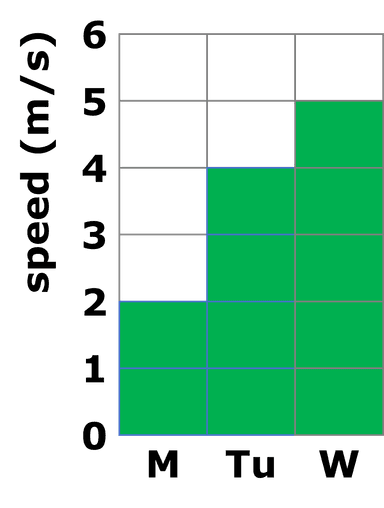
Q6.Aisha cycles to school three days in a row. Her speeds are shown on the bar chart.
What is her average speed for the journey to school?
Assessment exit quiz
6 Questions
Q1.Match the key words or phrases to their definitions.

Q2.Which of these statements about instantaneous and average speed is correct?
Q3.A student investigates the relationship between the steepness of a ramp and the instantaneous speed of a trolley at the end of the ramp. Which of these are control variables for the investigation?
Q4.A trolley rolls down a ramp and passes between two markers that are 20 cm apart in a time of 0.25 s.
Calculate the speed of the trolley in m/s.
Q5.A pupil collects the following set of timing data for a moving object: 0.25 s, 0.23 s, 0.35 s, 0.22 s, 0.21 s.
Which calculation should the pupil use to find the mean time?
Q6.A trolley rolls down a ramp passing between two markers, 0.20 m apart. The following results are collected: 0.17 s, 0.18 s, 0.17 s, and 0.20 s.
Calculate the mean instantaneous speed for the trolley.
To help you plan your 10 combined science lesson on: Measuring instantaneous speed practical (v = s ÷ t), download all teaching resources for free and adapt to suit your pupils' needs...
To help you plan your 10 combined science lesson on: Measuring instantaneous speed practical (v = s ÷ t), download all teaching resources for free and adapt to suit your pupils' needs.
The starter quiz will activate and check your pupils' prior knowledge, with versions available both with and without answers in PDF format.
We use learning cycles to break down learning into key concepts or ideas linked to the learning outcome. Each learning cycle features explanations with checks for understanding and practice tasks with feedback. All of this is found in our slide decks, ready for you to download and edit. The practice tasks are also available as printable worksheets and some lessons have additional materials with extra material you might need for teaching the lesson.
The assessment exit quiz will test your pupils' understanding of the key learning points.
Our video is a tool for planning, showing how other teachers might teach the lesson, offering helpful tips, modelled explanations and inspiration for your own delivery in the classroom. Plus, you can set it as homework or revision for pupils and keep their learning on track by sharing an online pupil version of this lesson.
Explore more key stage 4 combined science lessons from the Measuring and calculating motion unit, dive into the full secondary combined science curriculum, or learn more about lesson planning.