


Collaborative design for batch production
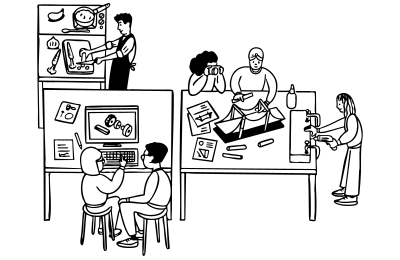


Lesson details
Learning outcome
I can work with others to create ideas.
Key learning points
- Designers collaborate, to identify design opportunities.
- Designers collaborate, to create, evaluate and iterate design ideas.
- A design requirement is something which is needed or wanted to make a product successful.
- Design requirements can support writing a design brief and along with exploring the context, can support designing.
- One way of designing that can be suited to collaborative work is to use the scribble technique.
Keywords
Toys - objects designed for play
Design requirement - something which is needed or wanted to make a product successful
Design idea - a creative concept
Common misconception
Pupils should design individually, and time should be taken when creating and thinking about design ideas.
Designers work in teams and collaborate to create design ideas. Working quickly when generating design ideas can prevent overthinking and allows freedom and creativity to lead the way.
Teacher tip
Live model the scribble technique from start to finish on a whiteboard or visulaiser. Ask pupils to choose the shapes they see from the scribble.

Equipment
whiteboard, visualiser, paper, pens, colouring pencils.

Licence

Lesson video
Loading...
Prior knowledge starter quiz
6 Questions
Q1.What is a freehand sketch?
Q2.Adding light and dark areas to a drawing helps create .
Q3.Match the technique to its purpose.

Q4.What is one-point perspective used for?
Q5.What do we use to show texture and surface detail in a drawing?
Q6.Match the drawing type to what it shows
Assessment exit quiz
4 Questions
Q1.Why is it helpful to use the scribble technique in a design team?
Q2.Working together with others to solve problems or share ideas is called .
Q3.Match the term to the example.
Q4.Order the design process with collaboration
To help you plan your 8 design and technology lesson on: Collaborative design for batch production, download all teaching resources for free and adapt to suit your pupils' needs...
To help you plan your 8 design and technology lesson on: Collaborative design for batch production, download all teaching resources for free and adapt to suit your pupils' needs.
The starter quiz will activate and check your pupils' prior knowledge, with versions available both with and without answers in PDF format.
We use learning cycles to break down learning into key concepts or ideas linked to the learning outcome. Each learning cycle features explanations with checks for understanding and practice tasks with feedback. All of this is found in our slide decks, ready for you to download and edit. The practice tasks are also available as printable worksheets and some lessons have additional materials with extra material you might need for teaching the lesson.
The assessment exit quiz will test your pupils' understanding of the key learning points.
Our video is a tool for planning, showing how other teachers might teach the lesson, offering helpful tips, modelled explanations and inspiration for your own delivery in the classroom. Plus, you can set it as homework or revision for pupils and keep their learning on track by sharing an online pupil version of this lesson.
Explore more key stage 3 design and technology lessons from the Collaborative design: tactile toys to teach unit, dive into the full secondary design and technology curriculum, or learn more about lesson planning.