


Water inequalities


Lesson details
Learning outcome
I can explain the importance of UN Global Goal 6: clean water and sanitation.
Key learning points
- Not all people around the world have access to clean, safe water or wastewater treatment.
- One in three people live without basic sanitation, causing unnecessary disease and death.
- The Global Goals are a plan agreed to by world leaders to build a greener, fairer, better world by 2030.
- The aim of Global Goal 6, is to achieve access to safe water and sanitation for all by 2030.
Keywords
Resource - A resource is anything that can be used for a human need.
Sanitation - Sanitation systems take dirty water and other waste products away.
Global Goals - 17 Global Goals created by the United Nations (UN), designed to be a way of working towards a better and more sustainable future for the world.
Common misconception
That there is nothing we can do to help with water supply problems.
Water is a precious resource everywhere in the world, in all countries. We can all do our bit by using water more carefully and encouraging other people to do the same.
Teacher tip
Pupils could do a water audit of ways that water is used at home and think about ways that they could use water more responsibly.

Content guidance
Depiction or discussion of sensitive content
Depiction or discussion of violence or suffering

Supervision
Adult supervision required

Licence

Lesson video
Loading...
Prior knowledge starter quiz
6 Questions
Q1.Which of these describes the water that comes out of taps at home?

Q2.What do we call water that has been used?
Q3.Put the steps into the correct order.
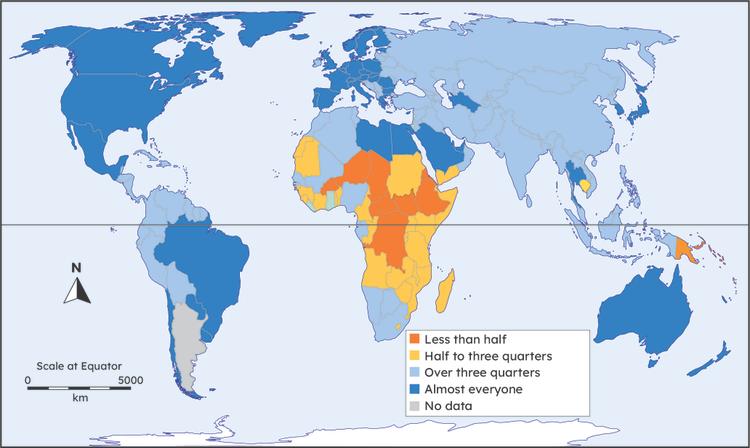
Q4.Look at the map. Choose the statement that you believe is correct.
Q5.Which of the following increases demand for water?
Q6.Why do some people not have access to a clean water supply?
Assessment exit quiz
6 Questions
Q1.Look at the map. Identify two statements that are true.
Q2.What is sanitation?
Q3.Which of the following are possible consequences of not having access to sanitation?
Q4.What does UN stand for?
Q5.Complete the sentence. The UN has created 17 global __________ to make the world a better place by 2030.
Q6.What does global goal 6 hope to achieve by 2030?
To help you plan your 3 geography lesson on: Water inequalities, download all teaching resources for free and adapt to suit your pupils' needs...
To help you plan your 3 geography lesson on: Water inequalities, download all teaching resources for free and adapt to suit your pupils' needs.
The starter quiz will activate and check your pupils' prior knowledge, with versions available both with and without answers in PDF format.
We use learning cycles to break down learning into key concepts or ideas linked to the learning outcome. Each learning cycle features explanations with checks for understanding and practice tasks with feedback. All of this is found in our slide decks, ready for you to download and edit. The practice tasks are also available as printable worksheets and some lessons have additional materials with extra material you might need for teaching the lesson.
The assessment exit quiz will test your pupils' understanding of the key learning points.
Our video is a tool for planning, showing how other teachers might teach the lesson, offering helpful tips, modelled explanations and inspiration for your own delivery in the classroom. Plus, you can set it as homework or revision for pupils and keep their learning on track by sharing an online pupil version of this lesson.
Explore more key stage 2 geography lessons from the The water cycle: why is it important? unit, dive into the full primary geography curriculum, or learn more about lesson planning.