


The role of geology in coastal erosion


Lesson details
Learning outcome
I can explain how geology can affect the development of coastal landforms.
Key learning points
- How resistant rock is to erosional processes is influenced by its rock type (hard/soft).
- Geological structure can result in concordant and discordant coastlines.
- Coastal erosion creates distinctive landforms.
Keywords
Erosion - the wearing away of rocks along the coastline
Resistant - refers to rocks that are less likely to be eroded or weathered
Retreat - the process where cliffs move backward over time as erosion wears away the base of a cliff
Geological structure - the arrangement of rock structure
Common misconception
Boulder clay is an example of sedimentary rock.
Boulder clay is an example of glacial till. Glacial till is an example of sedimentary deposits.
Teacher tip
The lesson in this unit called 'Using GIS to visualise the impact of physical and human processes on coasts' could be used to extend this lesson.

Licence

Lesson video
Loading...
Prior knowledge starter quiz
6 Questions
Q1.What is geology a study of?
Q2.Which of these are the main types of rock?
Q3.Which answer correctly defines coastal erosion?
Q4.What is the main factor that creates the waves we see at the seaside?
Q5.Climate change today is caused by human activities that increase gas levels.
Q6.Match the terms to the correct definition.

Assessment exit quiz
4 Questions
Q1.What category is glacial till in?
Q2.The name of a coastline that has alternative layers of hard and soft rock running perpendicular to the coastline is a coastline.
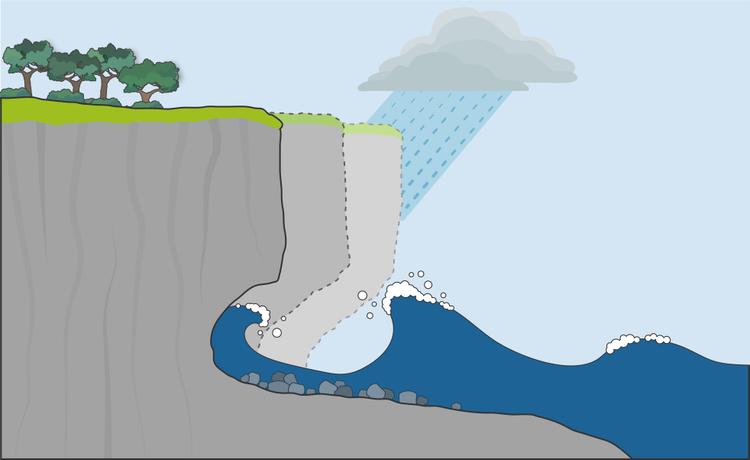
Q3.Correctly order the statements to show the formation of a wave-cut notch and platform
Q4.Coves form along which coastline type?
To help you plan your 10 geography lesson on: The role of geology in coastal erosion, download all teaching resources for free and adapt to suit your pupils' needs...
To help you plan your 10 geography lesson on: The role of geology in coastal erosion, download all teaching resources for free and adapt to suit your pupils' needs.
The starter quiz will activate and check your pupils' prior knowledge, with versions available both with and without answers in PDF format.
We use learning cycles to break down learning into key concepts or ideas linked to the learning outcome. Each learning cycle features explanations with checks for understanding and practice tasks with feedback. All of this is found in our slide decks, ready for you to download and edit. The practice tasks are also available as printable worksheets and some lessons have additional materials with extra material you might need for teaching the lesson.
The assessment exit quiz will test your pupils' understanding of the key learning points.
Our video is a tool for planning, showing how other teachers might teach the lesson, offering helpful tips, modelled explanations and inspiration for your own delivery in the classroom. Plus, you can set it as homework or revision for pupils and keep their learning on track by sharing an online pupil version of this lesson.
Explore more key stage 4 geography lessons from the Coastal landscapes unit, dive into the full secondary geography curriculum, or learn more about lesson planning.