


Use number facts to solve addition and subtraction problems.


Lesson details
Learning outcome
I can use number facts to solve addition and subtraction problems.
Key learning points
- Known facts can be used to help find new facts efficiently.
- Known facts can be used to solve addition and subtraction problems.
- Bar models can be drawn to help represent and understand problems.
Keywords
Efficiently - Not wasting time or effort. An efficient strategy is one we can carry out easily.
Whole - All of something. Complete.
Part - A piece or section of a whole.
Common misconception
Children may have difficulty knowing which operation is required to solve a problem, particularly in those involving finding the difference.
Encourage children to draw bar models or part-part-whole models to support their understanding of the structure of the problem and to articulate their thinking (as modelled in the lesson).
Teacher tip
Exploration of the same context, but with a different part missing each time, can support understanding of the structure of the problem. Understanding can be deepened by giving one problem and asking children to use the same context and numbers to make a new problem.

Licence

Lesson video
Loading...
Prior knowledge starter quiz
6 Questions
Q1.Which number would complete the equation that comes next in the pattern?
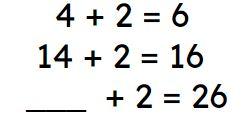
Q2.Use the first part-part-whole model to complete the pattern.

Q3.Use a known fact to find the missing number. 34 + = 39
Q4.Match the correct single digit fact to the equation that it could help solve.

Q5.Sam writes an addition that she can solve using the known fact 5 + 4 = 9 The first addend and the sum both have 6 tens. What could her fact be?
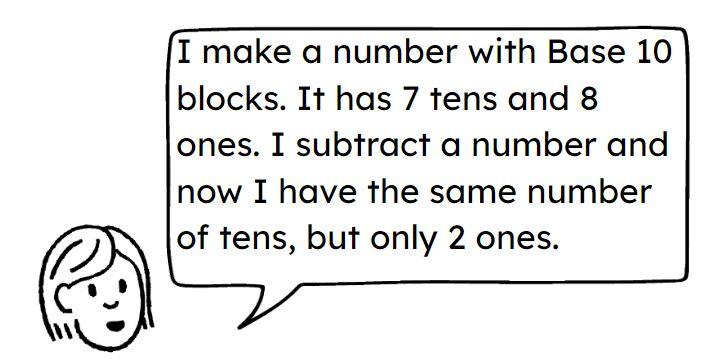
Q6.What number did Sam subtract?
Assessment exit quiz
6 Questions
Q1.Alex bought a cake for 34 p and a bag for 3 p. How much did he spend altogether? Which part-part-whole model represents the problem?
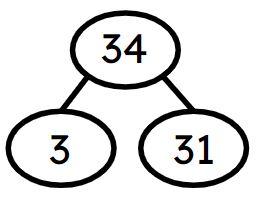
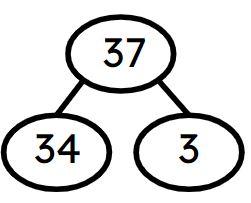
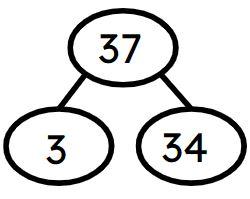
Q2.Sam spent 37 p altogether on a box and a ribbon. The ribbon cost 3 p. How much did the box cost?
Which known fact will help you solve the problem?
Q3.Choose the known fact that would help solve this problem. There were 54 cars in the car park. 3 were red. How many weren’t red?
Q4.Choose the known fact that would help solve this story. First, I had 75 books on the shelf. Then, 3 fell off. Now, how many books are on the shelf?
Q5.Sam’s sunflower was 86 cm tall and Alex’s sunflower was shorter. The difference between them was 4 cm. How tall was Sam’s sunflower. Write the known fact that would help you solve this problem.
Q6.Choose the known fact that would help solve this problem. Sam saved £45 and then she saved £4 more. How much money did she save altogether?
To help you plan your 2 maths lesson on: Use number facts to solve addition and subtraction problems., download all teaching resources for free and adapt to suit your pupils' needs...
To help you plan your 2 maths lesson on: Use number facts to solve addition and subtraction problems., download all teaching resources for free and adapt to suit your pupils' needs.
The starter quiz will activate and check your pupils' prior knowledge, with versions available both with and without answers in PDF format.
We use learning cycles to break down learning into key concepts or ideas linked to the learning outcome. Each learning cycle features explanations with checks for understanding and practice tasks with feedback. All of this is found in our slide decks, ready for you to download and edit. The practice tasks are also available as printable worksheets and some lessons have additional materials with extra material you might need for teaching the lesson.
The assessment exit quiz will test your pupils' understanding of the key learning points.
Our video is a tool for planning, showing how other teachers might teach the lesson, offering helpful tips, modelled explanations and inspiration for your own delivery in the classroom. Plus, you can set it as homework or revision for pupils and keep their learning on track by sharing an online pupil version of this lesson.
Explore more key stage 1 maths lessons from the Adding and subtracting ones and tens to and from 2-digit numbers unit, dive into the full primary maths curriculum, or learn more about lesson planning.