Choose exam board for KS4 Computer Science (GCSE)
Choose exam board for KS4 English
Choose exam board for KS4 French
Choose exam board for KS4 Geography
Choose exam board for KS4 German
Choose exam board for KS4 History
Choose tier for KS4 Maths
Choose exam board for KS4 Music
Choose exam board for KS4 Physical education (GCSE)
Choose exam board for KS4 Religious education (GCSE)
Choose exam board for KS4 Spanish

      Add on fractions with the same denominator
      Lesson details

      Learning outcome

      I can add on fractions with the same denominator.

      Key learning points

      1. If fractions have the same denominator they can be added on.
      2. If 2 plus 3 is equal to 5 then 2 one sevenths plus 3 one sevenths is equal to 5 one sevenths.
      3. To add fractions with the same denominator you use the language of unitising.

      Keywords

      • Units - The unit is one of something that defines the ‘one’ you are counting in.

      • Denominator - A denominator is the bottom number in a fraction. It shows how many parts a whole has been divided into.

      • Numerator - A numerator is the top number in a fraction. It shows how many parts we have.

      Common misconception

      When adding fractions with the same denominator many children may try and add both the numerator and denominator.

      This is a misunderstanding of the unitisation. Practise counting in different set of objects such as cubes, counters, children. Move children on to counting in fractions and explain that this is simply a different unit, shown by the denominator.

      Teacher tip

      It might be a good idea to use a counting stick (split into tenths) and a roll of paper to draw the growth of the sunflower in the second lesson cycle so the children can see the process of adding on a fraction. Consider ways you can practically show other problems or adapt to your setting.

      Licence

      This content is © Oak National Academy Limited (2025), licensed on Open Government Licence version 3.0
      except where otherwise stated. See Oak's terms & conditions
      (Collection 2).

      Lesson video

      Loading...

      Prior knowledge starter quiz

      6 Questions

      Q1.
      Which of these definitions describes a total?

      A number added to another number.
      Correct answer: All of the parts added together.

      Q2.
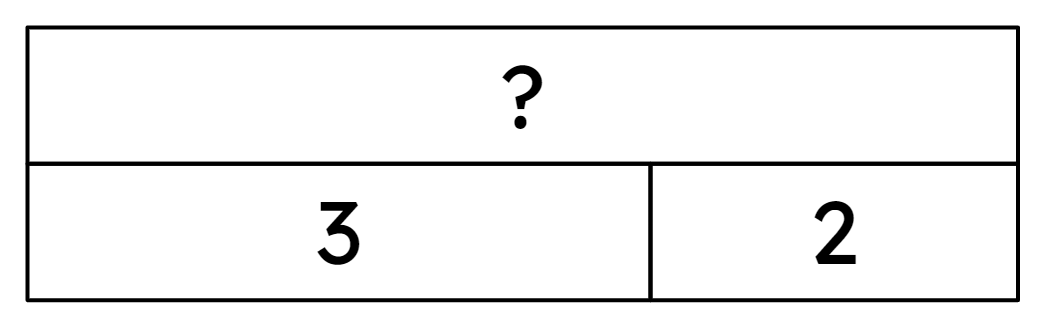
      What is the missing number in this bar model?

      An image in a quiz
      Correct Answer: 5, five

      Q3.
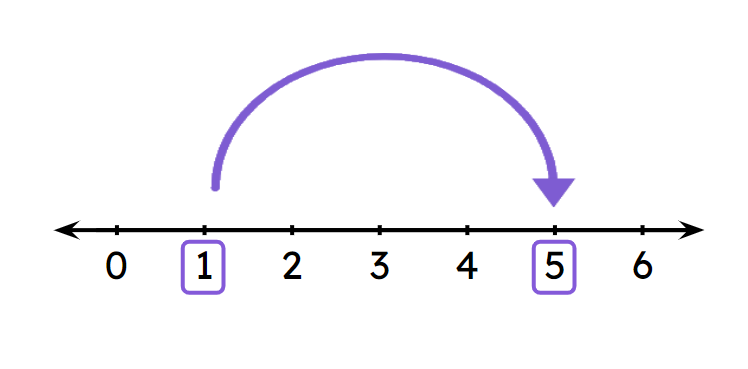
      What addition is being shown by this number line?

      An image in a quiz
      4 + 1 = 5
      Correct answer: 1 + 4 = 5
      4 = 5 + 1
      1 = 5 + 4

      Q4.
      A bag of marbles contains 9 marbles. What fraction of the total is each marble?

      $$ \frac{2}{8} $$
      $$ \frac{1}{8} $$
      Correct answer: $$ \frac{1}{9} $$
      $$ \frac{2}{9} $$

      Q5.
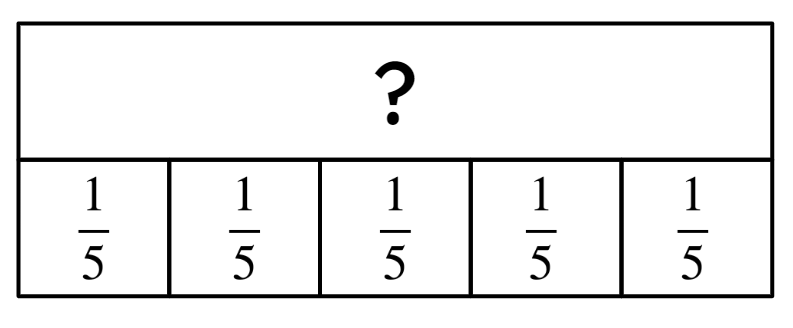
      What is the missing number in this bar model?

      An image in a quiz
      Correct answer: 1
      5
      6

      Q6.
      What is true of the numerator and denominator of a fraction if the fraction is equivalent to one whole?

      They add together to make 1
      They are always both 1
      Correct answer: They are the same.

      6 Questions

      Q1.
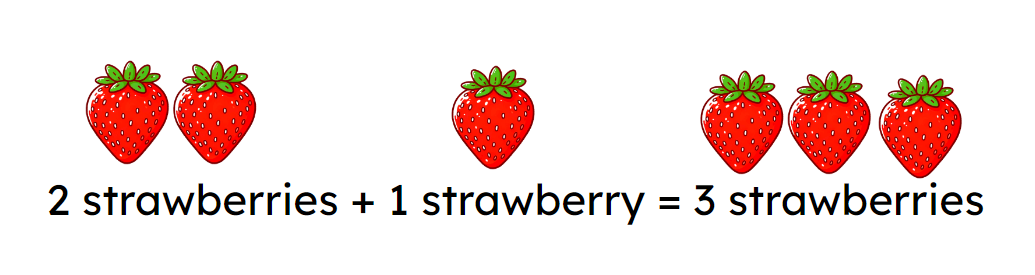
      Look at the picture. What is the unit of this addition?

      An image in a quiz
      Ones
      Wholes
      Correct answer: Strawberries

      Q2.
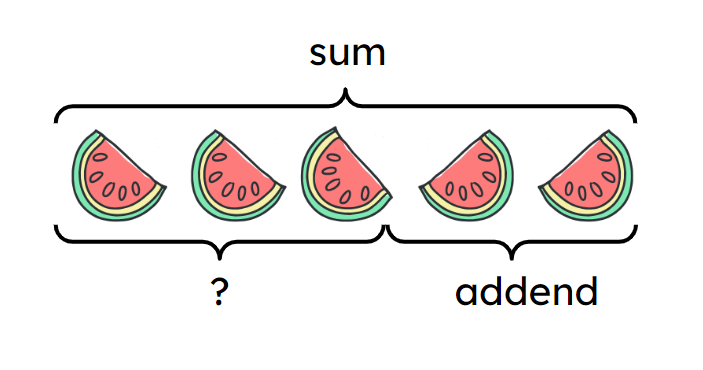
      Look at the image. What is the missing label marked with a question mark?

      An image in a quiz
      Correct answer: addend
      sum
      part

      Q3.
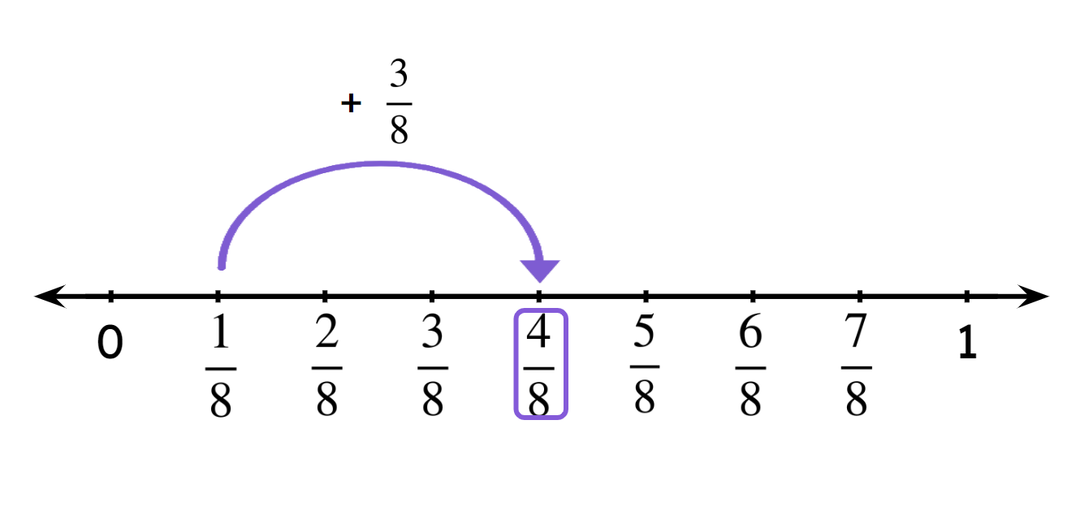
      What addition is being represented on this number line?

      An image in a quiz
      $$ \frac{1}{8} $$ + $$ \frac{4}{8} $$ = $$ \frac{3}{8} $$
      Correct answer: $$ \frac{1}{8} $$ + $$ \frac{3}{8} $$ = $$ \frac{4}{8} $$
      $$ \frac{6}{8} $$ + $$ \frac{5}{8} $$ = $$ \frac{1}{8} $$
      $$ \frac{3}{8} $$ + $$ \frac{3}{8} $$ = $$ \frac{6}{8} $$

      Q4.
      What is the sum of this equation? $$ \frac{2}{7} $$ + $$ \frac{4}{7} $$ = ___

      $$ \frac{6}{14} $$
      $$ \frac{8}{7} $$
      Correct answer: $$ \frac{6}{7} $$

      Q5.
      What is the correct sum for this equation? ___ = $$ \frac{4}{15} $$ + $$ \frac{6}{15} $$

      $$ \frac{10}{30} $$
      Correct answer: $$ \frac{10}{15} $$
      $$ \frac{15}{30} $$

      Q6.
      Which equation matches the problem? A sunflower is two-tenths of a metre tall. Over a month, it grows four-tenths more. How tall is the sunflower now?

      $$ \frac{2}{10} $$ + $$ \frac{4}{10} $$ = $$ \frac{10}{10} $$
      $$ \frac{2}{10} $$ + $$ \frac{6}{10} $$ = $$ \frac{4}{10} $$
      Correct answer: $$ \frac{2}{10} $$ + $$ \frac{4}{10} $$ = $$ \frac{6}{10} $$

      To help you plan your 3 maths lesson on: Add on fractions with the same denominator, download all teaching resources for free and adapt to suit your pupils' needs...