Myths about teaching can hold you back
- Year 7
Representing an unknown or variable
I can recognise that a letter can be used to represent a specific unknown or a variable and know the difference.
- Year 7
Representing an unknown or variable
I can recognise that a letter can be used to represent a specific unknown or a variable and know the difference.
Lesson details
Key learning points
- A letter can be used to represent a specific unknown in a variety of ways.
- A letter can be used to represent a variable in a number of ways.
- It is possible to tell the difference between letters representing unknowns or variables
Keywords
Unknown - An unknown is a quantity that has a set value but is represented by a symbol or letter.
Variable - A variable is quantity that can take on a range of values.
Formula - A formula is a rule linking sets of physical variables in context. The plural of formula is formulae.
Common misconception
Pupils may think that letters always represent a set value that can be 'found'.
Highlight the distinction between unknowns and variables. Allow pupils to explore expressions intrinsically before substituting in values.
To help you plan your year 7 maths lesson on: Representing an unknown or variable, download all teaching resources for free and adapt to suit your pupils' needs...
To help you plan your year 7 maths lesson on: Representing an unknown or variable, download all teaching resources for free and adapt to suit your pupils' needs.
The starter quiz will activate and check your pupils' prior knowledge, with versions available both with and without answers in PDF format.
We use learning cycles to break down learning into key concepts or ideas linked to the learning outcome. Each learning cycle features explanations with checks for understanding and practice tasks with feedback. All of this is found in our slide decks, ready for you to download and edit. The practice tasks are also available as printable worksheets and some lessons have additional materials with extra material you might need for teaching the lesson.
The assessment exit quiz will test your pupils' understanding of the key learning points.
Our video is a tool for planning, showing how other teachers might teach the lesson, offering helpful tips, modelled explanations and inspiration for your own delivery in the classroom. Plus, you can set it as homework or revision for pupils and keep their learning on track by sharing an online pupil version of this lesson.
Explore more key stage 3 maths lessons from the Expressions and equations unit, dive into the full secondary maths curriculum, or learn more about lesson planning.
Licence
Lesson video
Loading...
Prior knowledge starter quiz
6 Questions
Q1.The value halfway between 13 and 27 is
Q2.Complete the calculation: $$20+40\times 4$$ =
Q3.Select any values which are integers.
Q4.True or false: $$52y$$ is an equation for the number of weeks in a given number of years.
Q5.Sofia is thinking of a number. When she adds 6 then multiplies her number by 4 she gets 40. Which is an equation representing Sofia's number?
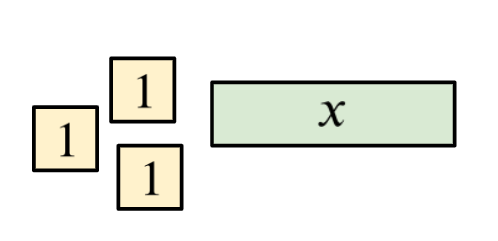
Q6.Which of the expressions below represent the algebra tiles in this diagram?

Assessment exit quiz
6 Questions
Q1.A letter can be used to represent , (quantities with set values) or variables (quantities that can take on a range of values).
Q2.Andeep says: I sleep 8 hours a night, I can write the number of hours I sleep for any number of nights as $$8n$$. which of the following are true?
Q3.True or false: $$3n$$ is always bigger than $$n$$
Q4.To cook a lamb ‘well done’ the recipe says the length of time (mins) is 50 × mass (kg) + 20. What is the variable in this scenario?
Q5.For the statement $$x+y=44$$. What value can $$x$$ have if it is 10 times bigger than $$y$$?
Q6.Match the expression with its relationship to the size of $$x$$
$$x^2$$ -
is smaller than $$x$$ when $$x$$ is between 0 and 1
$$x-3$$ -
is always smaller than $$x$$
$$x+1$$ -
is never smaller than $$x$$
$$4x$$ -
is smaller than $$x$$ when $$x$$ is negative
$$2x-10$$ -
is smaller than $$x$$ when $$x$$ is less than 10