Choose exam board for KS4 Computer Science (GCSE)
Choose exam board for KS4 English
Choose exam board for KS4 French
Choose exam board for KS4 Geography
Choose exam board for KS4 German
Choose exam board for KS4 History
Choose tier for KS4 Maths
Choose exam board for KS4 Music
Choose exam board for KS4 Physical education (GCSE)
Choose exam board for KS4 Religious education (GCSE)
Choose exam board for KS4 Spanish

      Lesson details

      Learning outcome

      I can assess the implications of making a journey in different ways.

      Key learning points

      1. There may be many options for how to travel to a place
      2. Various factors affect which mode of transport is most favourable
      3. Making the same journey multiple times means the impact of that journey is multiplied

      Keywords

      • Commute - A commute is a regular journey made between a person’s home and their place of work.

      Common misconception

      When calculating the amount of emissions per mile, pupils may forget to convert the information given from grams to kilograms.

      Always check whether the units for any values given in the information match the units that are required for the formula.

      Teacher tip

      This lesson could be extended into an investigation by asking pupils to calculate the time it would take them to travel to school using different methods of transport. They could also research current petrol prices so that they can calculate the cost of petrol to travel to school by car.

      Licence

      This content is © Oak National Academy Limited (2025), licensed on Open Government Licence version 3.0
      except where otherwise stated. See Oak's terms & conditions
      (Collection 2).

      Lesson video

      Loading...

      Prior knowledge starter quiz

      6 Questions

      Q1.
      __________ is the rate at which something is moving.

      distance
      Correct answer: speed
      time

      Q2.
      Which formula is correct?

      distance = speed $$\div$$ time
      distance = time $$\div$$ speed
      Correct answer: speed = distance $$\div$$ time
      speed = time $$\div$$ distance
      time = speed $$\div$$ distance

      Q3.
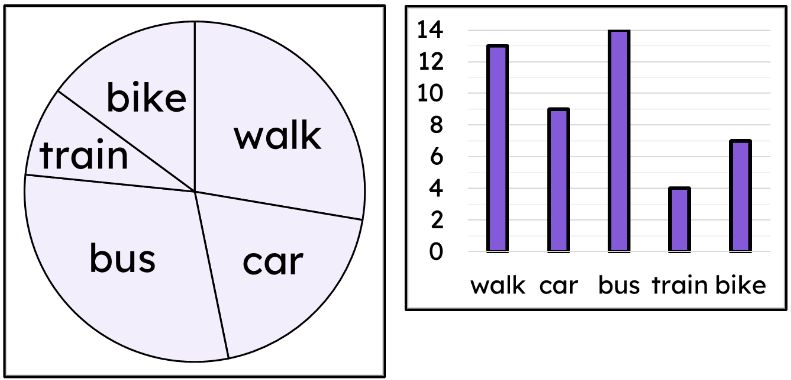
      The two diagrams represent the same dataset about the number of people that travel to work using each mode of transport. How many people travel by bike?

      An image in a quiz
      Correct Answer: 7, seven, 7 people, seven people

      Q4.
      The two diagrams represent the same dataset about the number of people that travel to work using each mode of transport. The number of people who walk is __________ a quarter of the total frequency.

      An image in a quiz
      less than
      equal to
      Correct answer: greater than

      Q5.
      Aisha runs 6 km in 45 minutes. Her average speed was km/h.

      Correct Answer: 8, eight, 8 km/h

      Q6.
      1 imperial gallon is approximately 4.546 litres. Starting with the smallest, sort the measurements in order of volume.

      1 - 4 litres
      2 - 1 imperial gallon
      3 - 5 litres
      4 - 8 litres
      5 - 9 litres
      6 - 2 imperial gallons
      7 - 10 litres

      6 Questions

      Q1.
      8.2 kg = g.

      Correct Answer: 8200, eight thousand two hundred, 8200 g

      Q2.
      Which rearrangements of speed = distance $$\div$$ time are correct?

      time = distance $$\times$$ speed
      Correct answer: time = distance $$\div$$ speed
      time = speed $$\div$$ distance
      Correct answer: distance = speed $$\times$$ time
      distance = speed $$\div$$ time

      Q3.
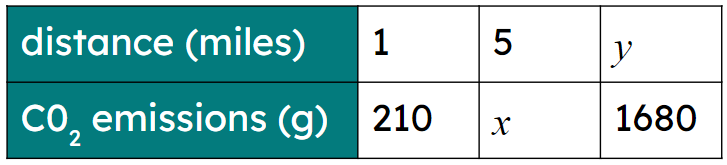
      Find the value of $$x$$.

      An image in a quiz
      Correct Answer: 1050, 1050 g, one thousand and fifty

      Q4.
      Find the value of $$y$$.

      An image in a quiz
      Correct Answer: 8, eight, 8 miles

      Q5.
      A person's car emits 8 kg of carbon dioxide per gallon of fuel and has a fuel efficiency of 50 mpg. Therefore, it produces g of emissions per mile.

      An image in a quiz
      Correct Answer: 160, one hundred and sixty, 160 g

      Q6.
      Aisha walks with an average speed of 5 km/h. It would take minutes to walk 3 km.

      Correct Answer: 36

      To help you plan your 9 maths lesson on: Making a journey, download all teaching resources for free and adapt to suit your pupils' needs...