Myths about teaching can hold you back
- Year 9
- Year 9
Making cities greener
I can understand various approaches to improve local environments.
Lesson details
Key learning points
- One approach could be improving walking or cycling routes
- One approach could be creating new green spaces
Keywords
Forecast - A forecast is a prediction of a future event occurring (based on data).
Extrapolation - Extrapolation is the process of estimating unknown values that are outside the range of existing data.
Climate - Climate is the average weather pattern in an area across a long period of time.
Urban - Urban is a word to describe a town or city, or certain properties of towns and cities.
Common misconception
An urban area should implement all of the strategies to make itself greener.
Not all strategies are viable for every urban area and some will be more effective than others depending on the location.
To help you plan your year 9 maths lesson on: Making cities greener, download all teaching resources for free and adapt to suit your pupils' needs...
To help you plan your year 9 maths lesson on: Making cities greener, download all teaching resources for free and adapt to suit your pupils' needs.
The starter quiz will activate and check your pupils' prior knowledge, with versions available both with and without answers in PDF format.
We use learning cycles to break down learning into key concepts or ideas linked to the learning outcome. Each learning cycle features explanations with checks for understanding and practice tasks with feedback. All of this is found in our slide decks, ready for you to download and edit. The practice tasks are also available as printable worksheets and some lessons have additional materials with extra material you might need for teaching the lesson.
The assessment exit quiz will test your pupils' understanding of the key learning points.
Our video is a tool for planning, showing how other teachers might teach the lesson, offering helpful tips, modelled explanations and inspiration for your own delivery in the classroom. Plus, you can set it as homework or revision for pupils and keep their learning on track by sharing an online pupil version of this lesson.
Explore more key stage 3 maths lessons from the Maths and the environment unit, dive into the full secondary maths curriculum, or learn more about lesson planning.
Equipment
Licence
Prior knowledge starter quiz
6 Questions
Q1.There are 800 g of bread to be shared between 5 people. This means that there are g per person.
Q2.Find 24% of 160.
Q3.What is 0.75% as a decimal?
Q4.Decrease 800 by 5%.
Q5.Which calculations would decrease 1572 by 12.5%?
Q6.Laura spends a total of 146 hours doing exercise in a year. This would suggest that Laura does hours of exercise per day, on average.
Assessment exit quiz
6 Questions
Q1.In 2021, the total transport emissions in Rotherham was 540.7 kt of CO$$_{2}$$. In 2022, this was reduced by 15% to kt of CO$$_{2}$$ (to 1 decimal place).
Q2.In 2021, the population of Rotherham was 266 183 and the total transport emissions was 540.7 kt of CO$$_{2}$$. This is equivalent to kt of CO$$_{2}$$ per person (to 3 significant figures).
Q3.A bus depot is 7950 m$$^2$$. Each bus requires a minimum area of 200 m$$^2$$ per bus. What is the maximum number of buses that can be stored in the depot?
Q4.The area of Rotherham is 287 km$$^2$$ and the population is 266 183. This means that there is __________ km$$^2$$ per person (to 3 significant figures).
Q5.The area of Rotherham is 287 km$$^2$$ and the population is 266 183. This means that there are __________ people per km$$^2$$ (to 3 significant figures).
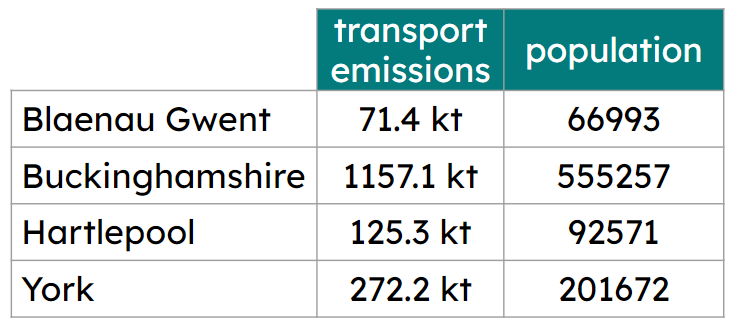
Q6.Starting with the least, sort the locations in ascending order by the amount of transport emissions per person.