Myths about teaching can hold you back
- Year 9
- Year 9
Interior designer
I can understand how maths is used in interior design.
These resources were made for remote use during the pandemic, not classroom teaching.
Switch to our new teaching resources now - designed by teachers and leading subject experts, and tested in classrooms.
Lesson details
Key learning points
- Measurements need to be accurate when designing a space
- Quantities of materials need to be determined to minimise waste
- Cost needs to be considered when pricing for a job
Keywords
Area - The area is the size of the surface and states the number of unit squares needed to completely cover that surface.
Common misconception
Rounding incorrectly for the stated context.
Pupils should consider the situation and ask - if rounding down, will there be enough? If rounding up, does this cover all cases? Thinking about the situation and trying different values to see what works can also help.
To help you plan your year 9 maths lesson on: Interior designer, download all teaching resources for free and adapt to suit your pupils' needs...
To help you plan your year 9 maths lesson on: Interior designer, download all teaching resources for free and adapt to suit your pupils' needs.
The starter quiz will activate and check your pupils' prior knowledge, with versions available both with and without answers in PDF format.
We use learning cycles to break down learning into key concepts or ideas linked to the learning outcome. Each learning cycle features explanations with checks for understanding and practice tasks with feedback. All of this is found in our slide decks, ready for you to download and edit. The practice tasks are also available as printable worksheets and some lessons have additional materials with extra material you might need for teaching the lesson.
The assessment exit quiz will test your pupils' understanding of the key learning points.
Our video is a tool for planning, showing how other teachers might teach the lesson, offering helpful tips, modelled explanations and inspiration for your own delivery in the classroom. Plus, you can set it as homework or revision for pupils and keep their learning on track by sharing an online pupil version of this lesson.
Explore more key stage 3 maths lessons from the Maths in the workplace unit, dive into the full secondary maths curriculum, or learn more about lesson planning.
Equipment
Licence
Prior knowledge starter quiz
6 Questions
Q1.The is the size of the surface and states the number of unit squares needed to completely cover that surface.
Q2.The dimensions of a rectangular door are 1.98 m by 76 cm. Which of the following are equivalent measurements of the same door?
Q3.The dimensions of a rectangular door are 1.98 m by 76 cm. What is the area of the door in cm$$^2$$? (You do not need to state the units with your answer.)
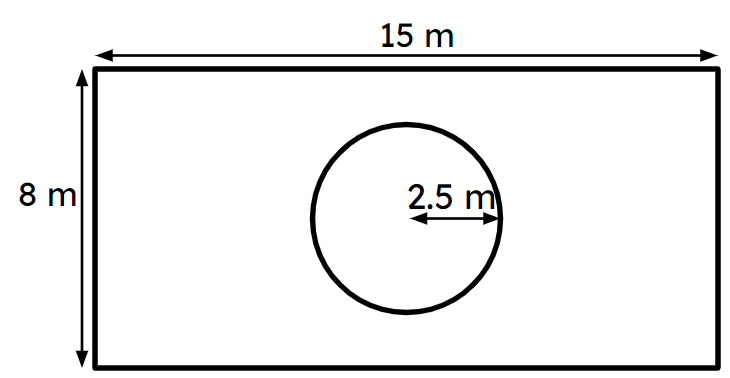
Q4.A rectangular garden with dimensions shown is completely covered with grass. The exception is the circular pond (indicated on the diagram). What is the area of the garden?

Q5.A rectangular garden with dimensions shown is completely covered with grass. The exception is the circular pond (indicated on the diagram). What is the area of the pond? (To the nearest integer.)

Q6.A rectangular garden with dimensions shown is completely covered with grass. The exception is the circular pond (indicated on the diagram). What is the area covered by grass? (To the nearest integer.)

Assessment exit quiz
6 Questions
Q1.The area is the size of the surface and states the number of unit squares needed to completely that surface.
Q2.Aisha wants to paint the ceilings in a house. The coverage is 11 m$$^2$$ per litre and tubs are 10 litres. What is the area (in m$$^2$$) that one tub can cover?
Q3.Aisha wants to paint the ceilings in a house. One tub of paint covers 110 m$$^2$$. The area of the ceilings is 98 m$$^2$$ and this must be painted twice. How many tubs of paint are needed?
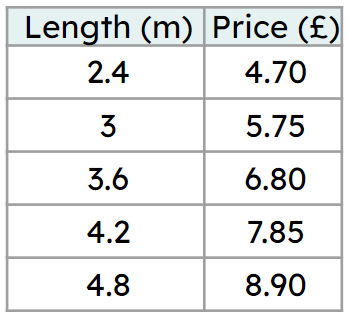
Q4.Calculate the cost per metre of the 2.4 metre length. Give your answer in pounds to the nearest penny.

Q5.Calculate the cost per metre of the 3.6 metre length. Give your answer in pounds to the nearest penny.

Q6.Which length is the best value for money based on the cost per metre?