Myths about teaching can hold you back
- Year 8
Problem solving with perimeter, area and volume
I can use my knowledge of perimeter, area and volume to solve problems.
- Year 8
Problem solving with perimeter, area and volume
I can use my knowledge of perimeter, area and volume to solve problems.
These resources were made for remote use during the pandemic, not classroom teaching.
Switch to our new teaching resources now - designed by teachers and leading subject experts, and tested in classrooms.
Lesson details
Key learning points
- The volume and surface area of shapes made from prisms and cylinders can be found.
- The volume and surface area of shapes made from parts of prisms and cylinders can be found.
- Unknown lengths can be found when surface area or volume are known.
- Volume and surface area can be used in context to solve problems.
Keywords
Prism - polyhedron with a base that is a polygon and identical parallel opposite face whose corresponding edges are joined by parallelograms.
Cylinder - 3D shape with a circle base and an identical parallel opposite face. Cross sections made parallel to the base will be congruent to the base.
Surface area - the total area of all the surfaces of a closed 3D shape. The surfaces include all faces and any curved surfaces.
Volume - the amount of space occupied by a closed 3D shape.
Common misconception
Pupils may struggle to decide whether the question is needing length, area or volume.
Support could be given by providing the units for the answer or pupils may be encouraged to think of contexts for each before hand.
To help you plan your year 8 maths lesson on: Problem solving with perimeter, area and volume, download all teaching resources for free and adapt to suit your pupils' needs...
To help you plan your year 8 maths lesson on: Problem solving with perimeter, area and volume, download all teaching resources for free and adapt to suit your pupils' needs.
The starter quiz will activate and check your pupils' prior knowledge, with versions available both with and without answers in PDF format.
We use learning cycles to break down learning into key concepts or ideas linked to the learning outcome. Each learning cycle features explanations with checks for understanding and practice tasks with feedback. All of this is found in our slide decks, ready for you to download and edit. The practice tasks are also available as printable worksheets and some lessons have additional materials with extra material you might need for teaching the lesson.
The assessment exit quiz will test your pupils' understanding of the key learning points.
Our video is a tool for planning, showing how other teachers might teach the lesson, offering helpful tips, modelled explanations and inspiration for your own delivery in the classroom. Plus, you can set it as homework or revision for pupils and keep their learning on track by sharing an online pupil version of this lesson.
Explore more key stage 3 maths lessons from the Perimeter, area and volume unit, dive into the full secondary maths curriculum, or learn more about lesson planning.
Licence
Prior knowledge starter quiz
6 Questions
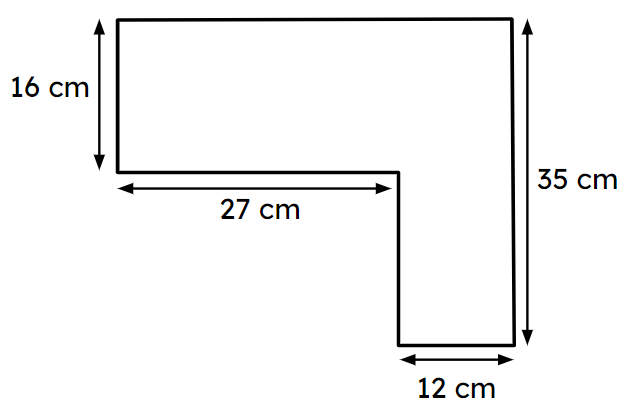
Q1.The perimeter of this composite rectilinear shape is cm.

Q2.The area of this composite rectilinear shape is cm².

Q3.Match each word to its definition.
Area -
the size of the surface.
Perimeter -
the distance around a 2D shape.
Volume -
the amount of space occupied by a closed 3D shape.
Surface area -
the total area of all the surfaces of a closed 3D shape.
Q4.A triangular prism with an equilateral triangle base has different shape faces.
Q5.A hexagonal prism has a cross-sectional area of 62 cm² and a length of 5 cm. What is the volume of the prism?
Q6.A cylinder has a volume of $$252\pi\text{ cm}^3$$ and an integer length. Which of these could be the radius?
Assessment exit quiz
6 Questions
Q1.A composite prism can be created by using two or more .
Q2.A cube has a volume of 125 cm³. The edge length of the cube is cm.
Q3.A cube has a volume of 64 cm³. The area of one face is cm².
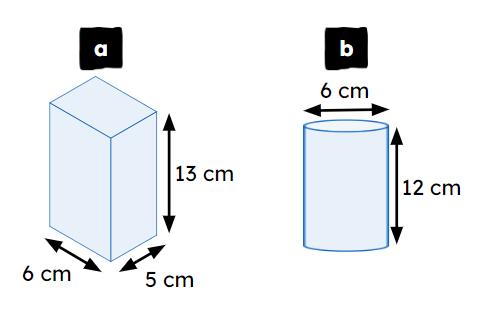
Q4.Which of these shapes have the largest volume?

Q5.Match the measurement to the context.
Length -
The amount of ribbon to put around a cake.
Area -
The amount of carpet to cover a floor.
Surface area -
The amount of silver to cover an earring.
Volume -
The amount of soil to fill in a hole.