Choose exam board for KS4 Computer Science (GCSE)
Choose exam board for KS4 English
Choose exam board for KS4 French
Choose exam board for KS4 Geography
Choose exam board for KS4 German
Choose exam board for KS4 History
Choose tier for KS4 Maths
Choose exam board for KS4 Music
Choose exam board for KS4 Physical education (GCSE)
Choose exam board for KS4 Religious education (GCSE)
Choose exam board for KS4 Spanish

      Place value in imperial units
      Lesson details

      Learning outcome

      I can interpret place value in the context of measure (imperial).

      Key learning points

      1. Imperial measures come from an older system of measuring.
      2. Imperial measures evolved over the course of history.
      3. Imperial measures use different bases to the metric system.

      Keywords

      • Imperial - Imperial is a system of units for measuring, which was created in the early 1800s during the British Empire.

      Common misconception

      Pupils may get mixed up between metric and imperial units.

      You may wish to refer to Lesson 6 of this unit, which explains the metric system’s use of prefixes, and compare this with imperial measures.

      Teacher tip

      You could ask pupils to find other examples of where imperial units are used or find imperial units not covered in the lesson. Task A includes ‘hands’, which are used to measure horses. Pupils can do Task A without knowing this, based on the words.

      Licence

      This content is © Oak National Academy Limited (2026), licensed on Open Government Licence version 3.0
      except where otherwise stated. See Oak's terms & conditions
      (Collection 2).

      Lesson video

      Loading...

      Prior knowledge starter quiz

      6 Questions

      Q1.
      $$5\times12=$$

      Correct Answer: 60

      Q2.
      $$140\div14=$$

      Correct Answer: 10

      Q3.
      Starting with the smallest, sort these lengths in ascending order or size.

      1 - 1 millimetre
      2 - 1 centimetre
      3 - 1 metre
      4 - 1 kilometre

      Q4.
      Units of measurement based around the standard units of metre, gram and litre are called __________ units.

      Correct Answer: metric

      Q5.
      Match measurements with the types of measures.

      Correct Answer:distance of a journey,length

      length

      Correct Answer:weight of a baby,mass

      mass

      Correct Answer:amount of space in a container,capacity

      capacity

      Q6.
      Which is NOT a metric unit?

      centimetre
      Correct answer: inch
      kilogram
      millilitre

      6 Questions

      Q1.
      Which of these is an imperial unit for measuring length?

      millimetres
      centimetres
      Correct answer: inches
      metres
      kilometres

      Q2.
      Which of these is an imperial unit for measuring capacity?

      millilitres
      centilitres
      Correct answer: pints
      litres

      Q3.
      Which of these could be measured in stones?

      height of a door
      Correct answer: mass of a person
      space available in a box
      area of a field

      Q4.
      Match each unit with its description.

      Correct Answer:feet,imperial unit of length

      imperial unit of length

      Correct Answer:metres,metric unit of length

      metric unit of length

      Correct Answer:gallons,imperial unit of capacity

      imperial unit of capacity

      Correct Answer:litres,metric unit of capacity

      metric unit of capacity

      Correct Answer:ounces,imperial unit of mass

      imperial unit of mass

      Correct Answer:grams,metric unit of mass

      metric unit of mass

      Q5.
      Convert 160 ounces to pounds.

      Correct Answer: 10, 10 pounds, 10 lb, 10 lbs

      Q6.
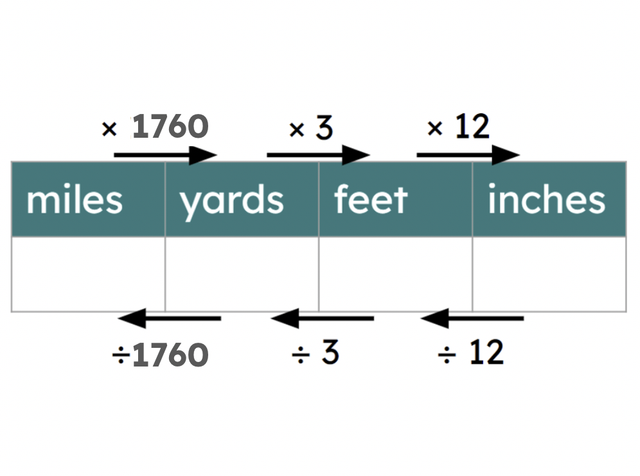
      Convert 3 yards into inches.

      An image in a quiz
      Correct Answer: 108, 108 inches

      To help you plan your 7 maths lesson on: Place value in imperial units, download all teaching resources for free and adapt to suit your pupils' needs...