Myths about teaching can hold you back
- Year 11•
- Foundation
Probabilities involving algebra
I can work with algebraic statements using the fact that exhaustive events sum to 1.
- Year 11•
- Foundation
Probabilities involving algebra
I can work with algebraic statements using the fact that exhaustive events sum to 1.
These resources were made for remote use during the pandemic, not classroom teaching.
Switch to our new teaching resources now - designed by teachers and leading subject experts, and tested in classrooms.
Lesson details
Key learning points
- Equations can be constructed when there is a known relationship between the probabilities of exhaustive events
- Equations can be manipulated and solved to find missing probabilities
- Algebraic statements can be created regardless of the way the probabilities are displayed
Keywords
Probability - The probability that an event will occur is the proportion of times the event is expected to happen in a suitably large experiment.
Common misconception
Pupils may be unsure whether a variable represents a probability, frequency or a particular outcome.
Variables can be used to represent either of these pieces of information. It can be helpful to start a problem by writing down what any variables represent (e.g. "Let x = the total number of marbles).
To help you plan your year 11 maths lesson on: Probabilities involving algebra, download all teaching resources for free and adapt to suit your pupils' needs...
To help you plan your year 11 maths lesson on: Probabilities involving algebra, download all teaching resources for free and adapt to suit your pupils' needs.
The starter quiz will activate and check your pupils' prior knowledge, with versions available both with and without answers in PDF format.
We use learning cycles to break down learning into key concepts or ideas linked to the learning outcome. Each learning cycle features explanations with checks for understanding and practice tasks with feedback. All of this is found in our slide decks, ready for you to download and edit. The practice tasks are also available as printable worksheets and some lessons have additional materials with extra material you might need for teaching the lesson.
The assessment exit quiz will test your pupils' understanding of the key learning points.
Our video is a tool for planning, showing how other teachers might teach the lesson, offering helpful tips, modelled explanations and inspiration for your own delivery in the classroom. Plus, you can set it as homework or revision for pupils and keep their learning on track by sharing an online pupil version of this lesson.
Explore more key stage 4 maths lessons from the Conditional probability unit, dive into the full secondary maths curriculum, or learn more about lesson planning.
Licence
Prior knowledge starter quiz
6 Questions
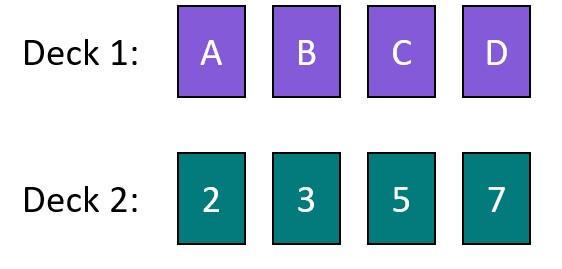
Q1.Here are two decks of cards.
A single card from Deck 1 and a single card from Deck 2 is drawn to make a pair.
There are possible outcomes for drawing one card from each deck.

Q2.Here are two decks of cards. A single card from Deck 1 and a single card from Deck 2 is drawn to make a pair.
What is the probability that this pair of cards contains an odd number?

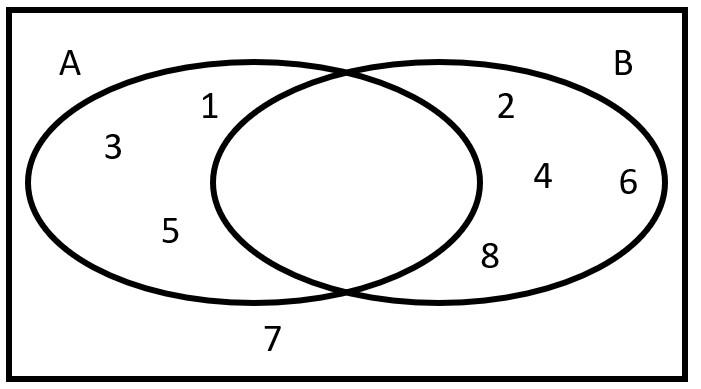
Q3.Each face on an 8-sided die has a unique integer from 1 to 8 written on it.
The Venn diagram shows Event A = {factors of 15} and Event B = {even numbers}.
Which of these statements are correct?

Q4.Sam plays a video game that can either be won or lost.
The probability that Sam wins the video game is 61%.
The probability that Sam loses the video game is %
Q5.This table shows the mutually exclusive and exhaustive set of outcomes, and the probability of each outcome, from spinning a spinner once.
Find the value of $$x$$.

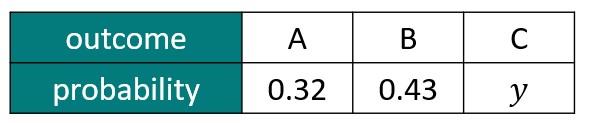
Q6.This table shows the set of outcomes and the probability of each outcome, from spinning a spinner once.
The spinner is spun 1000 times. How many times should you expect the spinner to land on C?

Assessment exit quiz
6 Questions
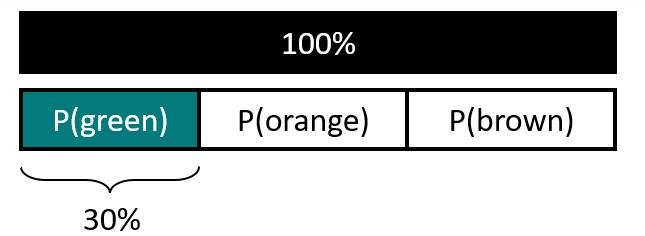
Q1.Lucas spins a spinner with colours: {green, orange, brown}.
P(green) = 30%.
P(orange) = P(brown).
P(brown) = %.

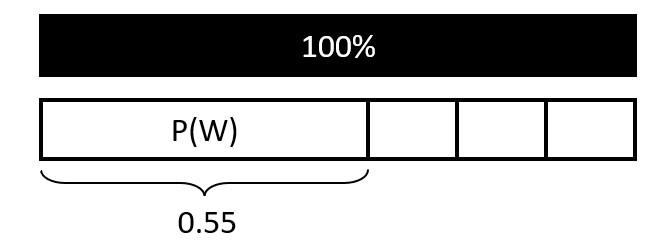
Q2.Izzy plays a game she can either win (W), lose (L), or draw (D)
P(W) = 0.55.
P(L) is twice as likely as P(D). P(D) = .

Q3.A game can either be won by Alex, Sam, or Jacob.
By constructing and solving an algebraic equation, find P(Sam wins).

Q4.A spinner with outcomes {A, B, C, D} is spun once.
P(A) = 0.12.
P(B) = $$x$$.
P(C) is twice as likely as P(B).
P(D) is equally likely as P(A or C).
Find an expression for P(D) in terms of $$x$$.
Q5.A bag of marbles only contains white (W), green (G), and cyan (C) marbles.
36% of the marbles are white.
P(G) : P(C) = 3 : 5.
P(C) = %.
Q6.A bag of sweets only contains four flavours. The table shows the frequency of each type of sweet in the bag.
P(cherry) = $$3\over10$$.
The number of apple sweets in the bag is .