Myths about teaching can hold you back
- Year 11•
- Foundation
Constructing a triangle given two side lengths and the angle between them using a compass
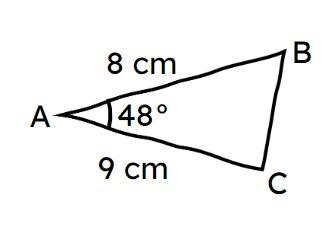
I can construct a triangle given two of the required side lengths and the size of the angle between them.
- Year 11•
- Foundation
Constructing a triangle given two side lengths and the angle between them using a compass
I can construct a triangle given two of the required side lengths and the size of the angle between them.
These resources were made for remote use during the pandemic, not classroom teaching.
Switch to our new teaching resources now - designed by teachers and leading subject experts, and tested in classrooms.
Lesson details
Key learning points
- The first side can be drawn accurately with a ruler
- The compass should be used to indicate potential positions for the remaining side
- A protractor should be used to accurately measure the desired angle
- The line to mark the required angle should be drawn to meet one of the potential positions for the remaining side
- All triangles with the same measurements are congruent
Keywords
Pair of compasses - A pair of compasses is a tool which can be used to draw circles and arcs. A pair of compasses is sometimes referred to just as a compass.
Congruent - If one shape can fit exactly on top of another using rotation, reflection or translation, then the shapes are congruent.
Common misconception
Some pupils may not recognise that they have constructed congruent triangles to one and another.
Use a piece of tracing paper to show that the triangles are congruent to each other.
To help you plan your year 11 maths lesson on: Constructing a triangle given two side lengths and the angle between them using a compass, download all teaching resources for free and adapt to suit your pupils' needs...
To help you plan your year 11 maths lesson on: Constructing a triangle given two side lengths and the angle between them using a compass, download all teaching resources for free and adapt to suit your pupils' needs.
The starter quiz will activate and check your pupils' prior knowledge, with versions available both with and without answers in PDF format.
We use learning cycles to break down learning into key concepts or ideas linked to the learning outcome. Each learning cycle features explanations with checks for understanding and practice tasks with feedback. All of this is found in our slide decks, ready for you to download and edit. The practice tasks are also available as printable worksheets and some lessons have additional materials with extra material you might need for teaching the lesson.
The assessment exit quiz will test your pupils' understanding of the key learning points.
Our video is a tool for planning, showing how other teachers might teach the lesson, offering helpful tips, modelled explanations and inspiration for your own delivery in the classroom. Plus, you can set it as homework or revision for pupils and keep their learning on track by sharing an online pupil version of this lesson.
Explore more key stage 4 maths lessons from the Loci and construction unit, dive into the full secondary maths curriculum, or learn more about lesson planning.
Equipment
Pair of compasses, ruler and protractor
Licence
Prior knowledge starter quiz
6 Questions
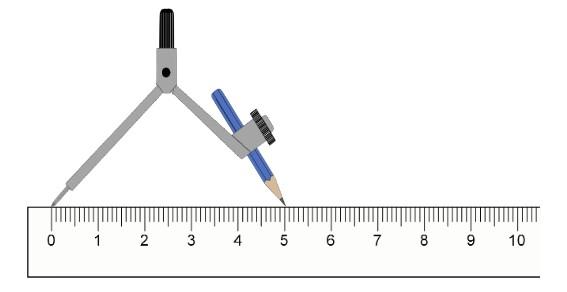
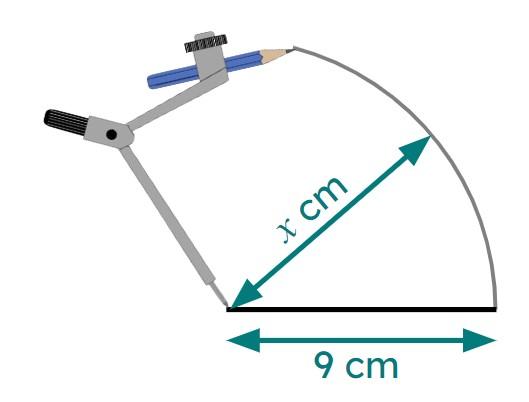
Q1.Andeep sets his compasses to the width shown in the diagram. Without changing the setting, Andeep draws a circle. The diameter of the circle is cm.

Q2.What equipment do you need in order to accurately construct a perpendicular bisector?
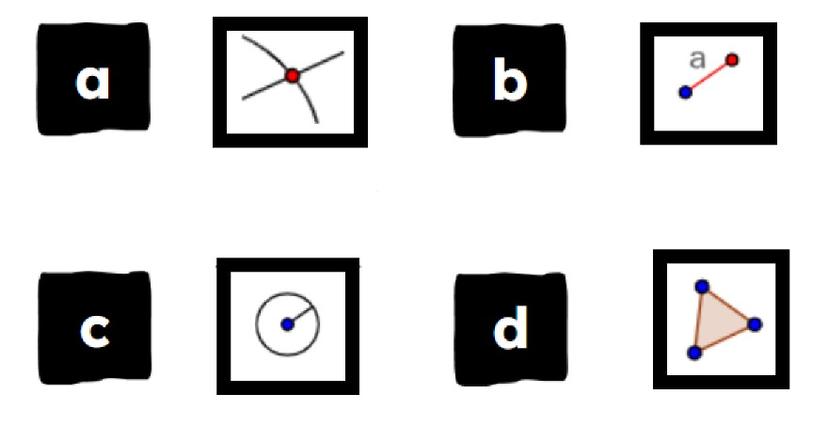
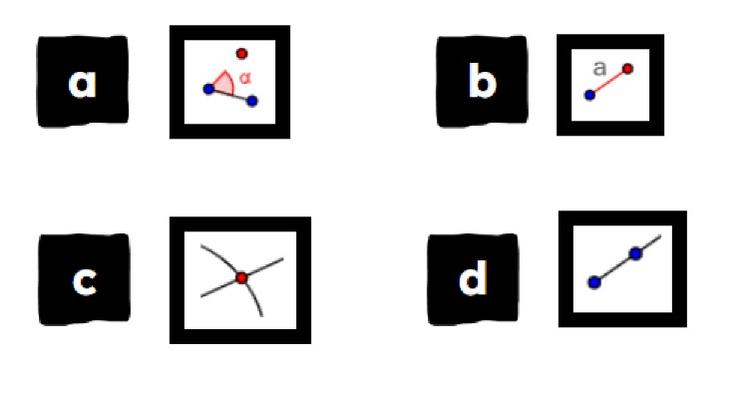
Q3.Sofia is using GeoGebra to accurately draw a triangle with side lengths 6 units, 8 units and 10 units. Which of these tools should Sofia use to find the points where her two circles intersect?

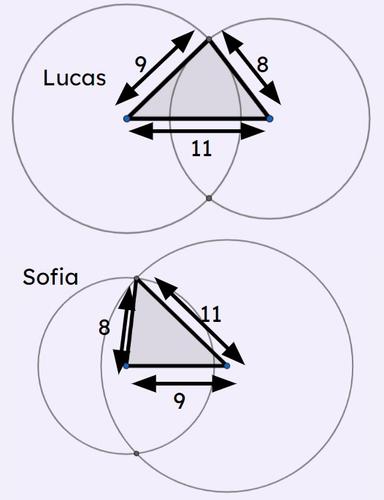
Q4.Lucas and Sofia both accurately construct triangles of sides 8 cm, 9 cm and 11 cm. Which statement is correct?

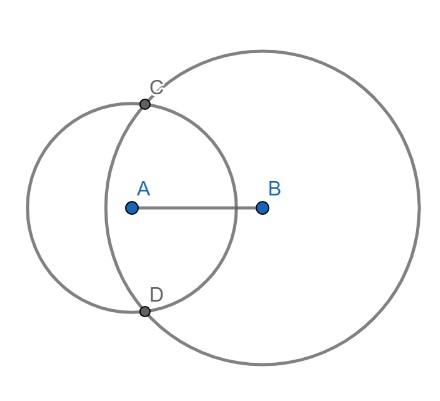
Q5.Here are two circles with centres A and B. The circles meet at C and D. The radius of the circles are 8.5 cm and 9.6 cm. The distance between their centres is 7.3 cm. Match each length to its value.

AB -
7.3 cm
CB -
9.6 cm
AD -
8.5 cm
Q6.Match each step to the correct instruction needed to construct a triangle ABC with sides 5 cm, 6 cm and 7 cm.
Step 1 -
Use a ruler to draw line of length 5 cm. Label line A and B
Step 2 -
Set compasses to 6 cm and needle of compasses on A.
Step 3 -
Draw a circle of radius 6 cm, centre A.
Step 4 -
Repeat last 2 steps using B and 7 cm.
Step 5 -
Label one of the points where the 2 circles intersect as C.
Step 6 -
Use a ruler to join both A and B to C.
Assessment exit quiz
6 Questions
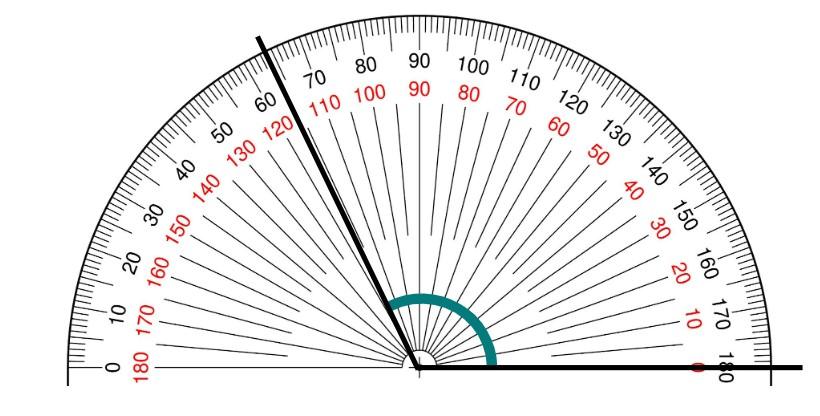
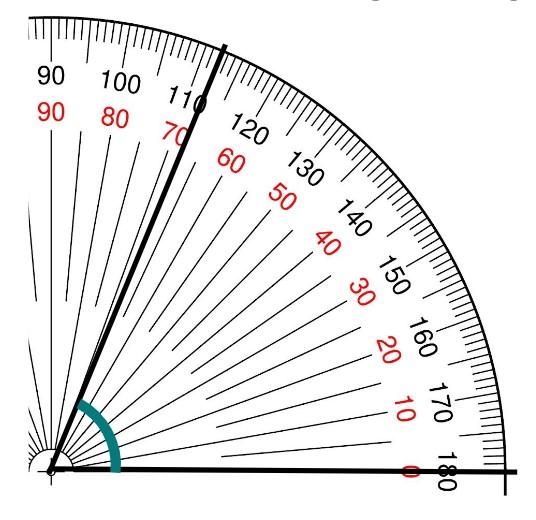
Q1.The diagram shows part of a protractor measuring an angle. What is the size of the angle?

Q2.The diagram shows a protractor measuring an angle. What is the size of the angle?

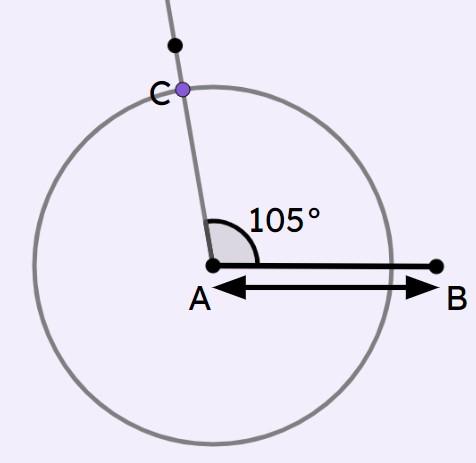
Q3.Jacob is using GeoGebra to accurately draw a triangle with side lengths 8 units, 9 units and an angle of size 67° between them. Which tool should Jacob use to construct the angle?

Q4.A pair of compasses is used to draw an arc. The value of $$x$$ is .

Q5.Jun draws a ray line and a circle with radius 5 units then marks their intersection with point C. Which line segment has a length of 5 units?

Q6.Starting with the first step, put these instructions in the correct order to construct triangle ABC.