Choose exam board for KS4 Computer Science (GCSE)
Choose exam board for KS4 English
Choose exam board for KS4 French
Choose exam board for KS4 Geography
Choose exam board for KS4 German
Choose exam board for KS4 History
Choose tier for KS4 Maths
Choose exam board for KS4 Music
Choose exam board for KS4 Physical education (GCSE)
Choose exam board for KS4 Religious education (GCSE)
Choose exam board for KS4 Spanish

      Problem solving with functions and proof
      Lesson details

      Learning outcome

      I can use my knowledge of functions and proof to solve problems.

      Key learning points

      1. In order to prove something, you may need to use any of your maths skills and knowledge.
      2. It is important to define any algebraic expressions at the start of a proof.
      3. This is so it is clear what cases you are proving.

      Keywords

      • Function - A function is a mathematical relationship that uniquely maps values of one set to the values of another set.

      • Expression - An expression contains one or more terms, where each term is separated by an operator.

      Common misconception

      Pupils may struggle with showing why the false proofs are false.

      Checking what each variable represents will help pupils see why each of the 'proofs' do not work.

      Teacher tip

      If pupils are interested by the triangle problem, ask them to research the dissection fallacy to see more examples.

      Licence

      This content is © Oak National Academy Limited (2025), licensed on Open Government Licence version 3.0
      except where otherwise stated. See Oak's terms & conditions
      (Collection 2).

      Lesson video

      Loading...

      Prior knowledge starter quiz

      6 Questions

      Q1.
      $${\text{fg}}(x)$$, $${\text{gh}}(x)$$, and $${\text{fgh}}(x)$$ are all examples of __________.

      equations
      quadratic equations
      multiple functions
      Correct answer: composite functions

      Q2.
      If $${\text{f}}(x)=5x−1$$ and $${\text{g}}(x)=2x+8$$ which is an expression for $${\text{fg}}(x)$$?

      $$7x+7$$
      $$10x+40$$
      Correct answer: $$10x+39$$
      $$10x+8$$
      $$10x+6$$

      Q3.
      If $${\text{f}}(x)=5x−1$$ then $$7{\text{f}}(8)=$$ .

      Correct Answer: 273, 7f(8)=273

      Q4.
      If $${\text{f}}(x)=x+5$$ and $${\text{g}}(x)=x^2+4x-7$$ which is an expression for $${\text{gf}}(x)$$?

      $$5(x+5)-7$$
      $$(x+5)^2+4x-7$$
      Correct answer: $$x^2+14x+38$$
      $$x^2+4x+3$$
      $$x^2+10x+25$$

      Q5.
      $$x^2=100$$ has how many solutions?

      $$0$$
      $$1$$
      Correct answer: $$2$$
      $$3$$

      Q6.
      Which of the below are accurate manipulations of the equation $$2x=y+3$$?

      $$3=y-2x$$
      Correct answer: $$2xy=y^2+3y$$
      $$2xy=y^2+3$$
      Correct answer: $$2x(y-3)=(y+3)(y-3)$$
      Correct answer: $$2xy-6x=y^2-9$$

      6 Questions

      Q1.
      If $${\text{f}}(x)=5x$$ and $${\text{g}}(x)=7-x$$ then $$5(7-x)$$ is __________ for $${\text{fg}}(x)$$.

      Correct answer: an expression
      an equation
      a formula

      Q2.
      If $${\text{f}}(x)=5x-18$$ which is an expression for $${\text{f}}(x+3)$$?

      $$5(x+3)$$
      $$5x-15$$
      Correct answer: $$5x-3$$
      $$5x+3$$

      Q3.
      If $${\text{f}}(x)=5x-18$$ and $${\text{g}}(x)=-2x$$ which is an expression for $$2{\text{gf}}(5x)$$?

      $$72-20x$$
      Correct answer: $$72-100x$$
      $$100x+72$$
      $$100x-72$$
      $$-2(5x-18)$$

      Q4.
      $${\text{f}}(x)=k(x-3)$$ If $${\text{f}}(-1)=-24$$ find $$k$$ where $$k$$ is a constant.

      $$k=-3$$
      $$k=1$$
      $$k=1$$
      $$k=3$$
      Correct answer: $$k=6$$

      Q5.
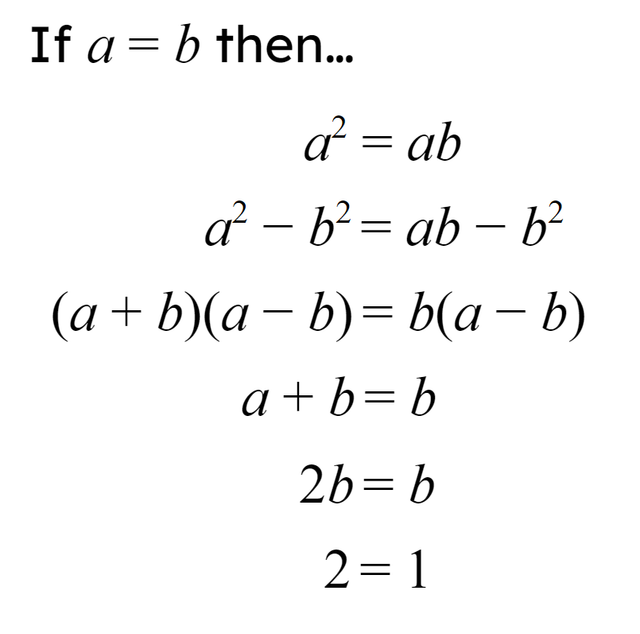
      Where is the error in this proof?

      An image in a quiz
      $$a^2-b^2=ab-b^2$$ as you can’t subtract a square from both sides.
      $$(a+b)(a-b)=b(a-b)$$ because $$a-b=0$$ and you can’t multiply by zero.
      Correct answer: From $$(a+b)(a-b)=b(a-b)$$ to $$a+b=b$$ because dividing by zero is undefined.
      $$a^2=a\times{a}$$, not $$a^2=a\times{b}$$

      Q6.
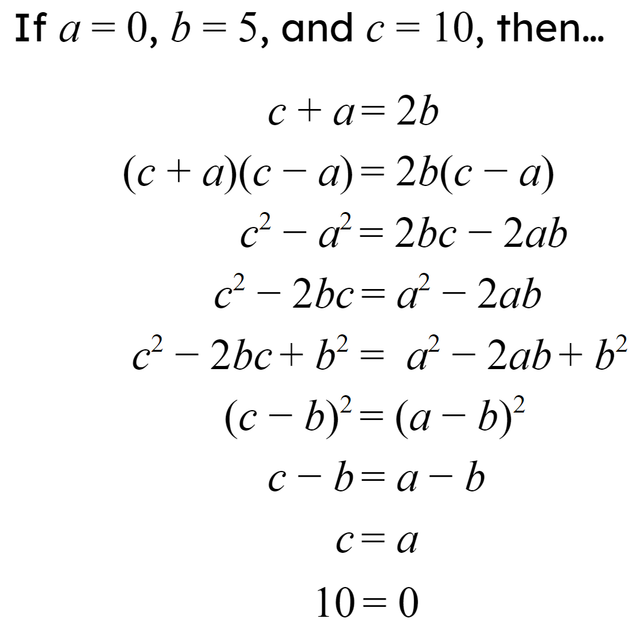
      Where is the error in this proof?

      An image in a quiz
      $$(c+a)(c-a)$$ does not expand to $$c^2-a^2$$
      $$c^2-2bc=a^2-2ab$$ is not an accurate rearrangement of $$c^2-a^2=2bc-2ab$$
      $$c^2-2bc+b^2$$ does not factorise to $$(c-b)^2$$
      Correct answer: From $$(c-b)^2=(a-b)^2$$ to $$c-b=a-b$$ because it assumes the positive root.

      To help you plan your 11 maths lesson on: Problem solving with functions and proof, download all teaching resources for free and adapt to suit your pupils' needs...