Choose exam board for KS4 Computer Science (GCSE)
Choose exam board for KS4 English
Choose exam board for KS4 French
Choose exam board for KS4 Geography
Choose exam board for KS4 German
Choose exam board for KS4 History
Choose tier for KS4 Maths
Choose exam board for KS4 Music
Choose exam board for KS4 Physical education (GCSE)
Choose exam board for KS4 Religious education (GCSE)
Choose exam board for KS4 Spanish

      Problem solving with surds
      Lesson details

      Learning outcome

      I can use my knowledge of surds to solve problems.

      Key learning points

      1. Surds are a useful format to leave an answer as.
      2. Surds can help with the accuracy of future calculations.
      3. Surds can be seen in many areas of maths.

      Keywords

      • Surd - A surd is an irrational number expressed as the root of a rational number.

      Common misconception

      Pupils may be uncertain how to solve problems with surds.

      Many problems can be solved through reasoning what you know, such as fully simplifying a surd.

      Teacher tip

      This lesson brings together previous learning from other units and asks pupils to use their new knowledge of surds within their previous learning. Pythagoras' theorem is a useful context as it prepares pupils for 3D problems.

      Licence

      This content is © Oak National Academy Limited (2025), licensed on Open Government Licence version 3.0
      except where otherwise stated. See Oak's terms & conditions
      (Collection 2).

      Lesson video

      Loading...

      Prior knowledge starter quiz

      6 Questions

      Q1.
      Order the fractions from smallest to largest.

      1 - $$2 \over 7$$
      2 - $$1 \over 3$$
      3 - $$4 \over 9$$
      4 - $$3 \over 5$$
      5 - $$5 \over 8$$

      Q2.
      What is the value of $$a + b - c$$ when $$a$$ = 7, $$b$$ = 21 and $$c$$ = 2.4

      Correct Answer: 25.6

      Q3.
      In order to rationalise $$(2 - \sqrt {3})$$ you would multiply by:

      Correct answer: $$(2 + \sqrt {3})$$
      $$(-2 + \sqrt {3})$$
      $$(3 - \sqrt {2})$$
      $$(3 + \sqrt {2})$$

      Q4.
      True or false? Pythagoras' theorem can only be used to find the length of the hypotenuse.

      True
      Correct answer: False

      Q5.
      When is a surd in it's simplest form?

      Correct answer: when the radicand is an integer and has no perfect square factors greater than 1
      when the radicand is an integer
      when the radicand is a perfect square

      Q6.
      Solve $$x\sqrt {180} - 30 = x\sqrt {80}$$ and write your answer in the form $$a\sqrt {b}$$. State the value of $$b$$.

      Correct Answer: 5

      6 Questions

      Q1.
      True or false? Surds are a way of giving an answer exactly.

      Correct answer: True
      False

      Q2.
      Arrange the surds from smallest to largest.

      1 - $$1 \over \sqrt {5}$$
      2 - $$2 \over \sqrt {7}$$
      3 - $$\sqrt {3}$$
      4 - $$\sqrt {7}$$

      Q3.
      The perimeter of a rectangle is $$12 + 8\sqrt {2}$$. One of the lengths is $$6 + \sqrt {2}$$. Find the area.

      $$10\sqrt {2}$$
      $$20 + 60\sqrt {2}$$
      $$3\sqrt {2}$$
      Correct answer: $$6 + 18\sqrt {2}$$

      Q4.
      The length of the line between (3,8) and (7,13) can be written in the form $$\sqrt {a}$$. What is the value of $$a$$?

      Correct Answer: 41

      Q5.
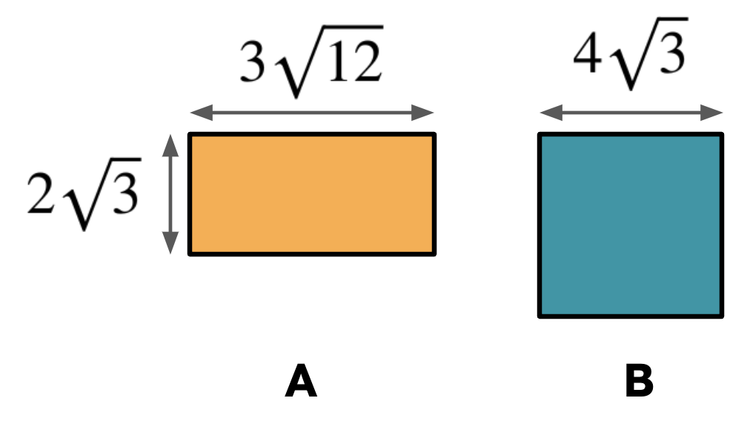
      Which of these shapes has a greater area?

      An image in a quiz
      Shape A
      Correct answer: Shape B
      They both have the same area

      Q6.
      Which of these shapes has a greater perimeter?

      An image in a quiz
      Shape A
      Shape B
      Correct answer: They both have an equal perimeter

      To help you plan your 10 maths lesson on: Problem solving with surds, download all teaching resources for free and adapt to suit your pupils' needs...