


Hearing sound


Lesson details
Learning outcome
I can explain how sound waves cause sounds to be heard, and describe the range and limits of human hearing.
Key learning points
- Sound waves cause our eardrums, tiny bones within our ears, and the cochlea to vibrate.
- Specialised cells in the cochlea sense vibrations and cause electrical signals to be sent to the brain along a nerve.
- The brain creates the sensation of hearing a sound when it receives signals from the ear through a nerve.
- Human ears can detect sound waves with frequencies between 20 Hz and 20 kHz, being most sensitive to 2–5 kHz waves.
- Sound waves below 20 Hz are called infrasound; above 20 kHz, ultrasound. They are not detected by human ears.
Keywords
Sound wave - a ‘pulse’ that travels through a material, caused by forward and backward vibrations of particles
Eardrum - a membrane within the ear that is caused to vibrate by incoming sound waves
Sound - a sensation of hearing something
Amplitude - a measure of how far particles vibrate in a sound wave
Frequency - the number of vibrations each second
Common misconception
Sound waves are the same thing as the sound heard. Sound waves somehow 'have' sound.
Distinguish between the sound heard and the sound wave. The brain creates the sensation of hearing a sound when it receives nerve signals from the ear. The sound (heard) does not exist until created by the brain. Sound waves themselves have no sound.
Teacher tip
Use a signal generator and a loudspeaker to test frequencies that pupils can detect by increasing volume from zero to maximum slowly and asking pupils to raise their hands (eyes closed) – telling them you will sometimes play no sound as a check.

Equipment
signal generator, speaker and connecting wires

Content guidance
Risk assessment required - equipment

Supervision
Adult supervision required

Licence

Lesson video
Loading...
Prior knowledge starter quiz
6 Questions
Q1.Which of the following describes the particles in air when there is no sound wave passing through?
Q2.What happens to the particles in air when a sound wave passes through?
Q3.Which of the following is the most accurate description of a sound wave?
Q4.Which of the following words can be used to describe a region of a sound wave in which the particles are closer together than normal?
Q5.A very loud sound is made, and the sound wave hits a small feather which is hanging from a thread. What happens to the feather?
Q6.Which of the following statements about sound waves are correct?
Assessment exit quiz
6 Questions
Q1.Match the following words with the correct definitions.

Q2.The diagram shows a human ear. Match each label with the name of the part.
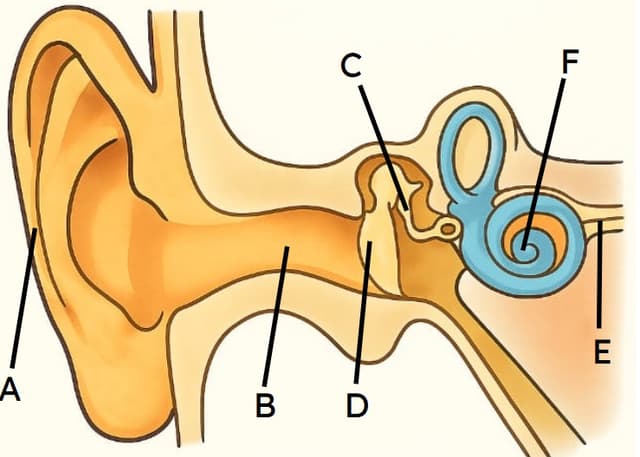
Q3.Which of the following statements about a sound wave is correct?
Q4.Match each of the following types of wave with the correct frequencies.
Q5.Which of the following sound wave frequencies is the human ear most sensitive to?
Q6.Starting with vibrating air particles in the ear canal, sort the following statements to describe the steps between a sound wave reaching a person’s ear and the person hearing the sound.
To help you plan your 9 science lesson on: Hearing sound, download all teaching resources for free and adapt to suit your pupils' needs...
To help you plan your 9 science lesson on: Hearing sound, download all teaching resources for free and adapt to suit your pupils' needs.
The starter quiz will activate and check your pupils' prior knowledge, with versions available both with and without answers in PDF format.
We use learning cycles to break down learning into key concepts or ideas linked to the learning outcome. Each learning cycle features explanations with checks for understanding and practice tasks with feedback. All of this is found in our slide decks, ready for you to download and edit. The practice tasks are also available as printable worksheets and some lessons have additional materials with extra material you might need for teaching the lesson.
The assessment exit quiz will test your pupils' understanding of the key learning points.
Our video is a tool for planning, showing how other teachers might teach the lesson, offering helpful tips, modelled explanations and inspiration for your own delivery in the classroom. Plus, you can set it as homework or revision for pupils and keep their learning on track by sharing an online pupil version of this lesson.
Explore more key stage 3 science lessons from the Waves unit, dive into the full secondary science curriculum, or learn more about lesson planning.