


New
New
Lesson 5 of 10
Balanced and unbalanced forces
I can use the idea of resultant force to explain whether a change of speed occurs or not.

Lesson 5 of 10
New
New
Balanced and unbalanced forces
I can use the idea of resultant force to explain whether a change of speed occurs or not.
Lesson details
Key learning points
- Two forces of equal size, acting in opposite directions on an object, are balanced.
- The resultant force is the sum of the forces acting on the object, taking into account their direction.
- When forces are balanced there is no resultant force and no change in speed.
- When there are two forces acting in opposite directions, the resultant force acts in the direction of the bigger force.
- The greater the resultant force on a given object, the greater or faster the change in speed.
Keywords
Balanced forces - Two forces of equal size acting in opposite directions on an object, are balanced. They fully cancel each other out so no change is caused.
Unbalanced forces - Unbalanced forces do not fully cancel out.
Resultant force - The ‘force left over’ is called the resultant force. Resultant forces cause changes in speed.
Common misconception
The direction of the (resultant) force shows the direction of motion.
The direction of the resultant force shows the direction of the change (not the direction of motion). Forces make things change.
Another prevalent misconception is "if there is no (resultant) force, there can be no motion". Provide examples of balanced forces acting on moving objects and ask what force is left over to change the speed.

Teacher tip

Licence
This content is © Oak National Academy Limited (2026), licensed on Open Government Licence version 3.0 except where otherwise stated. See Oak's terms & conditions (Collection 2).
Lesson video
Loading...
Prior knowledge starter quiz
Download quiz pdf
6 Questions
Q1.What do forces cause?
What do forces cause?

motion
stillness
Q2.Forces make things change. A larger force will cause a bigger or __________ change.
Forces make things change. A larger force will cause a bigger or __________ change.
smaller
slower
Q3.Which option is the best description of what it means when two things are balanced?
Which option is the best description of what it means when two things are balanced?
Something is bigger on one side than the other.
Two things acting in different directions are adding up to have a bigger effect.
Q4.A person walks 9 metres straight forwards, then 4 metres straight backwards. The result of doing this is they are metres from where they started.
A person walks 9 metres straight forwards, then 4 metres straight backwards. The result of doing this is they are metres from where they started.
Q5.Forces can change an object's , direction or shape.
Forces can change an object's , direction or shape.
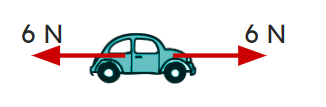
Q6.Are the forces on this car balanced or unbalanced?
Are the forces on this car balanced or unbalanced?
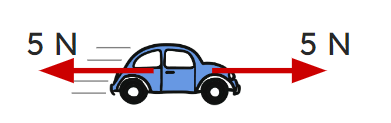
unbalanced
there is not enough information to decide
Assessment exit quiz
Download quiz pdf
6 Questions
Q1.Which image shows balanced forces?
Which image shows balanced forces?
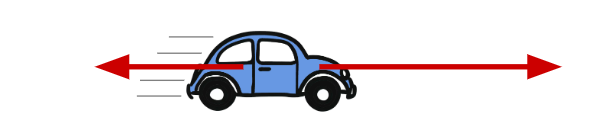
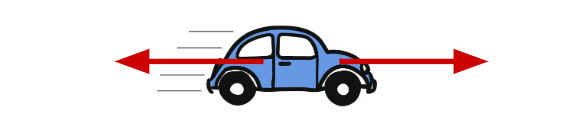


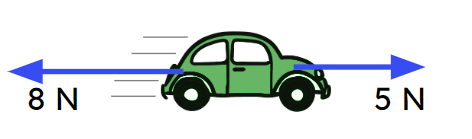
Q2.The resultant force on this car is N.
The resultant force on this car is N.
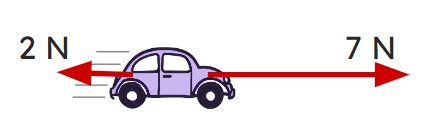
Q3.Which pictures show a resultant force of 12 N? Tick as many as you think.
Which pictures show a resultant force of 12 N? Tick as many as you think.
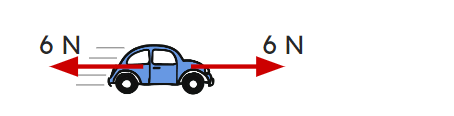
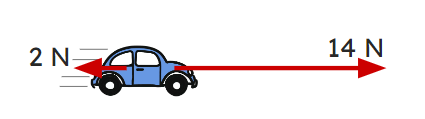
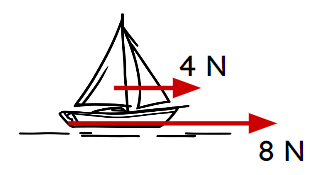
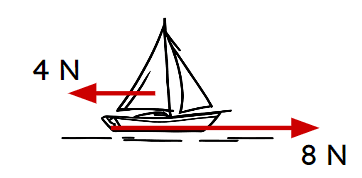
Q4.Which would cause an object to change speed?
Which would cause an object to change speed?
If the forces are balanced.
If there is no resultant force.
Q5.The diagram only shows the forces acting on this car, not whether it is moving or not. Which of the following could be happening to this car?
The diagram only shows the forces acting on this car, not whether it is moving or not. Which of the following could be happening to this car?
With these forces acting, the car could be moving forwards and getting faster.
With these forces acting, the car could be moving but will now immediately stop.
Q6.This car is moving forwards. What happens next to this car, with these forces acting?
This car is moving forwards. What happens next to this car, with these forces acting?
It keeps moving forwards at steady speed.
It keeps moving forwards but speeds up.
It immediately starts moving backwards at steady speed.
It immediately starts moving backwards and speeding up in that direction.