




Lesson details
Key learning points
- There are key differences between frequency trees and probability trees
- Frequency trees are constructed using frequencies
- Frequency trees display information on how often an outcome happened within a set number of trials
Keywords
Frequency - The frequency is the number of times an event occurs; or the number of individuals (people, animals etc.) with some specific property.
Tree diagram - Tree diagrams are a representation used to model statistical/probability questions. Branches represent different possible events or outcomes.
Probability - The probability that an event will occur is the proportion of times the event is expected to happen in a suitably large experiment.
Common misconception
Pupils may be tempted to always use the total frequency from a tree as the denominator of any fraction.
The denominator of the fraction should be the total frequency of the group that is being selected from. This could be the total population or it could be a subgroup of the population.


Licence
Lesson video
Loading...
Prior knowledge starter quiz
6 Questions
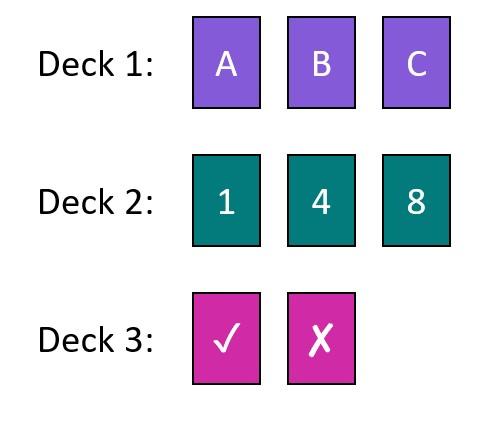
Q1.Here are three decks of cards.
A single card from each of Deck 1, Deck 2, and Deck 3 is drawn to make a trio.
What is the probability that this trio of cards contains an even number?

Q2.Sam plays a video game that can either be won or lost.
The probability that Sam wins the video game is $$8\over15$$.
What is the probability that Sam loses the video game?
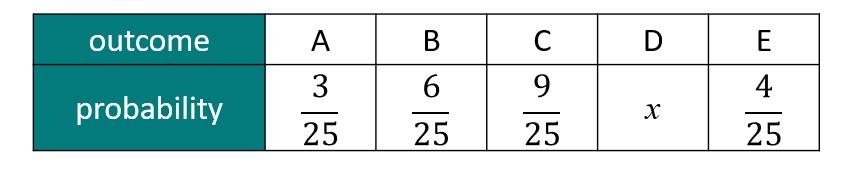
Q3.This table shows the mutually exclusive and exhaustive set of outcomes, and the probability of each outcome, from spinning a spinner once.
Find the value of $$x$$.
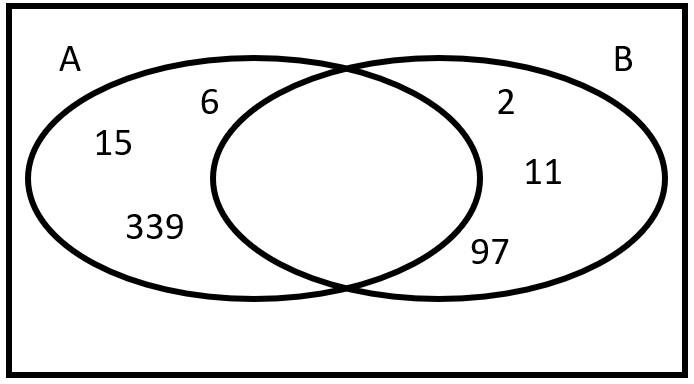
Q4.Each card in a deck of 7 cards has a unique integer on it. The Venn diagram shows events A = {multiples of 3} & B = {prime numbers}.
A and B are not mutually exclusive. Find the number on the 7th card
Q5.A game can be won by either Alex, Sam, or Jacob.
By constructing and solving an algebraic equation, find P(Sam wins).

Q6.A spinner with outcomes {A, B, C, D} is spun once.
P(A) = 0.15.
P(B) = $$x$$.
P(C) is three times as likely as P(B).
P(D) is equally likely as P(A or C).
P(B) = . Give your answer as a decimal.
Assessment exit quiz
6 Questions
Q1.1000 people were surveyed to see if they either commute to work, or work from home, and whether they use a computer or not. How many people work from home but don’t use a computer?
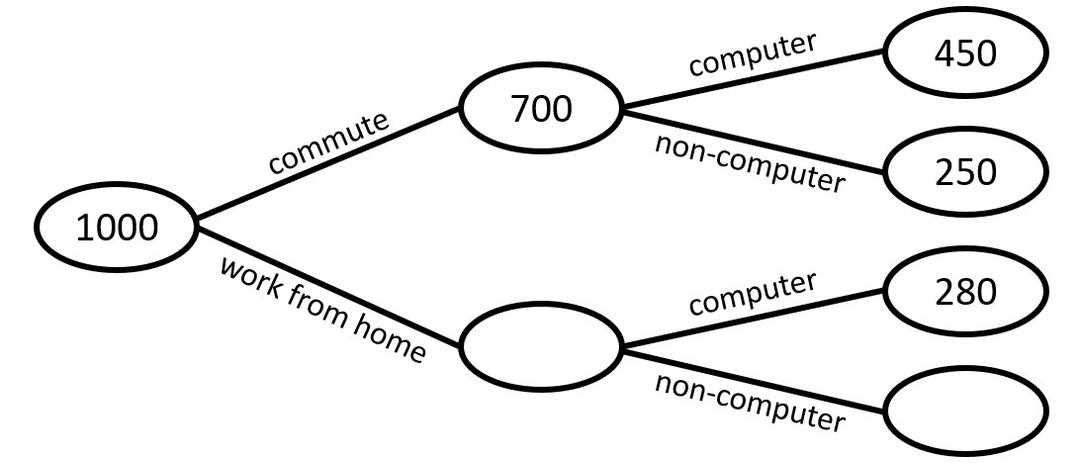
Q2.1000 people were surveyed to see if they either commute to work, or work from home, and whether they use a computer or not.
What fraction of people who work from home use a computer?
Q3.1000 people were surveyed to see if they either commute to work, or work from home, and whether they use a computer or not.
What fraction of people who use a computer work from home?
Q4.Match each frequency from the frequency tree to its value.
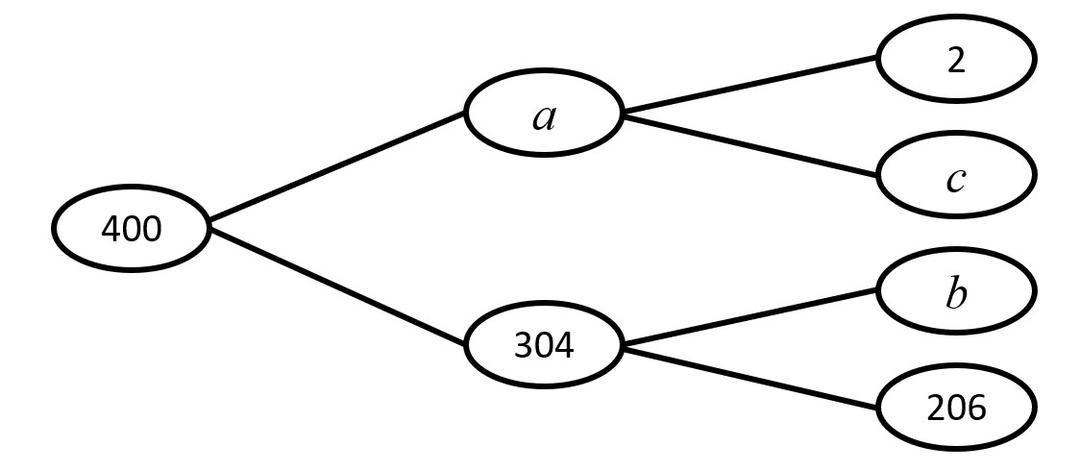
$$a$$ -
96
$$b$$ -
98
$$c$$ -
94
total frequency -
400
Q5.Of the 180 people who are day shift workers, 30 are security guards.
There are a total of 70 security guards. Match each frequency from the frequency tree to its value.
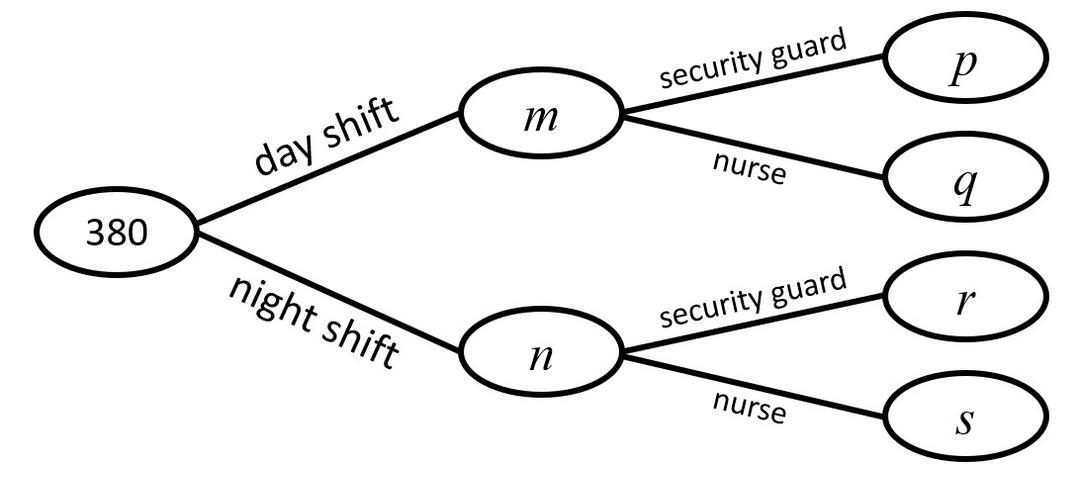
$$n$$ -
200
$$p$$ -
30
$$q$$ -
150
$$r$$ -
40
$$s$$ -
160
Q6.Jun and Izzy raised money for charity by selling ice cream. Izzy sold 60% of the ice cream, whilst Jun sold the rest.
Match each frequency from the frequency tree to its value.
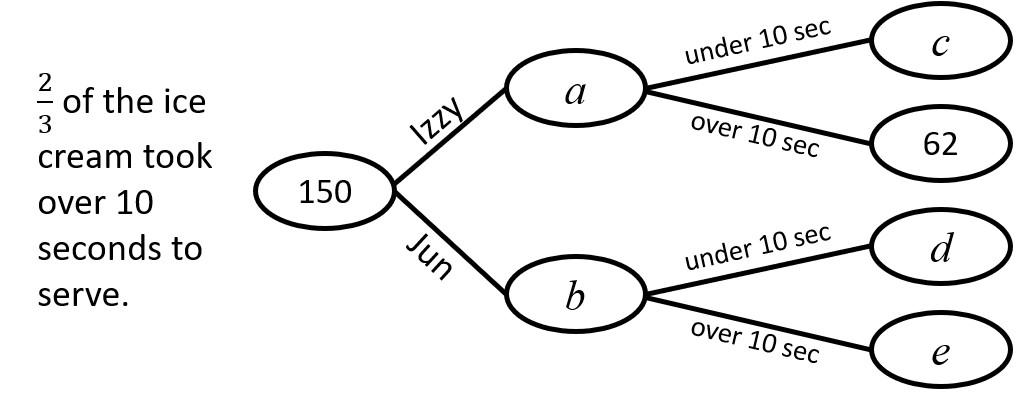
$$a$$ -
90
$$b$$ -
60
$$c$$ -
28
$$d$$ -
22
$$e$$ -
38