Generating a sequence using a position-to-term rule
I can appreciate that a sequence can be generated and described by a position-to-term rule.

Generating a sequence using a position-to-term rule
I can appreciate that a sequence can be generated and described by a position-to-term rule.
Lesson details
Key learning points
- The position of a term in the sequence is its term number.
- The general term can be used to identify a specific term.
- The general term can be used to generate a sequence .
- The general term can be used to generate any number in the sequence.
- The general term can be used to describe a sequence.
Keywords
Position-to-term - A position-to-term rule describes how to generate the term from the term number.
Common misconception
The position-to-term rule is the initial term add the common difference.
Once pupils have found the additive pattern get them to write each term as a value add the difference.


Licence
Lesson video
Loading...
Prior knowledge starter quiz
6 Questions
Q1.A term-to term rule describes how to calculate the next term from....

Q2.True or false. In the sequence 0, 1, 2, 3, 4, ... the 2nd term is 3.
Q3.If the 7 times table start with $$1\times 7 = 7$$ what is the 100th number in the 7 times table?
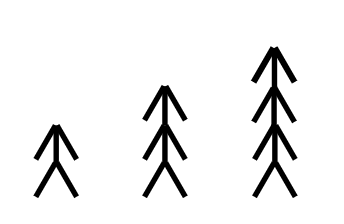
Q4.Here are the first 3 terms in a pictorial sequence. Which of these rules could refer to the number of lines in each term?
Q5.Which of these is an advantage for using a term-to-term rule
Q6.Match the sequences with the term-to-term rules.
-2, -6, -18, -54, ... -
multiply the previous term by 3
-2, -6, -10, -14, ... -
add $$-4$$ to the previous term
-2, -6, -14, -30, ... -
multiply the previous term by 2 then subtract 2
-2, -6, -12, -20, ... -
add $$-4$$, add $$-6$$, add $$-8$$, ...
-2, -6, -14, -26, ... -
add $$-4$$, add $$-8$$, add $$-12$$, ...
-2, -6, -8, -8, ... -
add $$-4$$, add $$-2$$, add 0, ...
Assessment exit quiz
6 Questions
Q1.Match up the keywords to their definitions
term -
each value or pattern in a sequence
term-to-term rule -
describes how to get from one term to the next
position-to-term rule -
describes how to calculate the term from the term number
sequence -
a succession of values or patterns usually following a rule.
Q2.Using the table shown, match the notation to the term.
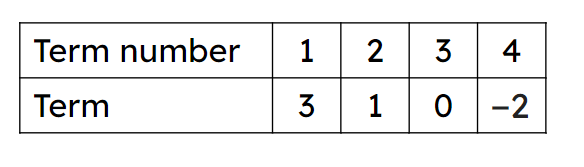
$$T_1$$ -
3
$$T_2$$ -
1
$$T_3$$ -
0
$$T_4$$ -
-2
Q3.The position-to-term rule for a sequence is 'multiply the term number by 5 then subtract 10'. What is the 20th term in this sequence?
Q4.Which of these is a position-to-term rule for the number of dots in each pattern of this sequence?

Q5.Which of these is a position-to-term rule for the sequence 12, 22, 32, 42, 52, ....
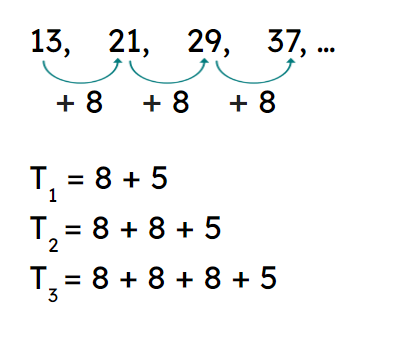
Q6.Work out the 100th term in the constant additive sequence which starts: 13, 21, 29, 37, ... The first few lines of working are shown.