Missing angles
I can solve problems that require a combination of angles facts to identify values of missing angles, providing explanations of reasoning and logic used.

Missing angles
I can solve problems that require a combination of angles facts to identify values of missing angles, providing explanations of reasoning and logic used.
Lesson details
Key learning points
- Missing angles can be found using parallel lines.
- Missing angles can be found using facts about triangles.
- Missing angles can be found in polygons using knowledge of exterior and interior angles.
- The relationship between interior and exterior angles can be used to find missing angles.
- Missing angles can be found by using a combination of all known facts.
Keywords
Corresponding angles - A pair of angles at different vertices on the same side of a transversal in equivalent positions.
Alternate angles - A pair of angles both between or both outside two line segments that are on opposite sides of the transversal that cuts them.
Co-interior angles - Co-interior angles are on the same side of the transversal line and in between the two other lines.
Interior angles - An interior angle is an angle formed inside a polygon by two of its edges.
Exterior angle - An exterior angle is an angle on the outside of a polygon between an extension of an edge and its adjacent edge.
Common misconception
Pupils may work out missing angles without writing out their justifications.
Each time a number which is not on the original diagram is used or found, an explanation should be given for where it has come from.


Licence
Lesson video
Loading...
Prior knowledge starter quiz
6 Questions
Q1.In which cases are the angles always equal to each other?
Q2.Co-interior angles on parallel lines sum to °.
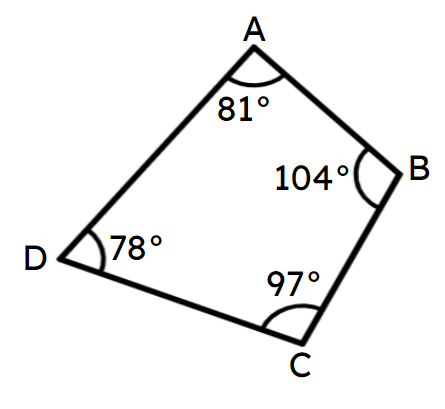
Q3.Which angle is 97°?
Q4.Match each shape with the sum of its interior angles.

1440°
900°
720°
1260°
1080°
540°
Q5.∠ACE = ∠FEC because .
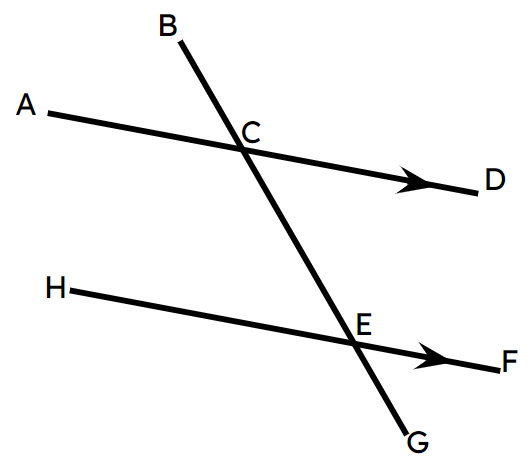
Q6.Which angle is co-interior to ∠ACE?
Assessment exit quiz
6 Questions
Q1.∠ABG = 112°. Based on this information, which justification could be used to explain why ∠CBG = 68°?
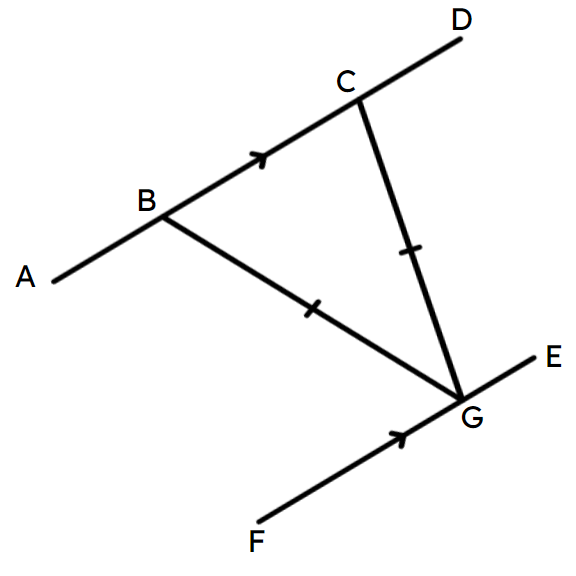
Q2.Which justification could be used to explain why ∠CGF = ∠GCD?
Q3.Match each statement with its justification.
alternate angles in parallel lines are equal
corresponding angles in parallel lines are equal
vertically opposite angles are equal
adjacent angles on a straight line sum to 180°
co-interior angles in parallel lines sum to sum to 180°
Q4.Given ∠EGC = 82°, then ∠CGB = °.
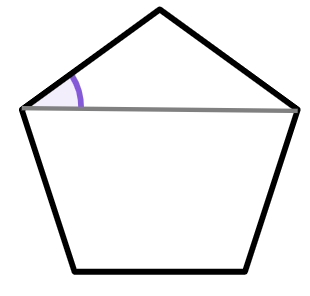
Q5.The pentagon in the image is regular. The size of the shaded angle is °.
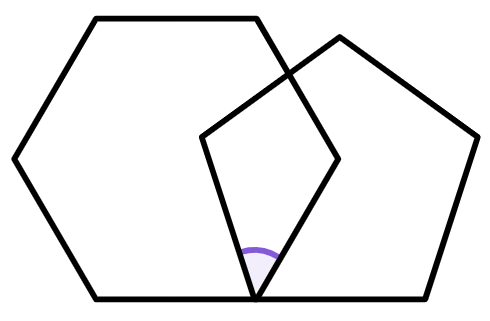
Q6.The image shows a regular pentagon and a regular hexagon. The size of the shaded angle is °.