


Problem solving with further surface area and volume
I can use my enhanced knowledge of surface area and volume to solve problems.

Problem solving with further surface area and volume
I can use my enhanced knowledge of surface area and volume to solve problems.
Lesson details
Key learning points
- The surface area of many solids can be calculated by a known method.
- The volume of many solids can be calculated by a known method.
- Writing an algebraic statement about surface area/volume can be done from a diagram.
Keywords
Prism - A prism is a polyhedron with a base that is a polygon and a parallel opposite face that is identical. The corresponding edges of the two polygons are joined by parallelograms.
Cylinder - A cylinder is a 3D shape with a base that is a circle and a parallel opposite face that is identical. A cross-section of a cylinder made parallel to the base will be congruent to the base.
Surface area - The surface area is the total area of all the surfaces of a closed 3D shape. The surfaces include all faces and any curved surfaces.
Volume - Volume is the amount of space occupied by a closed 3D shape.
Common misconception
Pupils may confuse whether they need to calculate the volume or surface area of a 3D shape, if not told specifically to do so in a problem.
Use the context to decide which calculation is needed. If the question refers to packaging or painting the shape, a surface area calculation is needed.


Licence
Lesson video
Loading...
Prior knowledge starter quiz
6 Questions
Q1.The amount of space occupied by a closed 3D shape is called the __________ of the shape.

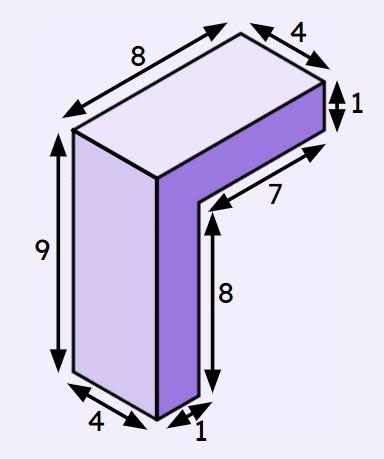
Q2.The diagram shows a composite solid constructed from two congruent cuboids. All lengths given are in centimetres. Which of these calculations give the total volume of the solid?
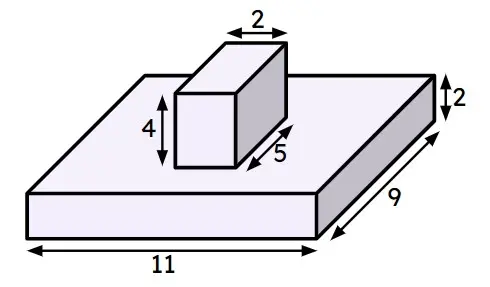
Q3.This composite solid is constructed from two cuboids. All lengths given are in millimetres. The total volume of the solid is mm³.
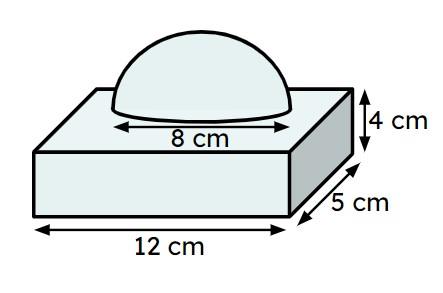
Q4.This composite solid is constructed by placing a hemisphere with diameter 8 cm on top of a cuboid. Find the volume of the solid. Give your answer to the nearest cubic centimetre.
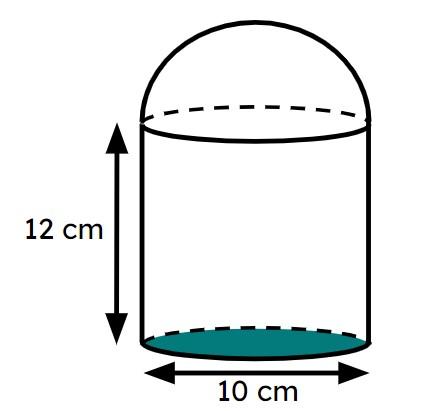
Q5.This composite solid is constructed with a cylinder and a hemisphere. Each have a diameter of 10 cm. The volume of the solid is cm³ (correct to 4 significant figures).
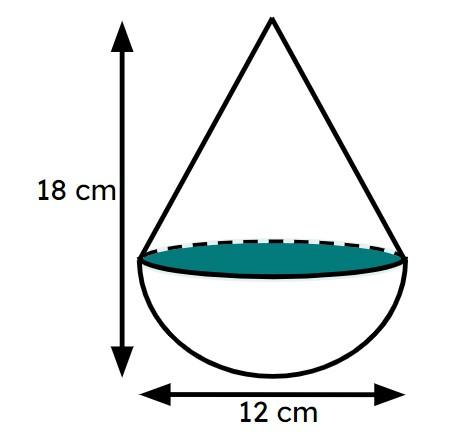
Q6.This composite solid is constructed with a cone and a hemisphere. The volume of the solid, in terms of 𝜋, is 𝜋 cm³.
Assessment exit quiz
6 Questions
Q1.Name a 3D shape that has exactly one curved surface and no flat surfaces.
Q2.Starting with the cuboid with the smallest volume, put these cuboids into order of size according to their volumes.
Q3.Starting with the cuboid with the smallest surface area, put these cuboids into order of size according to their surface areas.
Q4.In this cuboid, the depth is $$k$$ cm. The lengths of the depth to the height to the width of the cuboid can be written in the ratio 1 : 2 : 4. Select an expression for the volume of the cuboid.
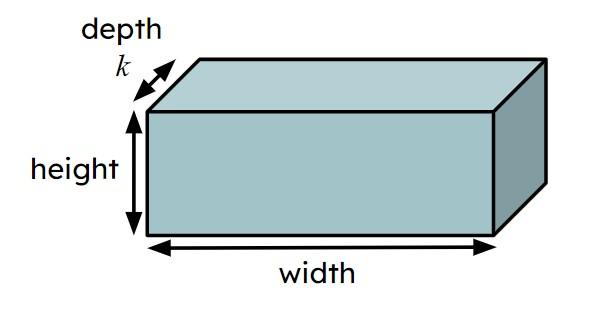
Q5.In this cuboid, the depth is $$k$$ cm. The lengths of the depth to the height to the width of the cuboid can be written in the ratio 1 : 2 : 4. Find an expression for the surface area of the cuboid.
Q6.A drink can contains 33 cl of sparkling water. The can has a radius of 4 cm. The height of the can is cm to 1 d.p. (assume the can is a perfect cylinder and ignore the thickness of the metal).