Refracting light
I can describe and draw how a ray of light refracts when it moves from one medium to another, and explain how refraction can cause virtual images.

Refracting light
I can describe and draw how a ray of light refracts when it moves from one medium to another, and explain how refraction can cause virtual images.
Lesson details
Key learning points
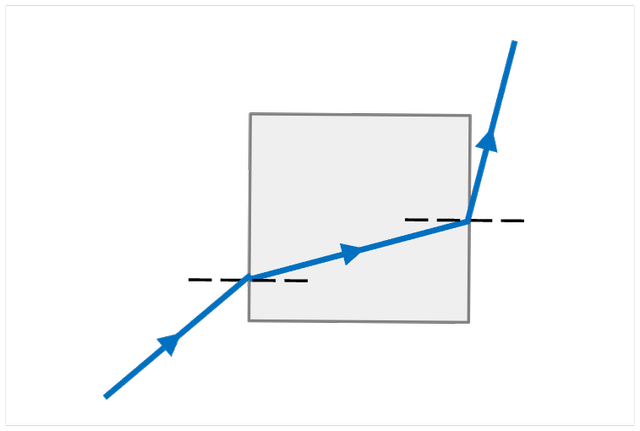
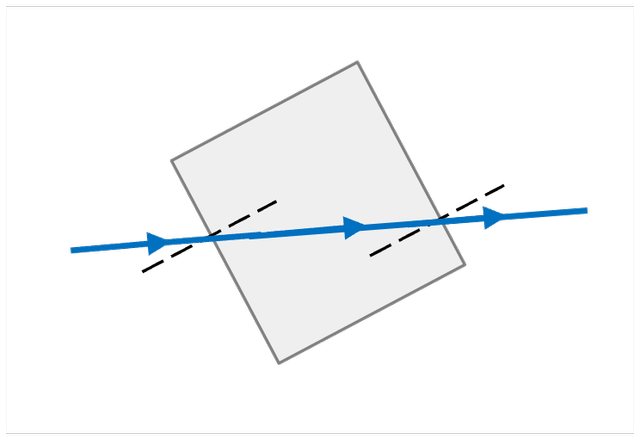
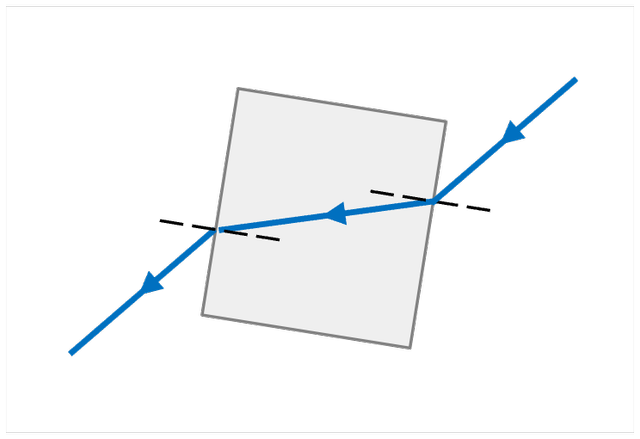
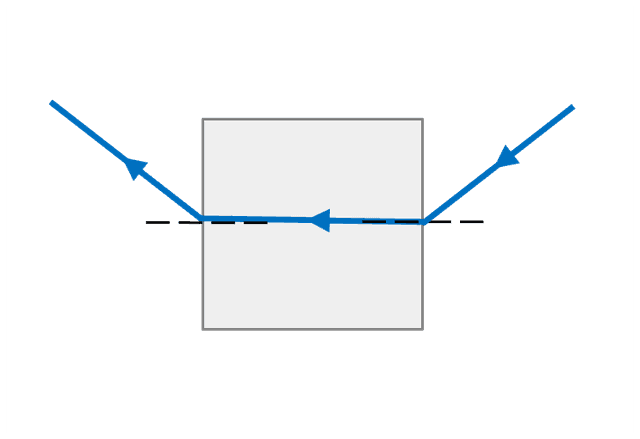
- Light changes direction when it moves into a new medium (material) at an angle to the normal. This is called refraction.
- When light enters a transparent material from air, it turns towards the normal.
- When light leaves a transparent material and re–enters air it turns away from the normal.
- A ray that enters and leaves glass through parallel sides ends up in its original direction, but displaced to the side.
- Refraction can cause virtual images of objects to appear where light seems to be coming from.
Keywords
Transmit - when light moves into and through a new medium
Medium - the material that light is travelling through
Refraction - when light changes direction when it enters a new medium
Normal - a line drawn at 90° to the surface of a material
Virtual image - a representation of an object seen where light appears to be coming from, not where light actually comes from
Common misconception
A ray of light curves as it passes through glass, perspex or water.
Use a perspex block with the bottom painted white to demonstrate the path of a ray of light through it. Avoid putting too much emphasis on the term 'bending' light, instead try to primarily refer to light changing direction at a boundary.


Equipment
Transparent rectangular blocks, ray boxes (and power supplies if needed), coins (or heavy counters), mugs/white plastic cups (or similar open–topped, non–transparent containers), beakers.

Content guidance
- Risk assessment required - equipment

Supervision
Adult supervision required

Licence
Lesson video
Loading...
Prior knowledge starter quiz
6 Questions
Q1.When a wave bounces back from a surface or boundary, this is called .

Q2.Which of the following types of material transmit light?
Q3.Which of the following statements describe a light ray?
Q4.Which of the following describe the normal in a ray diagram for reflection?
Q5.A representation of an object seen where light appears to come from, not where light actually comes from, is called a image.
Q6.Which of the following best describes the conclusion of an experiment?
Assessment exit quiz
6 Questions
Q1.Which of the following is a definition of ‘medium’?
Q2.Which of the following is a definition of ‘refraction’?
Q3.Which of the following are possible when light hits a boundary between two materials?
Q4.An incident ray hits a boundary between air and glass. There is no refraction if the angle of incidence is...
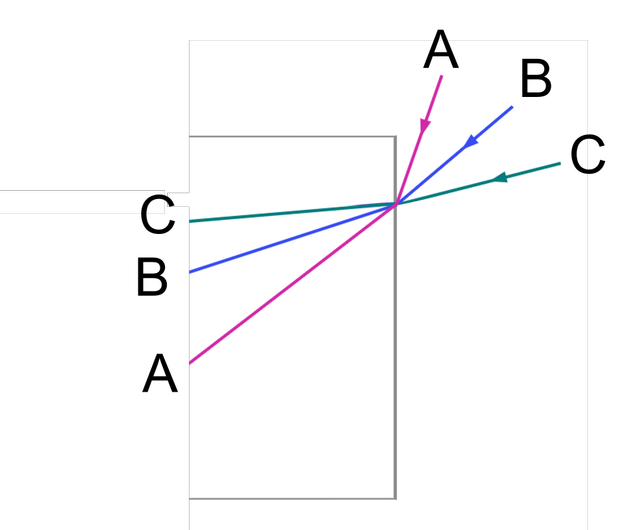
Q5.The diagram shows three light rays entering a block of glass. Which of the following statements are correct?
Q6.Which of the following diagrams show possible paths of light rays passing through transparent rectangular blocks?