Round a decimal number with hundredths to the nearest whole number
I can round a decimal number with hundredths to the nearest whole number

Round a decimal number with hundredths to the nearest whole number
I can round a decimal number with hundredths to the nearest whole number
Lesson details
Key learning points
- Identify the next and previous whole numbers to the number being rounded.
- Identify which whole number is nearest to the number being rounded.
- If the value of the tenths is 5 or greater then round up to the next whole number.
- If the value of the tenths is less than 5, ignore the tenths and round down to the whole number.
- To round a number with hundredths to the nearest whole number, you only need to look at the tenths.
Keywords
Multiple - A multiple is the result of multiplying a number by an integer. For example 2 × 5 = 10 so 10 is a multiple of 2 and 5.
Previous - Something that comes before something else is known as the previous thing.
Next - Something that comes after something else is known as the next thing.
Rounding - Rounding means making a number simpler but keeping its value close to what it was.
Common misconception
Pupils may mistake the previous multiple of one for example: previous multiple of 6.38 being 5.
Ensure pupils are given plenty of opportunities to place numbers on number lines, identifying the previous and next multiples of one.


Licence
Lesson video
Loading...
Prior knowledge starter quiz
6 Questions
Q1.Which numbers are multiples of 1?
Q2.What is the missing number in the sequence?

Q3.Match the number to the correct letter on the number line.
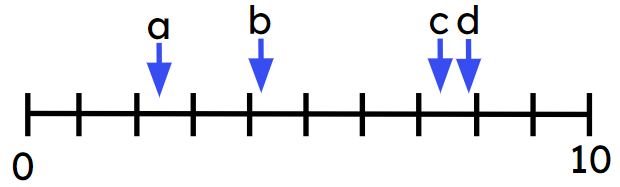

A
B
C
D
Q4.What are the closest multiples of one that 6.38 sits between?
Q5.What is 9.97 rounded to the nearest multiple of 0.1?
Q6.What is 9.9 rounded to the nearest multiple of 1?
Assessment exit quiz
6 Questions
Q1.What are the closest multiples of one that 3.29 sits between?
Q2.Tick the statements that are correct about the number 4.56
Q3.What is 6.50 rounded to the nearest multiple of 1?
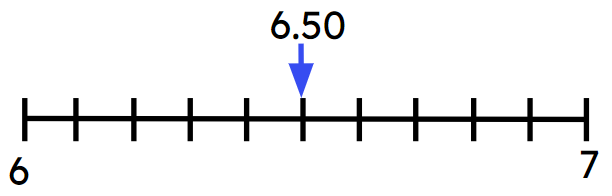
Q4.Tick the numbers that would round to the previous multiple of one, in this case 8.