


Securing understanding of angles from KS2
I can confidently state the sums of the angles around a point and on a straight line.

Securing understanding of angles from KS2
I can confidently state the sums of the angles around a point and on a straight line.
Lesson details
Key learning points
- The sum of angles at a point can be used to find missing angles.
- The angle sum of a straight line can be used to find missing angles.
- Vertically opposite angles can be used to find missing angles.
- The size of missing angles can be justified by using known facts.
Keywords
Vertical angles - Vertical angles are pairs of opposite angles formed when two lines intersect at a point. They are equal.
Vertex - A vertex is the point where two or more line segments meet. The plural is vertices.
Similar - Two shapes are similar if the only difference between them is their size. Their side lengths are in the same proportions.
Supplementary angles - Supplementary angles are a pair of angles that sum to 180°.
Conjugate angles - Conjugate angles are a pair of angles that sum to 360°.
Common misconception
Angles on a straight line sum to 180°
Angles on a straight line only sum to 180° if all of those angles share a common vertex. Show two angles "on a line" at different points.


Licence
Lesson video
Loading...
Prior knowledge starter quiz
6 Questions
Q1.Complete the sentence: The two angles of 44° and 136° are ____________ with each other.

Q2.The size of angle $$a$$ is measured accurately. Which of these statements could be accurate for angle $$a$$?

Q3.Match the angle name to its size.
acute -
11.7°
right angle -
90°
obtuse -
117°
reflex -
217°
one full turn -
360°
Q4.Match the pairs of angles to their description.
30° and 60° -
lie on a right angle
45° and 135° -
supplementary angles
120° and 240° -
conjugate angles
120° and 140° -
two random angles
Q5.Which of these statements about this diagram are accurate?
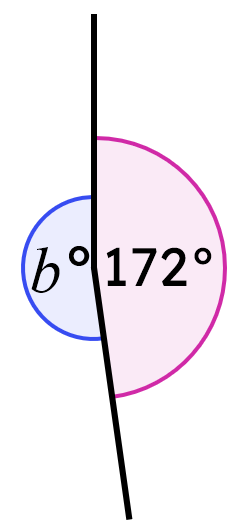
Q6.QR is a line segment. Find the value of $$c+d+g+h$$.

Assessment exit quiz
6 Questions
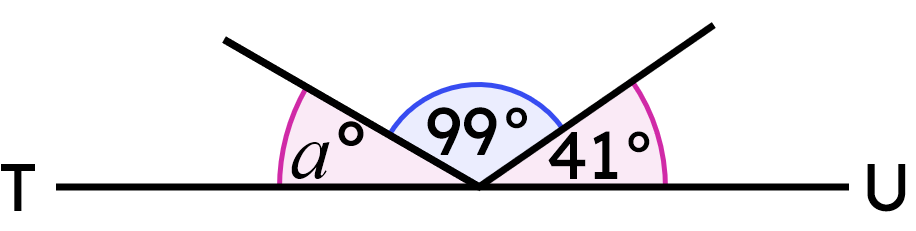
Q1.TU is a line segment. Angle $$a$$° = °.
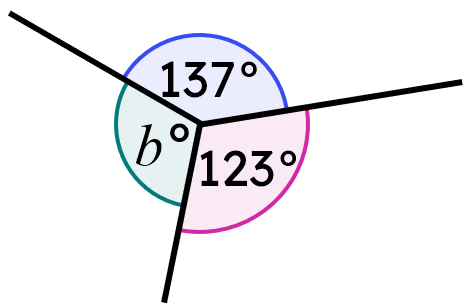
Q2.These three angles lie around a point on a full turn. Angle $$b$$° is °.
Q3.This diagram shows four angles around two line segments that meet at an intersection. Which of these statements are correct for angle $$c$$°?
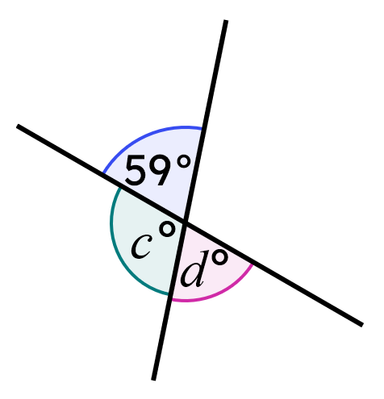
Q4.This diagram shows four angles around two line segments that meet at an intersection. Which of these statements are correct for angle $$d$$?
Q5.PQ and RS are straight line segments. Angle $$e$$° = °.
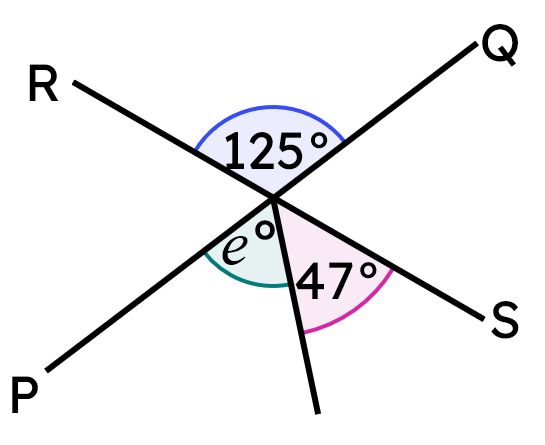
Q6.PQ and RS are straight line segments. Match each angle to its size.
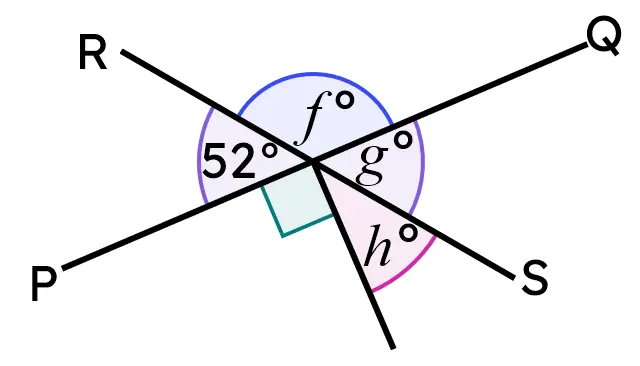
$$f$$° -
128°
$$g$$° -
52°
$$h$$° -
38°
right angle -
90°
not an angle on the diagram -
32°