


Stretching springs
I can measure extensions of a spring for a good range of stretching forces.

Stretching springs
I can measure extensions of a spring for a good range of stretching forces.
Lesson details
Key learning points
- Applying a force to a spring will make it extend (stretch).
- A range of masses suspended on a mass holder will produce constant and measurable forces on a spring.
- A set square ensures measuring scales are vertical.
- Diagrams show how equipment should be set up.
Keywords
Extension - The extension of a spring is the change in length.
Gravitational force - Masses will have a gravitational force that pulls them downwards.
Hanging masses - Hanging masses (weights) can be used to put a known force onto a spring.
Mass hanger - A mass hanger can be attached to a spring; adding masses to it causes the spring to stretch in a controlled way.
Common misconception
The length of the spring is equal to the extension of the spring.
Focus on the fact that forces cause the length of the spring to change and pupils are measuring the size of that change.


Content guidance
- Risk assessment required - equipment

Supervision
Adult supervision required

Licence
Lesson video
Loading...
Prior knowledge starter quiz
6 Questions
Q1.Somebody slides down a slide. What force is causing them to speed up as they slide?
Q2.Somebody slides down a slide. What two forces are opposing the motion as they slide?
Q3.Which of the following can a force do to an object?
Q4.Some masses are placed on a balance. Which force acts downwards on the masses?
Q5.The image shows a newton meter which has a spring inside it. Why is a spring used in the newton meter?

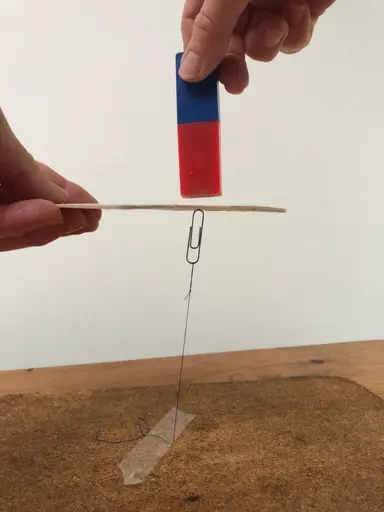
Q6.The picture shows a steel paperclip on some thread being attracted by a magnet. The paperclip is stationary. Which statements must be true?
Assessment exit quiz
6 Questions
Q1.Match the key words and phrases to their explanation.

The change in length of an object when a force acts on it.
A force that pulls objects downwards due to their mass.
Metal discs used to produce forces on a spring.
This is used to attach masses to the end of a spring.
Q2.A spring is 10 cm long when there is no force on it. What is its length when it has been extended by 5 cm?
Q3.Which of these allows the readings from a ruler to be used to measure the extension of a spring directly?
Q4.The table shows the results of an experiment to find out how a spring extends. How do the results show that the measurements have been made accurately?
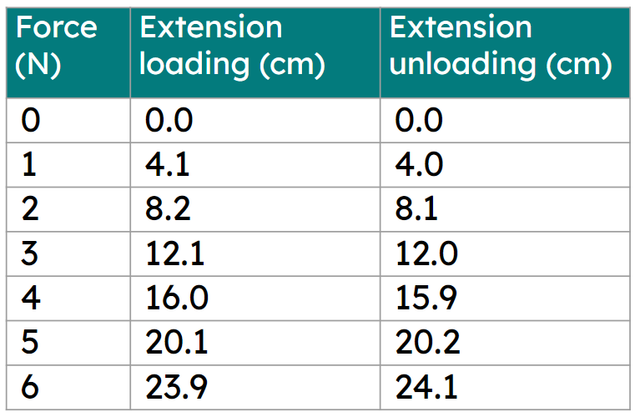
Q5.The table shows the results of an experiment to find out how a spring extends. Which statements can be made from the results?
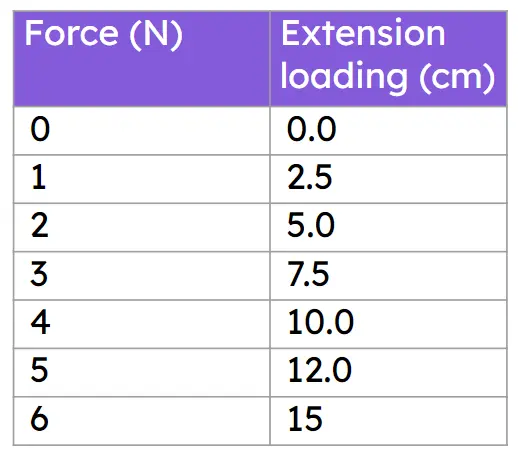
Q6.The table shows how a spring extends. The spring was originally 10 cm long. Use the results to predict the length of the spring when a force of 10 N is acting on the spring.