


New
New

Lesson details
Key learning points
- DNA is a type of biological molecule called a nucleic acid.
- DNA is made of two strands, each a long polymer of nucleotides, wound together in a double helix shape.
- DNA is a polymer of four different nucleotides (A, C, G and T).
- Each of the four types of nucleotide in DNA is made of the same sugar and a phosphate group, bonded to a different base.
- Nucleotides in each strand of DNA pair up in a complementary way; A pairs with T, and C pairs with G.
Keywords
DNA - DNA is a nucleic acid polymer made up of four nucleotides, it contains the genetic code in all living organisms.
Nucleic acid - A nucleic acid is a polymer made up of nucleotides, an example is DNA.
Polymer - A polymer is a chemical made up of smaller repeating chemical groups.
Nucleotide - A nucleotide is a chemical group that make up the building blocks of DNA, the four types are coded A, T, C and G.
Base - A base is the part of a nucleotide that pairs to its complementary base across the middle of the DNA double helix C-G and A-T.
Common misconception
DNA is living and not necessarily a chemical.
Discussing that DNA is a chemical molecule and showing how it is made up of smaller chemical groups, and then modelling this chemical structure.
Make models with pupils in class or for homework and get them to peer evaluate each other's; focus in on the structure of the nucleotide.

Teacher tip

Licence
This content is © Oak National Academy Limited (2025), licensed on Open Government Licence version 3.0 except where otherwise stated. See Oak's terms & conditions (Collection 2).
Lesson video
Loading...
Prior knowledge starter quiz
Download quiz pdf
6 Questions
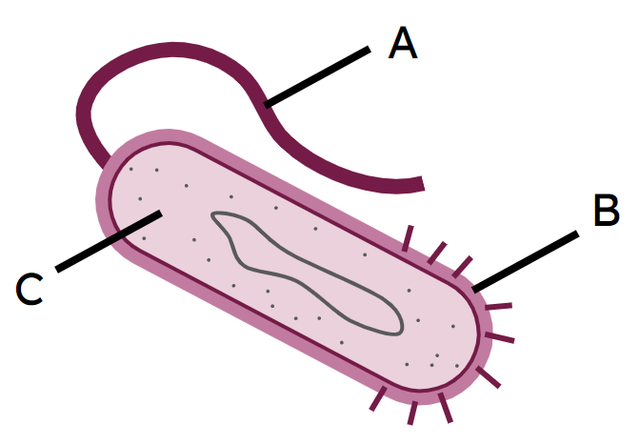
Q1.The drawing shows a bacterial cell. Which structure (A, B or C) contains the genetic material?
The drawing shows a bacterial cell. Which structure (A, B or C) contains the genetic material?
A
B

Q2.Which is the best definition of a gene?
Which is the best definition of a gene?
A large chemical molecule made of smaller groups.
All the DNA of an organism.
All the chromosomes in the nucleus.
Q3.All organisms have similarities in their DNA. Put these examples in order, starting with the example of two things that have the most similar DNA.
All organisms have similarities in their DNA. Put these examples in order, starting with the example of two things that have the most similar DNA.
Q4.What do scientists call the sections of DNA in a chromosome that lie between genes?
What do scientists call the sections of DNA in a chromosome that lie between genes?

Q5.True or false? Only genes make up the genome of an organism.
True or false? Only genes make up the genome of an organism.
true
Q6.Which is the best explanation for why the genomes of humans and bananas have similarities?
Which is the best explanation for why the genomes of humans and bananas have similarities?
Humans and bananas are very closely related.
Humans and bananas share many similar features.
Humans and bananas have no similar features.
Assessment exit quiz
Download quiz pdf
6 Questions
Q1.In plant and animal cells, the genome is stored in the ...
In plant and animal cells, the genome is stored in the ...
Q2.DNA is a nucleic acid polymer. How many nucleic acid strands make up each DNA molecule?
DNA is a nucleic acid polymer. How many nucleic acid strands make up each DNA molecule?
one
four
eight
Q3.Put these in size order, starting with the smallest.
Put these in size order, starting with the smallest.
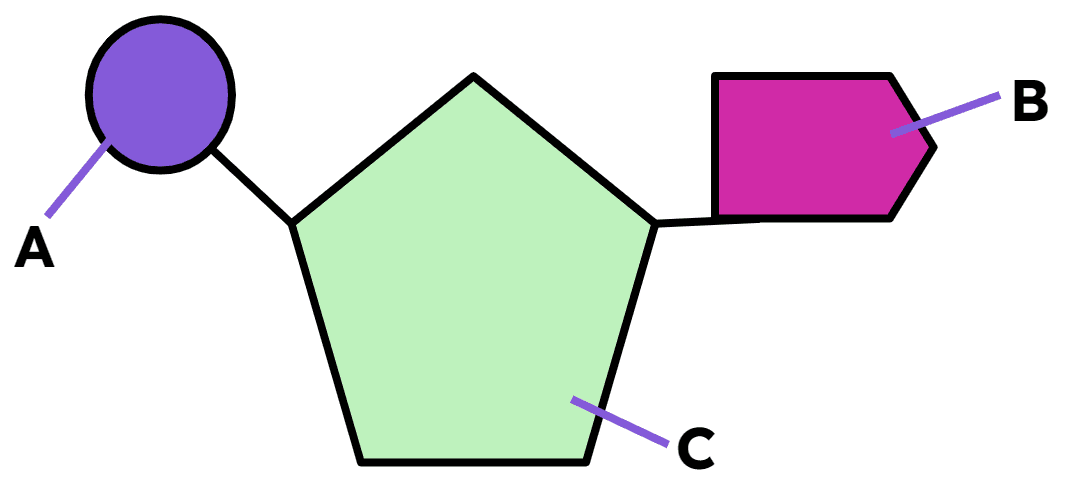
Q4.The diagram is a model of a nucleotide. Which part (A, B or C) represents the base?
The diagram is a model of a nucleotide. Which part (A, B or C) represents the base?
Q5.The instructions contained in a gene are often referred to as the genetic code. Which is the best description of the genetic code?
The instructions contained in a gene are often referred to as the genetic code. Which is the best description of the genetic code?
It is the feature or process that the gene provides instructions for.
It is all of the DNA in a nucleus.
It is the number of nucleotide bases in a gene.
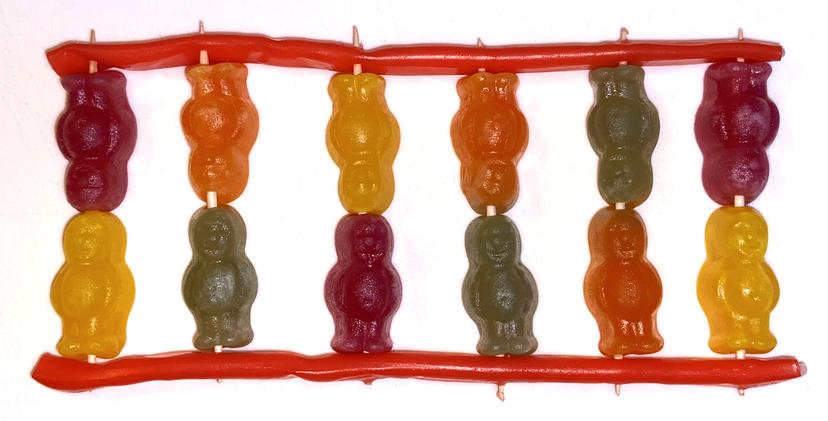
Q6.The photograph shows a model of part of a DNA molecule. It is made from liquorice and jelly babies. What would improve the model?
The photograph shows a model of part of a DNA molecule. It is made from liquorice and jelly babies. What would improve the model?
Add more than four colours of jelly baby.
Add more than two liquorice sticks.
Bend the model into a square.