The unit circle
I can appreciate that the trigonometric functions are derived from measurements within a unit circle.


- Year 9
The unit circle
I can appreciate that the trigonometric functions are derived from measurements within a unit circle.
Lesson details
Key learning points
- The unit circle is a circle with a radius of one.
- The unit circle is centered on the origin.
- The sine of an angle is the y-coordinate of the point where the radius has been rotated through that angle.
- The cosine of an angle is the x-coordinate of the point where the radius has been rotated through that angle.
- The tangent of an angle is the length of the side opposite the angle along the tangent at x = 1 to the unit circle.
Keywords
Trigonometric functions - Trigonometric functions are commonly defined as ratios of two sides of a right-angled triangle for a given angle.
Sine function - The sine of an angle (sin(θ°)) is the y-coordinate of point P on the triangle formed inside the unit circle.
Cosine function - The cosine of an angle (cos(θ°)) is the x-coordinate of point P on the triangle formed inside the unit circle.
Tangent function - The tangent of an angle (tan(θ°)) is the y-coordinate of point Q on the triangle which extends from the unit circle.
Common misconception
When reading the values of the trigonometric functions during the explanation slides and the tasks, pupils may think that all the values taken from the graphs are fully accurate.
Explain that many of the values from the trigonometric functions have digits beyond the second decimal place. However, two decimal places is a reasonable degree of accuracy for reading values from the graphs during this lesson.
To help you plan your year 9 maths lesson on: The unit circle, download all teaching resources for free and adapt to suit your pupils' needs...
To help you plan your year 9 maths lesson on: The unit circle, download all teaching resources for free and adapt to suit your pupils' needs.
The starter quiz will activate and check your pupils' prior knowledge, with versions available both with and without answers in PDF format.
We use learning cycles to break down learning into key concepts or ideas linked to the learning outcome. Each learning cycle features explanations with checks for understanding and practice tasks with feedback. All of this is found in our slide decks, ready for you to download and edit. The practice tasks are also available as printable worksheets and some lessons have additional materials with extra material you might need for teaching the lesson.
The assessment exit quiz will test your pupils' understanding of the key learning points.
Our video is a tool for planning, showing how other teachers might teach the lesson, offering helpful tips, modelled explanations and inspiration for your own delivery in the classroom. Plus, you can set it as homework or revision for pupils and keep their learning on track by sharing an online pupil version of this lesson.
Explore more key stage 3 maths lessons from the Trigonometry unit, dive into the full secondary maths curriculum, or learn more about lesson planning.


Licence
Lesson video
Loading...
Prior knowledge starter quiz
6 Questions
Q1.In a right triangle, if the hypotenuse is 37.5 cm and a second side is 30 cm, what is the length of the third side? (Use a calculator to help you.)

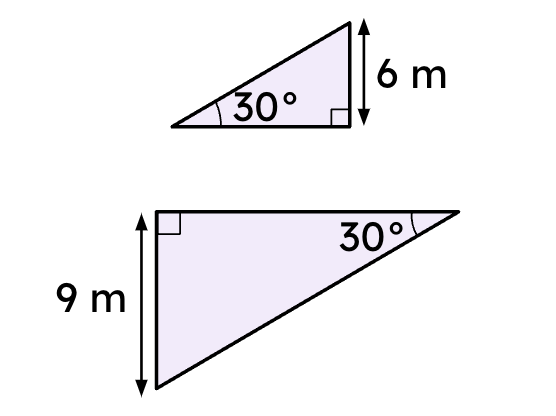
Q2.Which of the following statements is true for these triangles?
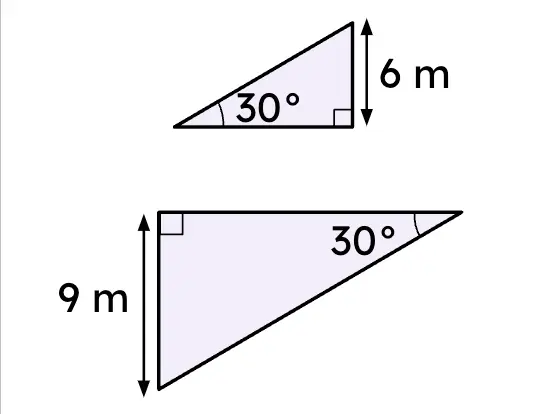
Q3.An isosceles triangle has an internal angle of 50ᵒ, what might the other two angles be?
Q4.In a right triangle, if the shortest sides are 36 cm and 48 cm, what is the length of the hypotenuse? (Use a calculator to help you.)
Q5.Would a triangle ABC with sides AB = 10cm, BC = 7.5cm, AC = 12.5cm be similar to the one shown in the diagram?
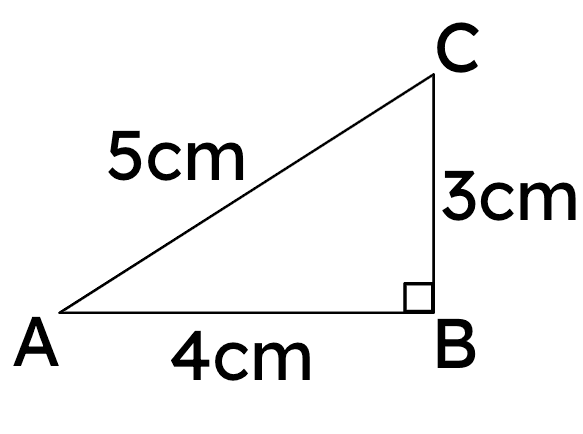
Q6.For this pair of triangles, can you determine whether they are similar without using side lengths?