


New
New
Lesson 7 of 14
Types of rainfall
I can describe how rain forms and understand different reasons for its formation.

Lesson 7 of 14
New
New
Types of rainfall
I can describe how rain forms and understand different reasons for its formation.
Lesson details
Key learning points
- Relief rainfall occurs when warm moist air from the ocean rises up over mountains.
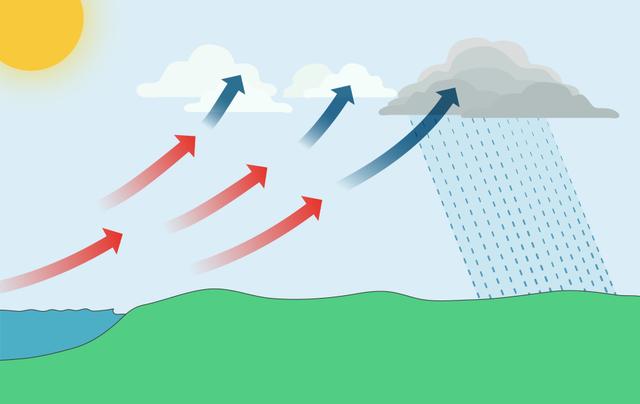
- Convectional rainfall occurs when the sun heats up the land, when it cools and condenses it forms rainclouds.
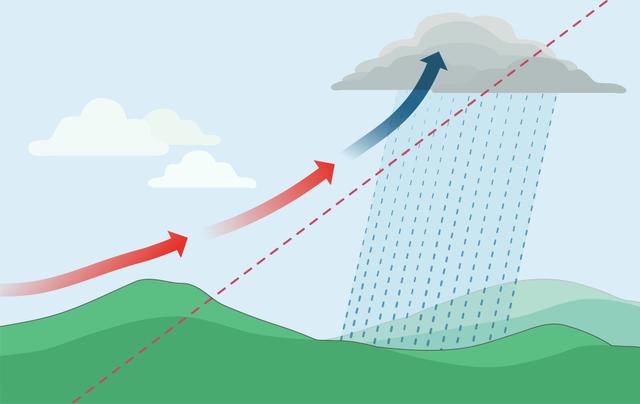
- Frontal rainfall occurs when a warm front meets a cold front.
- The west of the UK is generally wetter than the east.
Keywords
Evaporation - the process of something changing from a liquid state to a gaseous state
Precipitation - water that falls from the sky as rain, snow, hail or sleet
Sublimation - conversion of a substance from solid to a gaseous form
Relief - the physical shape of the land in an area, including its height and steepness
Common misconception
There is only one type of rain; it is all the same.
Students will be exposed to the three different types of rainfall: relief, convectional, frontal.
Ensure that students are familiar with the hydrological cycle before starting this lesson.

Teacher tip

Equipment
Atlas

Licence
This content is © Oak National Academy Limited (2026), licensed on Open Government Licence version 3.0 except where otherwise stated. See Oak's terms & conditions (Collection 2).
Lesson video
Loading...
Prior knowledge starter quiz
Download quiz pdf
6 Questions
Q1.Water can be:
Water can be:
a solid
a liquid
a gas

Q2.What do you think is happening to the water represented by the blue arrow here?
What do you think is happening to the water represented by the blue arrow here?
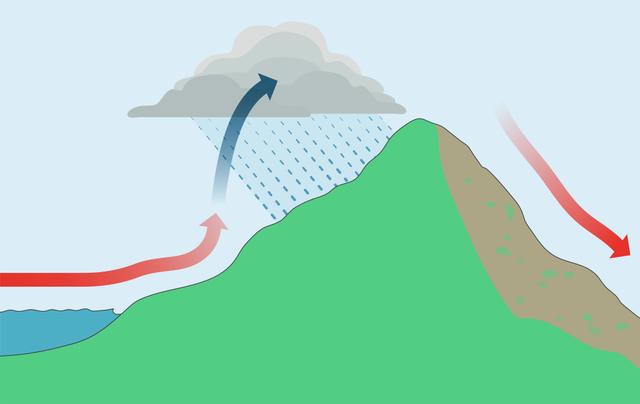
It is evaporating as it goes higher and turning into rain.
It is moving down the hill and warming up.
Q3.How would you describe the climate of the UK?
How would you describe the climate of the UK?
hot and dry
cold and dry
hot and wet
Q4.What is "precipitation"?
What is "precipitation"?
The process of water turning into clouds.
Water that evaporates into the air.
The movement of water through rivers.
Q5.Temperature __________ with altitude.
Temperature __________ with altitude.
increases
stays the same
Q6.Why is "relief" important when studying rainfall patterns?
Why is "relief" important when studying rainfall patterns?
It explains how clouds form.
It shows how fast wind travels.
It helps predict the temperature of the area.
Assessment exit quiz
Download quiz pdf
6 Questions
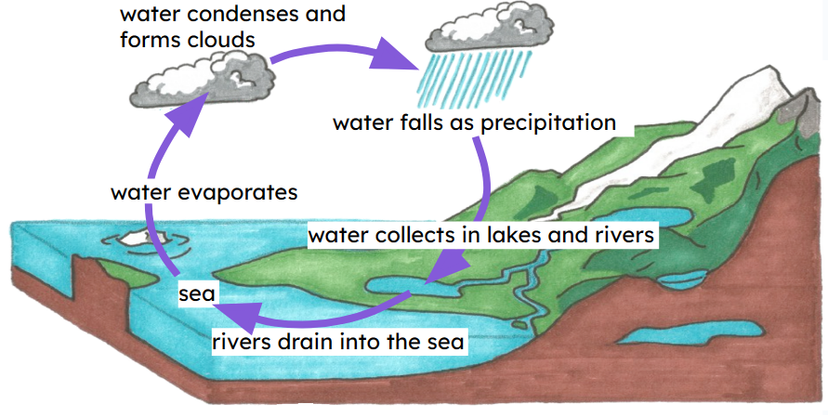
Q1.What is the correct term for this system?
What is the correct term for this system?
Q2.Which of these diagrams is correctly representing relief rainfall?
Which of these diagrams is correctly representing relief rainfall?
Q3.What type of rainfall is common in the south east of England, typically in the summer months?
What type of rainfall is common in the south east of England, typically in the summer months?
Frontal
Relief
Q4.Which region of the UK is generally wetter?
Which region of the UK is generally wetter?
North
East
South
Q5.What happens to liquid water when it is frozen?
What happens to liquid water when it is frozen?
It becomes a gas.
Nothing happens.
Q6.What does rainfall start as when it falls out of the cloud?
What does rainfall start as when it falls out of the cloud?
Sleet
Rain
Hail
Ice