


Why do people commit crime?


Lesson details
Learning outcome
I can understand the different reasons why people might commit a crime.
Key learning points
- There are different and complex reasons for why people commit crime e.g social, economic, psychological and educational.
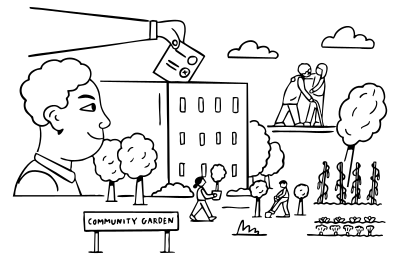
- The physical environment can impact crime rates.
- Prejudice exists towards crime and criminality and this can have a negative impact in the justice system.
Keywords
Factors - elements or conditions that influence an outcome
Socio-economic - relating to a combination of social and financial factors
Regeneration - the process of renewal and improvement
Prejudice - a biased or unfair judgement or opinion without proper knowledge
Disproportionate - out of balance or unequal in relation to something else
Common misconception
That crime is only committed by specific groups of people.
Crime is complex and there are social, economic, psychological and environmental factors which can all impact the likelihood of crime.
Teacher tip
Be aware that pupils may have direct experience of the justice system or may be a member of a group of people that are disproportionally represented within the justice system, sensitivity is needed.

Content guidance
Depiction or discussion of discriminatory behaviour
Depiction or discussion of mental health issues
Depiction or discussion of peer pressure or bullying

Supervision
Adult supervision required

Licence

Lesson video
Loading...
Prior knowledge starter quiz
6 Questions
Q1.What is the definition of crime?
Q2.Complete the sentence, shoplifting may have increased due to the cost of ...
Q3.Which act is now illegal, due to changes in societal views.
Q4.What is a valid reason for online crime increasing?
Q5.Complete the sentence, social structures organise ...
Q6.Complete the sentence, when new laws are created, certain types of crime will ...
Assessment exit quiz
6 Questions
Q1.Match the word to its definition

Q2.Which of the factors below is not a socio-economic reason for committing crime?
Q3.The Broken Window Theory relates to increases in crime based on which factor?
Q4.Which are examples of urban regeneration?
Q5.Which group of people typically are not prejudiced against in relation to crime?
Q6.What is a key citizenship skill that is needed for this topic?
To help you plan your 10 citizenship lesson on: Why do people commit crime?, download all teaching resources for free and adapt to suit your pupils' needs...
To help you plan your 10 citizenship lesson on: Why do people commit crime?, download all teaching resources for free and adapt to suit your pupils' needs.
The starter quiz will activate and check your pupils' prior knowledge, with versions available both with and without answers in PDF format.
We use learning cycles to break down learning into key concepts or ideas linked to the learning outcome. Each learning cycle features explanations with checks for understanding and practice tasks with feedback. All of this is found in our slide decks, ready for you to download and edit. The practice tasks are also available as printable worksheets and some lessons have additional materials with extra material you might need for teaching the lesson.
The assessment exit quiz will test your pupils' understanding of the key learning points.
Our video is a tool for planning, showing how other teachers might teach the lesson, offering helpful tips, modelled explanations and inspiration for your own delivery in the classroom. Plus, you can set it as homework or revision for pupils and keep their learning on track by sharing an online pupil version of this lesson.
Explore more key stage 4 citizenship lessons from the What can we do to reduce crime? unit, dive into the full secondary citizenship curriculum, or learn more about lesson planning.