


Practising handwriting with some famous quotations



Lesson details
Learning outcome
I can correctly copy out famous quotations in legible, cursive handwriting.
Key learning points
- The quotation is demarcated with inverted commas.
- The quotation starts with a capital letter.
- After forming a capital letter, you need to lift your pencil to start the next part of the word.
- The letter spacing and letter sizing is consistent so the writing is legible.
- A range of joins will be used depending on which letters are joining to which letters.
Keywords
Inverted commas - also known as quotation marks, are punctuation marks used to indicate the beginning and end of direct speech or a quotation
Quotation - a word, phrase, or sentence that is taken directly from someone's speech or writing and is presented within quotation marks to indicate it as someone else's words
Join - how the letters are connected together
Letter spacing - the amount of space between individual letters in a word
Common misconception
Sometimes children can forget the capital letter after the inverted commas.
As you model, repeat the same words to remind the children that the capital letter comes after the inverted commas. For example, 'Let's start, inverted commas, capital letter, pencil off, lead in...'.
Teacher tip
We have suggested some quotes in this lesson. It would also be motivating to let the children find some quotes by people they are inspired by to copy.

Content guidance
Risk assessment required - physical activity

Supervision
Adult supervision required

Licence

Lesson video
Loading...
Prior knowledge starter quiz
6 Questions
Q1.What is the main purpose of using cursive handwriting?

Q2.Which part of a letter extends below the baseline in cursive writing?
Q3.What is the importance of spacing between words and letters in handwriting?
Q4.Select the cursive letter joins used in this word.
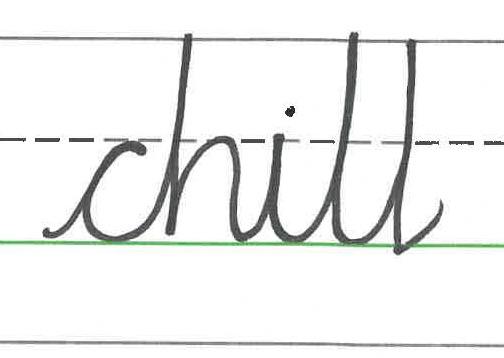
Q5.Which cursive letter joins would you use to join the letter o to the letter l?
Q6.Which cursive letter joins would you use to write the word 'fire'?
To help you plan your 6 English lesson on: Practising handwriting with some famous quotations, download all teaching resources for free and adapt to suit your pupils' needs...
To help you plan your 6 English lesson on: Practising handwriting with some famous quotations, download all teaching resources for free and adapt to suit your pupils' needs.
The starter quiz will activate and check your pupils' prior knowledge, with versions available both with and without answers in PDF format.
We use learning cycles to break down learning into key concepts or ideas linked to the learning outcome. Each learning cycle features explanations with checks for understanding and practice tasks with feedback. All of this is found in our slide decks, ready for you to download and edit. The practice tasks are also available as printable worksheets and some lessons have additional materials with extra material you might need for teaching the lesson.
The assessment exit quiz will test your pupils' understanding of the key learning points.
Our video is a tool for planning, showing how other teachers might teach the lesson, offering helpful tips, modelled explanations and inspiration for your own delivery in the classroom. Plus, you can set it as homework or revision for pupils and keep their learning on track by sharing an online pupil version of this lesson.
Explore more key stage 2 English lessons from the Building fluency with note taking, choice, quotations and emphasis unit, dive into the full primary English curriculum, or learn more about lesson planning.