


Examining our geographical data


Lesson details
Learning outcome
I can answer my enquiry question using the data I have collected and presented.
Key learning points
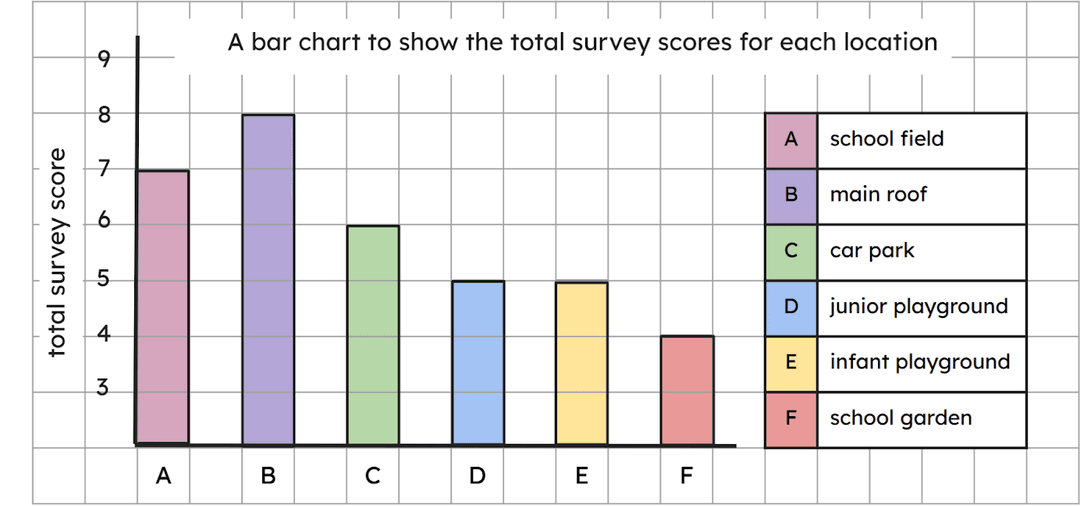
- Geographers can compare the total scores for different sites to decide on the best location for something.
- Geographers can compare the scores for different categories to understand where there are strengths and weaknesses.
- Geographers use all their data to answer their enquiry question.
Keywords
Compare - to look at data to see where there are similarities and differences
Summarise - to bring all the key information together at the end of the enquiry
Hypothesis - a prediction that geographers make about the results of their enquiry
Common misconception
Geographers are only concerned with the data that shows the maximum scores.
Geographers do often use the maximum scores to show the best option, but they also look within the data to see how some variables compare with others.
Teacher tip
Where geographical data offers a number of options, teachers can introduce a voting system where the whole class gets to decide on the final conclusion.

Content guidance
Risk assessment required - outdoor learning

Supervision
Adult supervision required

Licence

Lesson video
Loading...
Prior knowledge starter quiz
6 Questions
Q1.Data that is drawn on a map is known as data.

Q2.What happens after we present data?
Q3.Which piece of equipment is essential for drawing bar charts?
Q4.Maps and bar charts both have …
Q5.How do our 3 x 3 grids on our map help us reflect on our data?
Q6.On our bar chart, the bottom is marked with the six different locations.
Assessment exit quiz
4 Questions
Q1.If we look at data to find similarities and differences, we are …
Q2.Which of the following statements is true?
Q3.Which of the following would not give us detailed data about our enquiry?
Q4.Which of these is the right order in which to write a conclusion?
To help you plan your 5 geography lesson on: Examining our geographical data, download all teaching resources for free and adapt to suit your pupils' needs...
To help you plan your 5 geography lesson on: Examining our geographical data, download all teaching resources for free and adapt to suit your pupils' needs.
The starter quiz will activate and check your pupils' prior knowledge, with versions available both with and without answers in PDF format.
We use learning cycles to break down learning into key concepts or ideas linked to the learning outcome. Each learning cycle features explanations with checks for understanding and practice tasks with feedback. All of this is found in our slide decks, ready for you to download and edit. The practice tasks are also available as printable worksheets and some lessons have additional materials with extra material you might need for teaching the lesson.
The assessment exit quiz will test your pupils' understanding of the key learning points.
Our video is a tool for planning, showing how other teachers might teach the lesson, offering helpful tips, modelled explanations and inspiration for your own delivery in the classroom. Plus, you can set it as homework or revision for pupils and keep their learning on track by sharing an online pupil version of this lesson.
Explore more key stage 2 geography lessons from the Fieldwork: how can we investigate the sustainability of our school? unit, dive into the full primary geography curriculum, or learn more about lesson planning.